
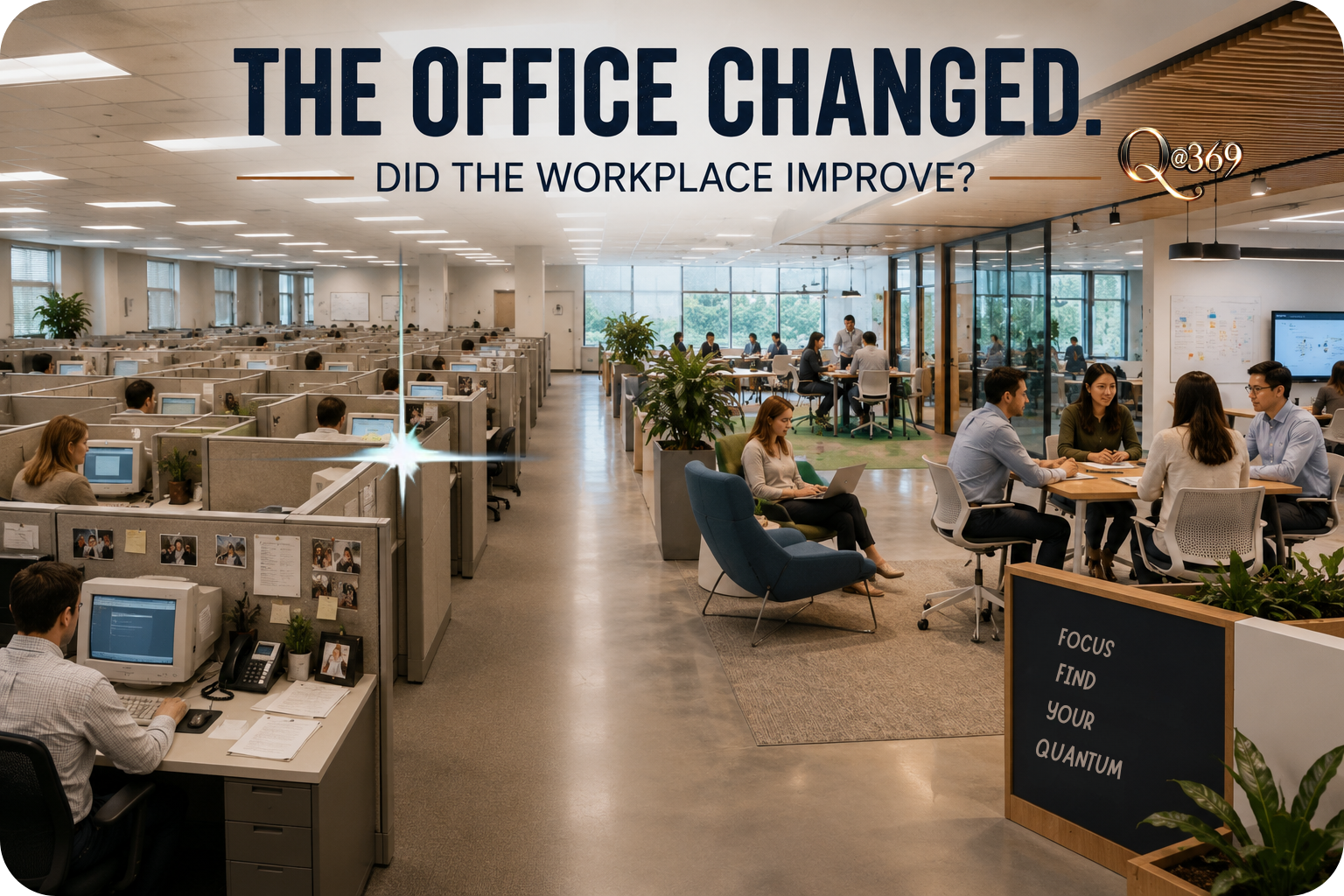
What Workplace Design Can Teach Us About Focus And Collaboration

What happens when the place designed to help people work becomes one of the things making work more difficult?
Workplace, cube farm design influences concentration, communication, privacy, interruption, and how easily people can work together.
- Cubicles originally offered employees personal workspace without completely separating colleagues.
- Dense cube farms often reduced privacy while allowing noise and interruptions to travel across the office.
- Open offices increased visibility and proximity, yet proximity does not automatically create useful collaboration.
- Private offices can protect concentration while making spontaneous interaction less convenient.
- Different tasks require different levels of quiet, privacy, communication, and shared space.
- Better workplace design begins by understanding the work before arranging the furniture.
✨ AUDIO: Listen to “What happens when the place designed to help people work becomes one of the things making work more difficult?” by Isaac Yue
🎯 Also Available on SPOTIFY
🙏 Join Our Community Today!
💞 Share with Friends and Colleagues
Remember The Cube Farm?
Walk into a large corporate office during the 1990s or early 2000s and you might encounter an unmistakable landscape. Rows of fabric covered partitions stretched across the room, creating dozens or even hundreds of nearly identical workstations.
Each worker had a desk, computer, telephone, filing cabinet, and perhaps a family photograph attached to the partition. Stand up, and you could often see several coworkers. Sit down, and the walls created a modest sense of personal territory.
The arrangement eventually earned a less flattering name.
The cube farm.
Cubicles became a familiar symbol of corporate life. Then many companies began removing the partitions and replacing them with open offices, shared tables, collaboration spaces, lounges, and flexible seating.
The office changed.
The challenge of balancing concentration and communication remained.
The Cubicle Did Not Begin As A Joke
The cubicle has become easy material for workplace humor. Its original purpose was more thoughtful than the later cube farm might imply.
Office systems developed during the twentieth century attempted to give workers usable personal space while maintaining flexibility. Partitions could define work areas without constructing permanent walls around every employee.
That provided organizations with practical advantages. Workstations could be rearranged as teams changed, and more employees could share a large floor.
Workers gained some visual separation too. Documents, telephones, conversations, and personal belongings had a defined place.
Problems emerged when flexibility became density.
A design intended to create functional personal workspaces could become rows of increasingly small enclosures.
Privacy Is More Than Having Walls
A cubicle can block part of your view without blocking sound.
You may not see the colleague two workstations away. You can still hear the telephone conversation, keyboard activity, laughter, coughing, and discussion happening nearby.
That creates an interesting problem.
The worker feels separated enough to lose some visual connection while remaining exposed to surrounding noise and interruptions.
Privacy therefore has several dimensions. Visual privacy, conversational privacy, acoustic privacy, and psychological privacy are not necessarily created by the same physical barrier.
A partition can provide one while failing to provide another.
Concentration Needs Protection
Imagine working through a complicated spreadsheet, engineering analysis, contract, computer program, or detailed report.
You are holding several pieces of information in mind. Then a conversation begins nearby.
Your attention shifts briefly.
You return to the work and need to reconstruct where you were.
The interruption may consume only seconds. Repeated interruptions can create a much larger effect across an hour or an entire workday.
This is why workplace design matters for more than comfort or appearance.
The physical environment participates in the work.
Then The Walls Started Coming Down
Open offices promised a different workplace experience.
Remove the cubicle walls and employees can see one another. Teams become physically closer, communication appears easier, and the office feels less divided.
The visual transformation can be dramatic. Natural light may travel farther through the building, and shared spaces can feel more energetic than long corridors of partitions.
Open offices also appear to encourage spontaneous conversation.
Yet making conversation possible does not guarantee that useful collaboration will occur.
Proximity Is Not The Same As Collaboration
Imagine two engineers sitting ten feet apart.
One needs uninterrupted concentration. The other needs a quick answer about a project.
The open office makes the conversation easy to begin. It also makes the interruption easy to create.
That tension appears throughout workplace design.
Communication has value. Concentration has value too.
A workplace designed entirely around interaction may make focused work difficult. A workplace designed entirely around isolation can make collaboration unnecessarily complicated.
The goal is not maximum communication.
It is useful communication at useful times.
People Adapt To The Space
Workers do not passively accept their surroundings. They develop ways to manage them.
Headphones appear.
People reserve conference rooms for individual work. Someone carries a laptop to an empty corner. Another employee arrives early to finish concentrated work before the office becomes busy.
These behaviors provide useful information.
When employees repeatedly escape the environment created for them, the workspace may not support everything their work requires.
The headphones are not merely accessories.
Sometimes they are portable walls.
The Private Office Has Tradeoffs Too
A private office can provide greater control over sound, interruptions, confidential conversations, and visual distractions.
Close the door and concentrated work becomes easier.
Yet doors create boundaries.
Colleagues may hesitate before interrupting. Informal conversations become less frequent, and employees can become physically separated from the daily activity of their teams.
Private offices therefore solve some workplace problems while creating others.
Once again, no single design wins.
Different Work Creates Different Spatial Needs
Consider the variety of activities that can occur during one workday.
A financial analyst may need two hours of uninterrupted concentration. A project team may need thirty minutes around a whiteboard. A manager may need a confidential conversation with an employee.
Later, two colleagues may need an informal place to compare ideas. Someone else may join a video meeting with participants across several countries.
Those activities require different conditions.
Trying to perform all of them in one type of workspace creates predictable friction.
Focus Space
Concentrated work benefits from environments where interruptions can be controlled.
That might mean a private office, quiet room, library style area, enclosed workstation, or remote workspace.
The important feature is not luxury.
It is the ability to protect attention long enough to complete demanding work.
Collaboration Space
Teams sometimes need to talk freely, move around, sketch ideas, share displays, and challenge each other’s thinking.
That work benefits from spaces designed for interaction.
A collaboration room can support conversation without requiring everyone nearby to participate involuntarily.
That distinction matters.
Good collaborative space allows people to communicate without turning their collaboration into someone else’s interruption.
Conversation Space
Not every interaction needs a formal conference room.
Small seating areas, project tables, and informal meeting spaces can provide places for brief discussions. They give conversations somewhere to go.
This can protect surrounding workers while preserving the spontaneous interaction organizations often want.
The physical message is simple.
Talk here. Focus there.
Privacy Space
Some workplace conversations should not happen where everyone can hear them.
Employee feedback, personnel matters, customer information, health discussions, intellectual property, and sensitive business decisions require appropriate privacy.
An attractive open office does not eliminate those responsibilities.
Workplace design should recognize that confidentiality is part of functional work.
The Office Is Also A Social Environment
People do not enter an office only to operate computers.
They learn from colleagues, build relationships, exchange information, notice problems, share humor, mentor newer employees, and develop a sense of belonging.
Workplace design can either support those interactions or make them awkward.
A useful office therefore needs more than desks.
It needs places where different kinds of human interaction can happen naturally.
Technology Changed The Office Too
The traditional cubicle was designed during an era when work was strongly connected to physical equipment.
Desktop computers stayed on desks. Paper files occupied cabinets. Telephones were attached to walls or workstations.
Today, many workers carry much of their office inside a laptop and smartphone.
That mobility changes what a workplace can become.
Employees can move between a quiet room, project area, meeting room, laboratory, home office, or shared desk while remaining connected to information.
The office no longer needs to provide one workstation for every activity.
It can provide different environments for different activities.
Hybrid Work Makes Design More Interesting
Hybrid work adds another dimension.
If fewer employees occupy the office every day, organizations may need fewer permanent individual desks. That space can potentially become meeting areas, quiet rooms, project spaces, laboratories, training areas, or informal gathering places.
The office then serves a different purpose.
Instead of merely being the place where employees sit, it can become a collection of environments supporting work that benefits from physical presence.
That may be a more useful question for workplace design.
Why are people coming here today?
Isaac Yue Reflection

My aerospace engineering career placed me in many different workplaces. I worked in offices, cubicles, laboratories, conference rooms, manufacturing areas, and eventually a home office.
Cubicles always carried an amusing association for me. I grew up on a dairy farm, where bringing the cows into the barn was part of everyday life. Each cow knew exactly which stanchion was hers and returned to the same place.
Years later, whenever I entered an office where I had an assigned cubicle, that childhood scene returned. Everyone walked through the office and settled into their designated cube, much as those cows had returned to their familiar stanchions.
I could almost hear them mooing in my head.
The comparison always made me smile, yet it also made me think about workplace design. A cubicle gave me a familiar personal space and everything needed for routine work. It also placed many people within hearing distance of one another.
That proximity could become distracting during concentrated engineering work. At other times, overhearing a technical conversation alerted me to a problem where my experience could help. The same environment could interfere with one task and support another.
The factory floor offered an entirely different experience. When critical aerospace hardware was being assembled or tested, being near the hardware and the people working on it could make communication immediate. A short conversation beside the equipment could accomplish far more than a lengthy exchange of emails.
Today, most of my QuantumAlchemist369 work happens from my home office. Seminars, trade shows, and other events still remind me of the value found in shared spaces and direct human interaction.
From dairy barn stanchions to office cubes, aerospace factories, and my home office, the surroundings have certainly changed. One lesson has remained remarkably consistent.
The workspace does not merely contain the work. It can influence how the work happens.
What Can The Cube Farm Teach Us?
The old cube farm does not need to return for us to learn from it.
Its history reminds us that workplace design involves tradeoffs.
Partitions can create personal territory while trapping people inside repetitive layouts. Open offices can increase visibility while exposing concentration to more interruptions.
Private offices can protect focus while reducing spontaneous interaction. Remote work can provide control while limiting some forms of immediate communication.
Every design solves something.
Every design can also create something new to solve.
Design Around Activities Instead Of Trends
Workplace design can easily become fashionable.
Cubicles were modern once. Open offices became modern later. Collaboration lounges, shared desks, phone booths, standing tables, and flexible spaces followed.
A trend does not know what your employees actually do.
The work does.
Organizations can begin with practical questions.
Which tasks require concentration? Which require collaboration? Where do confidential conversations happen? What equipment must remain accessible? When do employees benefit from spontaneous interaction?
Those answers can shape the workspace more intelligently than copying the newest office trend.
Look At Your Own Workspace
You do not need responsibility for an entire corporate office to apply this idea.
Look at where you work.
What helps you concentrate? What repeatedly interrupts you? Where do useful conversations happen? Where can you go when you need privacy?
Then notice how you adapt.
Perhaps you wear headphones whenever concentration matters. Maybe you move to another room for video calls or wait until colleagues leave before beginning detailed work.
Those habits reveal what your environment provides and what it lacks.
Conclusion
The office cube farm faded partly as organizations searched for workplaces that felt more open, collaborative, and flexible.
Removing partitions did not remove the underlying challenge.
People still need concentration and communication. They still need privacy and connection. They need places for quiet analysis and places for energetic collaboration.
No single floor plan can maximize every requirement simultaneously.
The most useful workplace may therefore contain several kinds of spaces rather than one universal answer.
Cubicles taught us about personal territory. Open offices taught us about visibility and interaction. Remote work reminded us that concentration and productivity can happen beyond corporate walls.
The next lesson may be simpler.
Design the workplace around how people actually work.
Reflection Question
What does your current workspace make easier, and what does it make unnecessarily difficult?
Consider concentration, interruptions, privacy, communication, collaboration, and access to the people or resources you need.
Practical Action
Observe your workspace during one normal workday. Identify one moment when the environment helped your work and one moment when it interfered.
Then make one small adjustment.
Move concentrated work somewhere quieter. Take a conversation away from people trying to focus. Create a clearer signal when you should not be interrupted.
You may not control the entire office.
You can still become more intentional about where different kinds of work happen.

References
- Bernstein, E. S., & Turban, S. 2018. he Impact of the Open Workspace on Human Collaboration. Philosophical Transactions of the Royal Society B.
https://doi.org/10.1098/rstb.2017.0239 - Kim, J., & de Dear, R. 2013. Workspace Satisfaction: The Privacy Communication Trade Off in Open Plan Offices. Journal of Environmental Psychology, 36, 18–26.
https://doi.org/10.1016/j.jenvp.2013.06.007 - Sundstrom, E., Town, J. P., Rice, R. W., Osborn, D. P., & Brill, M. 1994. Office Noise, Satisfaction, and Performance. Environment and Behavior, 26, 195–222.
https://doi.org/10.1177/001391659402600204
See more of QuantumAlchemist369™ selected self-empowerment knowledge selections on the Book Shelf
Interactive Live Meetups
Thursday 7PM EDT Live Q&A with Isaac Yue
Join the Live Meetup Community discussion.
2026 Community Feedback Now Open
You are invited to help build QuantumAlchemist369. Take a few minutes to complete the Quantumarian Community Review 2026.
“Quantum Alchemy: The Convergence of Science, Spirit, and Enlightenment”
Second Edition – Refined & Expanded


Leave a Reply