
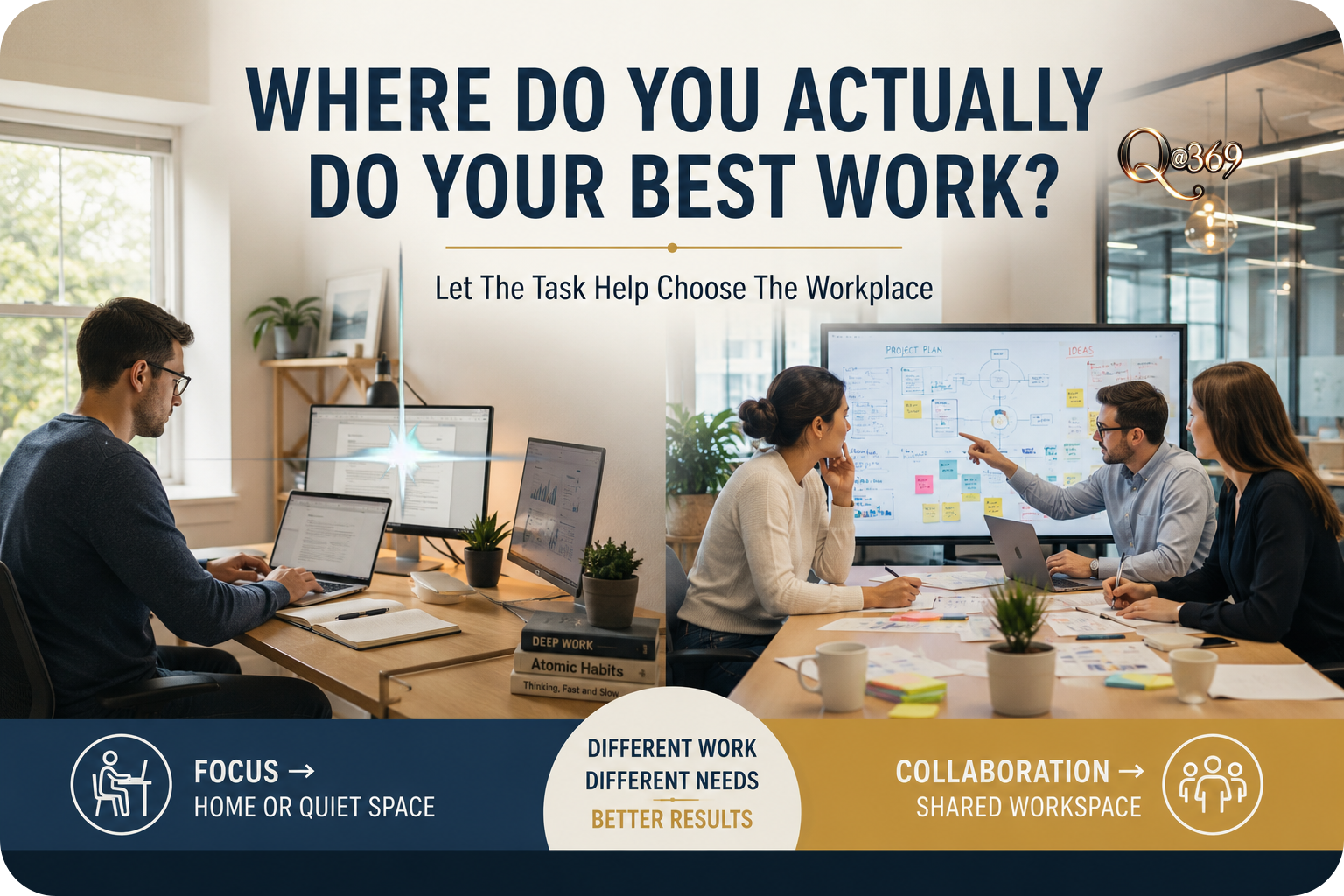
Finding The Right Balance Between Remote And Office Work

What if the best work place depends less on where you prefer working and more on what you need to accomplish?
Remote and office best work provide different advantages, so productive workers can match the environment with the needs of the task.
- Remote work can provide greater control over interruptions, schedules, and individual concentration.
- Office work can make spontaneous communication, mentoring, collaboration, and relationship building easier.
- Neither environment automatically produces greater productivity for every person or task.
- Individual personality, home conditions, job responsibilities, and team structure influence what works best.
- Hybrid work can become more useful when location follows task requirements rather than a fixed assumption.
- Evaluate your work by asking where each important task can be performed most effectively.
✨ AUDIO: Listen to “What if the best work place depends less on where you prefer working and more on what you need to accomplish?” by Isaac Yue
🎯 Also Available on SPOTIFY
🙏 Join Our Community Today!
💞 Share with Friends and Colleagues
The Workplace Question Has Changed
For generations, going to work usually meant going somewhere else. Offices, factories, laboratories, schools, stores, hospitals, and other workplaces separated employment from home life.
Digital technology changed that relationship for many knowledge workers. Laptops, cloud services, video meetings, messaging platforms, and secure networks made location less important for some tasks.
Then remote work expanded dramatically during the COVID 19 pandemic. Millions of workers discovered that jobs previously considered office dependent could sometimes be performed successfully from home.
That experience created a debate that continues today. Is remote work better, or should people return to the office?
Perhaps that question is too simple.
Start With The Work
Imagine two tasks waiting on your schedule.
The first requires three uninterrupted hours to analyze information and write a detailed report. The second requires your team to develop ideas for a complicated new project.
Do those tasks require the same environment?
Perhaps not.
The report may benefit from quiet concentration. The project discussion may benefit from rapid conversation, shared visual information, and people responding naturally to each other’s ideas.
Instead of asking where you prefer working, consider asking:
Where can I perform this particular task most effectively?
That changes the discussion from workplace preference to workplace purpose.
Remote Work Can Protect Concentration
Some work requires extended periods of focused attention. Writing, programming, engineering analysis, financial modeling, research, planning, and creative development can all benefit from fewer interruptions.
A well organized home workspace can provide control over the environment. Workers may be able to manage noise, lighting, temperature, breaks, and interruptions more easily.
Removing a commute can also return time to the day. That time may support additional sleep, exercise, family responsibilities, or simply a calmer beginning to work.
These advantages are meaningful when the home environment supports concentration. They become less valuable when home creates its own interruptions.
Home Is Not Automatically Quiet
Remote work is sometimes described as though every worker has a private office overlooking a peaceful garden.
Reality is more complicated.
Children may be home. A partner may also work remotely. Deliveries arrive, pets need attention, neighbors make noise, and household responsibilities remain visible throughout the day.
Space matters too. Working from a dedicated office is very different from working at a kitchen table in a crowded home.
Remote work therefore cannot be evaluated only by location. The quality of the working environment matters just as much.
The Office Provides Something Different
An office can create interruptions, yet some of those interruptions have value.
A colleague walks past and asks a question. Someone overhears a technical discussion and remembers a similar problem. Two people begin talking after a meeting and discover a solution neither had considered earlier.
These encounters are difficult to schedule.
They occur partly through proximity.
That can make the office valuable for collaborative work, mentoring, relationship building, complex discussions, and situations where information needs to move quickly among people.
Collaboration Is More Than A Meeting
Video meetings allow people across cities and countries to work together effectively. Screen sharing, collaborative documents, messaging, and digital whiteboards have removed many geographic barriers.
Yet communication contains more than spoken words. Body language, informal conversation, facial expressions, timing, and the small exchanges surrounding a meeting can also carry information.
A scheduled video call usually begins with a defined purpose. An office conversation can begin with one subject and unexpectedly reveal another.
Neither form of communication is automatically superior.
They provide different kinds of interaction.
Some Work Needs People Nearby
Consider a new employee learning an unfamiliar job.
Formal training may provide procedures and technical information. Much of workplace learning also happens through observation and informal questions.
The new employee hears how experienced colleagues discuss problems. They notice who understands particular systems and learn when to ask for assistance.
Those small interactions can accelerate learning.
Remote mentoring can certainly work. It may require greater intention since the learner cannot simply turn toward someone nearby and ask a quick question.
Some Work Needs People Far Away
The opposite can also be true.
A specialized project may require people located across several offices, states, or countries. Digital collaboration can bring the right expertise together without requiring everyone to occupy the same building.
Remote work can also expand hiring possibilities. An organization may recruit someone with needed expertise even when that person lives hundreds of miles away.
Workers gain flexibility too. Geography becomes less restrictive when physical presence is not essential to the work.
The important question remains the same.
What does this work actually require?
Productivity Is More Than Visible Activity
One challenge surrounding remote work is how productivity is measured.
Seeing someone sitting at a desk does not reveal how much useful work they are accomplishing. A busy office can contain meetings, interruptions, conversations, and activity without producing meaningful results.
The same applies at home. A green status indicator on a messaging application does not prove that someone is performing valuable work.
Useful productivity measures outcomes.
Was the problem solved? Was the report accurate? Did the customer receive what was needed? Did the project move forward?
Location becomes less important when expectations and results are clear.
Flexibility Can Become A Management Skill
Hybrid work is often described simply as spending several days at home and several days in an office.
That approach provides predictability. It does not necessarily connect location with the work being performed.
Imagine commuting to the office on Tuesday only to spend most of the day alone in video meetings. Then imagine remaining home on Wednesday while trying to conduct a complicated collaborative discussion remotely.
The schedule may be hybrid.
The work may not be optimized.
A more purposeful approach considers what people need to accomplish before deciding where they should accomplish it.
Match The Environment To The Task
One simple framework can make this easier.
Focus Work
Writing, analysis, research, programming, planning, and other concentrated tasks may benefit from the environment with fewer meaningful interruptions.
For some people, that is home. For others, it may be a private office or quiet workplace area.
Collaborative Work
Brainstorming, problem solving, project planning, design reviews, and complicated discussions may benefit from bringing people together.
Physical presence can be particularly useful when conversation needs to move rapidly among several participants.
Relationship Work
Mentoring, onboarding, team building, difficult conversations, and relationship development can benefit from richer human interaction.
These tasks may deserve intentional face to face time even when routine work remains remote.
Routine Work
Email, documentation, administrative activities, and individual follow up may work equally well from several locations.
Convenience and efficiency can guide the choice when physical presence adds little value.
Personality Matters Too
People do not respond to working environments identically.
Someone who concentrates well in solitude may find a busy office exhausting. Another person may gain energy, motivation, and ideas from being around colleagues.
Neither response represents a better work ethic.
People simply differ in how they respond to stimulation, social interaction, structure, and independence.
Self awareness becomes part of productivity. Knowing how you work can help you choose conditions that support the task rather than fight against it.
Managers Face A Different Question
Managers may be tempted to establish one workplace rule for everyone. Uniform rules are easy to understand and administer.
The work itself may resist that simplicity.
A software developer, project manager, laboratory technician, salesperson, financial analyst, and new employee can have very different reasons for being physically present.
Good management therefore requires more than choosing between remote and office work. It requires understanding what employees actually do.
That conversation can begin with outcomes.
What needs to be accomplished? Who needs to participate? What equipment is required? How much concentration or interaction does the task need?
The answers can make location easier to determine.
Avoid Turning Location Into Identity
Workplace discussions can become surprisingly personal.
Someone who prefers remote work may view office requirements as outdated. Someone who values the office may see remote workers as disconnected from the organization.
Neither assumption is particularly useful.
Remote work is not a personality trait. Office work is not a measure of commitment.
They are working arrangements.
Once we treat them as tools rather than identities, we can evaluate them according to how well they support the work.
Isaac Yue Reflection

My aerospace engineering career required a balance between focused remote work and time spent where the hardware was actually being built. During my full time years, I settled into a predictable routine of two remote days and three office days. My colleagues knew the schedule, which made communication and planning easier for everyone.
That schedule was never more important than the work. When critical hardware reached the factory floor, I was there to assist. Some engineering problems are simply easier to understand when you can see the hardware, talk directly with the people building it, and respond immediately.
Remote days offered a different kind of productivity. Concentrated engineering work could share the day with ordinary home activities. I could chop onions for a Quantum Chef dinner, marinate proteins, or throw a load of laundry into the washer between tasks.
These days, I am mostly retired from sustained aerospace hardware engineering activities. Much of my work now centers on QuantumAlchemist369 from my home office, with occasional seminars, trade shows, and other events bringing me back into shared spaces.
My work has changed, yet the lesson remains remarkably consistent. I do not see remote and office work as competitors. Each environment has advantages when matched with the right purpose.
The task comes first. The workplace follows.
Your Best Workplace May Change During The Day
You may discover that your ideal workplace is not one place.
A quiet morning at home could support concentrated writing or analysis. An afternoon with colleagues could support collaboration, mentoring, or project coordination.
Another day may require the opposite arrangement.
The important principle is flexibility with purpose.
Flexibility should not mean working anywhere without structure. It means recognizing that different tasks can require different conditions.
Try A Work Environment Audit
Look at the major tasks you performed during the past week.
For each one, ask whether it required focus, collaboration, relationships, specialized resources, or routine execution.
Then consider where you performed it.
Did the environment help?
Perhaps you attempted focused work in a location filled with interruptions. Maybe you handled an important collaborative problem through messages when a direct conversation would have been easier.
Those observations can reveal where your work environment supports you and where it creates unnecessary friction.
Conclusion
The debate between remote and office work often assumes that one environment must eventually win.
Work does not need a winner.
Some tasks benefit from solitude and concentration. Others improve through conversation, proximity, specialized equipment, or spontaneous interaction.
Remote work can provide flexibility and focus. Office work can provide collaboration, connection, mentoring, and access to shared resources.
Hybrid work becomes more meaningful when it does more than divide the week between two locations. It can allow the environment to follow the work.
The better question may therefore be surprisingly practical.
Where does this particular work have the best chance of succeeding?
Reflection Question
Which parts of your work genuinely improve when you change where you perform them?
Consider concentration, collaboration, communication, equipment, mentoring, and your own energy. The answer may be different for each kind of work.
Practical Action
Choose five recurring tasks from your normal workweek. Label each one Focus, Collaboration, Relationship, Resource Dependent, or Routine.
Next, identify the environment where you perform each task most effectively. Compare that answer with where you currently perform it.
Do not begin by choosing remote or office work.
Begin with the task, then choose the environment.

References
- Bloom, N., Han, R., & Liang, J. 2024. Hybrid Working From Home Improves Retention Without Damaging Performance. Nature, 630, 920–925.
https://doi.org/10.1038/s41586-024-07500-2 - Yang, L., Holtz, D., Jaffe, S., et al. 2022. The Effects of Remote Work on Collaboration Among Information Workers. Nature Human Behaviour, 6, 43–54.
https://doi.org/10.1038/s41562-021-01196-4 - Barrero, J. M., Bloom, N., & Davis, S. J. Survey of Working Arrangements and Attitudes. WFH Research.
https://wfhresearch.com/
See more of QuantumAlchemist369™ selected self-empowerment knowledge selections on the Book Shelf
Interactive Live Meetups
Thursday 7PM EDT Live Q&A with Isaac Yue
Join the Live Meetup Community discussion.
2026 Community Feedback Now Open
You are invited to help build QuantumAlchemist369. Take a few minutes to complete the Quantumarian Community Review 2026.
“Quantum Alchemy: The Convergence of Science, Spirit, and Enlightenment”
Second Edition – Refined & Expanded


Leave a Reply