
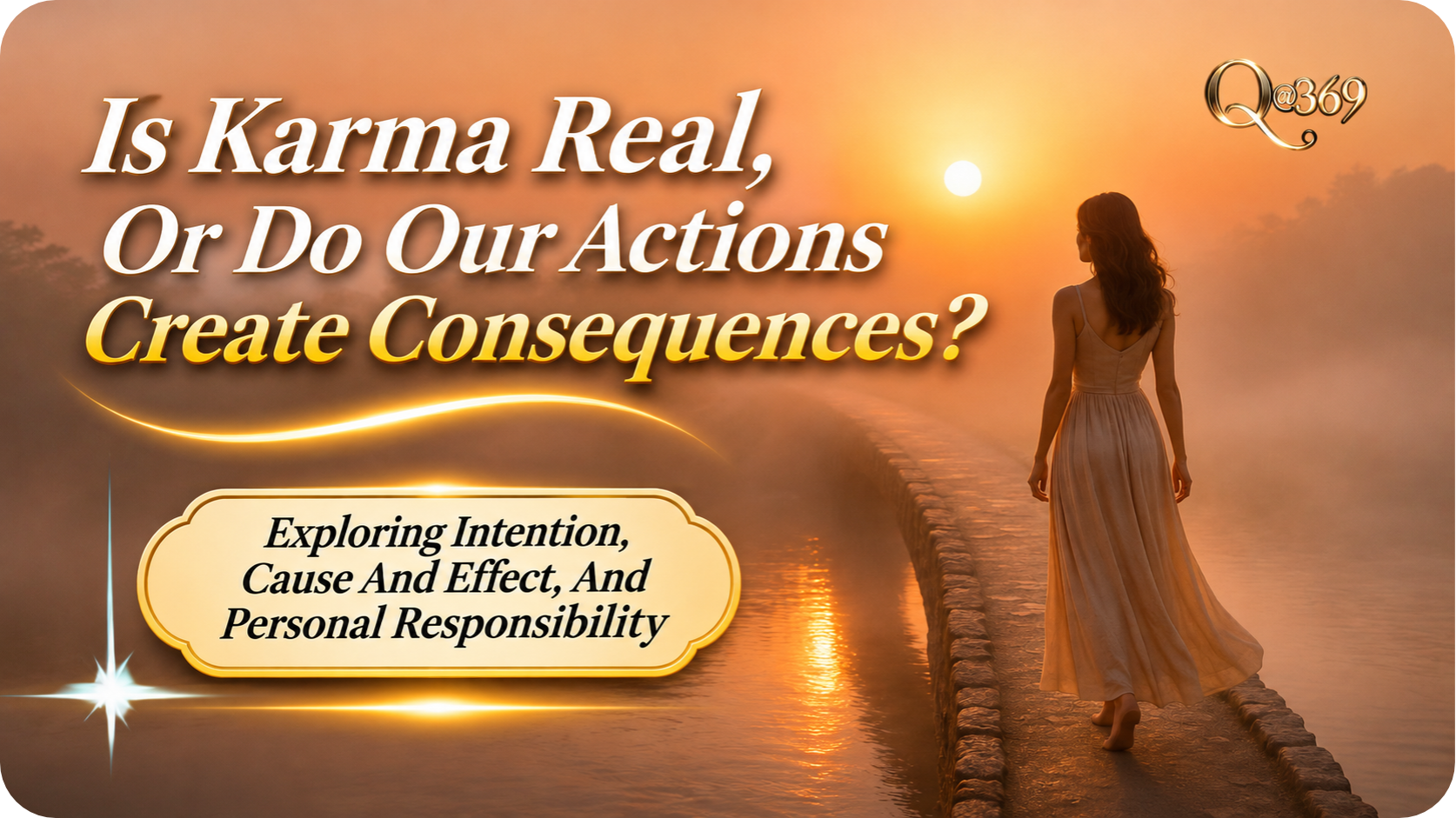
Understanding Karma, Cause And Effect, And The Influence Of Our Intentions
“Whether karma governs our destiny remains an open question. What we can examine is how our intentions shape our actions and influence the lives we touch.” — Isaac Yue
Can Life’s Consequences Reveal Something About Our Choices?
We often describe such experiences as karma. Yet the connection between an action and its outcome deserves closer examination.
Understanding this question can help us make thoughtful decisions without assuming that life always rewards goodness or punishes wrongdoing.
Five Concepts Worth Exploring
- Karma: A spiritual principle connecting intentional actions with their consequences.
- Cause And Effect: How actions contribute to outcomes through observable relationships.
- Personal Intention: The motivations influencing our choices and behavior.
- Human Interpretation: Our tendency to identify patterns and assign meaning to events.
- Personal Responsibility: Recognizing what we can influence without assuming everything is within our control.
✨Listen to: AUDIO PODCAST or on SPOTIFY
🙏 Join Our Community Today!
💞 Share with Friends and Colleagues
What Does Karma Actually Mean?
The word karma originates from Sanskrit and generally means action. Its deeper meaning varies across Hinduism, Buddhism, Jainism, and other philosophical traditions.
In many Buddhist teachings, intention plays a central role in karma. Actions motivated by generosity, compassion, or harmful intentions are understood to carry moral consequences.
Traditional interpretations can extend beyond a person’s present lifetime. These spiritual teachings should not be confused with scientifically established laws of physical causation.
Popular culture often presents karma as an invisible system of rewards and punishments. Someone behaves badly, experiences misfortune, and observers declare that karma has delivered justice.
However, traditional teachings are more complex than this familiar expression. Karma does not necessarily mean that every unfortunate experience represents punishment for an earlier action.
Do Our Actions Naturally Create Consequences?
We do not need a supernatural explanation to recognize that actions influence outcomes. Many consequences arise through ordinary relationships between behavior, circumstances, and human responses.
Consider someone who consistently treats friends with honesty and respect. Over time, those behaviors may strengthen trust and encourage others to offer support.
Now consider someone who repeatedly breaks promises. Friends may become cautious, relationships may weaken, and future opportunities for cooperation may diminish.
These examples demonstrate understandable social processes rather than proof of cosmic justice. Our actions influence circumstances, but they do not determine every outcome.
A generous person may experience hardship, while someone behaving dishonestly may avoid immediate consequences. Life does not consistently distribute rewards according to moral character.
Recognizing this uncertainty helps us separate personal responsibility from unrealistic expectations. We can choose our behavior without assuming complete control over the future.
Why Do We See Karma In Everyday Events?
Human beings naturally search for patterns and explanations. This ability helps us learn from experience, anticipate problems, and understand relationships.
However, our interpretations are not always accurate. We sometimes notice events supporting our beliefs while overlooking examples that challenge them.
Imagine someone behaves rudely during a conversation and later experiences an embarrassing setback. An observer might immediately interpret the setback as karma.
Yet the two events may have no causal connection. Their sequence alone does not establish that one caused the other.
Psychological research also examines our tendency to assume that people receive outcomes they deserve. This belief can provide emotional reassurance, but it may also encourage unfair judgments.
When someone experiences hardship, we should not automatically assume their previous actions caused it. Compassion requires recognizing circumstances beyond our knowledge.
Does Intention Matter More Than The Outcome?
Intentions influence the decisions we make, but intentions and outcomes are not identical. A well intended action can produce unexpected difficulties, while a careless action may occasionally produce a favorable result.
Consider someone offering advice to a friend experiencing a difficult situation. Their intention may be helpful, yet the advice could overlook important circumstances.
Recognizing the outcome allows the person to reconsider their approach. Good intentions become more useful when combined with awareness, knowledge, and responsibility.
This relationship offers a practical interpretation of karma. Our intentions influence our actions, and our actions contribute to consequences that deserve thoughtful evaluation.
However, intention alone does not guarantee a particular result. Understanding consequences requires examining evidence rather than relying entirely on personal expectations.
Isaac Yue Reflection: Curiosity About Karma
My curiosity about karma began with a familiar question. Is there an underlying principle connecting our intentions with the consequences we eventually experience?
I recognize that the absence of evidence does not automatically establish that something is impossible. However, it also does not provide evidence that a particular explanation is correct.
Throughout my experiences, I have observed situations where a person’s general intentions appeared to carry forward into consequences. Repeated behavior can influence relationships, opportunities, and how others respond.
Someone who consistently approaches others with kindness may develop stronger relationships. Someone who repeatedly acts without considering others may eventually encounter resistance or damaged trust.
These observations make me curious about the relationship between intention and consequence. Yet I recognize that observing a pattern does not establish the existence of a universal moral force.
My approach to Quantum Alchemy encourages positive intentions, thoughtful actions, and personal awareness. I value these principles because they influence how I participate in everyday life.
I do not need to prove a supernatural explanation to appreciate the practical importance of my choices. I can examine their consequences, learn from experience, and remain open to questions that deserve further investigation.
Can Quantum Physics Explain Karma?
Quantum physics describes physical phenomena through mathematical theories supported by experimental evidence. Its principles do not establish that the universe rewards moral behavior or punishes harmful intentions.
Quantum uncertainty also does not demonstrate that personal intentions control external events. Such claims extend beyond what quantum experiments have established.
Within Quantum Alchemy, scientific concepts can provide philosophical analogies for reflection. However, an analogy should never be presented as experimental proof of a spiritual belief.
Karma remains a meaningful spiritual and philosophical concept for many people. Its traditional interpretations deserve respectful consideration without confusing belief with scientific verification.
Practical Reflection: Test Your Assumptions
The next time an event appears to demonstrate karma, consider examining your interpretation. This activity encourages curiosity without requiring you to accept or reject a spiritual explanation.
- Recall An Experience
- Think about a situation where someone’s behavior appeared connected to a later consequence. It might involve kindness, dishonesty, cooperation, or a personal decision.
- Examine The Evidence
- Identify what actually happened and what you know about the circumstances. Consider whether there is an observable connection between the original action and its outcome.
- Question Your Assumptions
- Ask whether coincidence, outside circumstances, or another person’s decisions might explain the result. Notice whether your interpretation depends on information you do not possess.
- 4. Reflect On Your Own Choices
- Consider what the experience teaches you about intention, responsibility, and personal behavior. Focus on lessons you can apply rather than assigning moral judgment to someone else.
The purpose is not to determine whether karma exists through one experience. It is to develop greater awareness of how we interpret events and learn from consequences.
What Can We Learn Without Resolving The Mystery?
Whether karma represents a spiritual principle or a human interpretation of consequences remains a philosophical and religious question. Science can examine observable behavior and outcomes, but it has not established a universal system of moral rewards.
We can still recognize the practical importance of intention, responsibility, and thoughtful action. Our choices influence relationships and circumstances, even when outcomes remain uncertain.
Perhaps the most useful question is not whether every action eventually receives a deserved reward or punishment. It is whether our present choices reflect the person we intend to become.
Join The Conversation
Do you believe karma represents a spiritual principle, or do our actions create consequences through ordinary cause and effect?
Share your experiences and interpretations in the Quantumarian Community. Consider how personal responsibility and compassion can guide our choices without assuming every outcome is deserved.
Find Your Quantum

References
- Buddhist Society of Australia. What Is Karma? An introduction to intention, action, and consequences in Buddhist teaching. https://buddhistsocietiesofaustralia.org/topics/karma/
- OpenStax. Psychology 2e, Chapter 12: Social Psychology. Explains attribution and how people interpret others’ behavior. https://openstax.org/books/psychology-2e/pages/12-1-what-is-social-psychology
- White, C. J. M., and Willard, A. K. (2025). How Karma Harms and Helps Generosity Toward Those in Need. Personality and Social Psychology Bulletin. https://doi.org/10.1177/01461672251313829
See more of QuantumAlchemist369™ selected self-empowerment knowledge selections on the Book Shelf

Pioneers of Quantum Physics

Interactive Live Meetups
Thursday 7PM EDT Live Q&A with Isaac Yue
Join the Live Meetup Community discussion.
QA369 Forum – Empower Your Life
Join the Conversation? Start sharing your insights today! On our Quantumarian Forum Page


Leave a Reply