
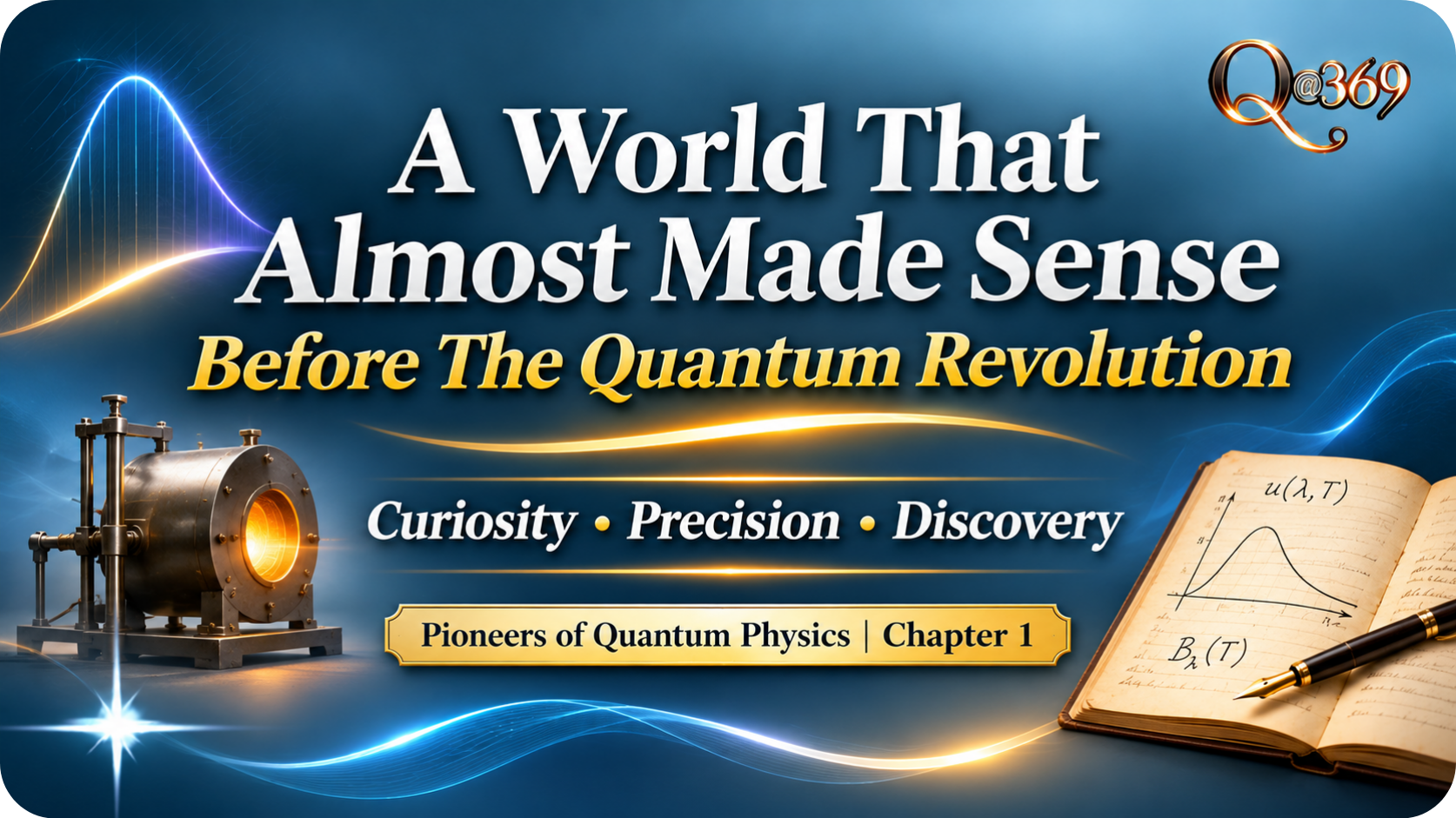
Pioneers of Quantum Physics | Chapter 1 Review
How Curiosity, Precise Measurements, And Scientific Collaboration Prepared The Way For Quantum Physics
“Behind every great discovery stands a history of curiosity, evidence, and people who helped make the discovery possible.” – Isaac Yue
How Does A Scientific Revolution Begin?
How does a scientific revolution begin when the existing theories appear to explain nearly everything?
Near the end of the nineteenth century, physics had achieved remarkable success. Yet increasingly precise measurements revealed problems that established theories could not fully explain.
Chapter 1 of Pioneers of Quantum Physics, by Isaac Yue, explores the discoveries that prepared the way for quantum theory. It follows scientists whose curiosity, experiments, and collaborations gradually transformed our understanding of nature.
Five Concepts Guide This Chapter Review:
- Scientific Confidence: Why classical physics appeared remarkably successful.
- Unanswered Questions: How small experimental discrepancies challenged established explanations.
- Precision Measurement: Why better instruments revealed previously hidden problems.
- Scientific Collaboration: How experimentalists and theorists contributed to discovery.
- Curiosity And Discovery: Why major breakthroughs often emerge through years of investigation rather than sudden inspiration.
✨Listen to: AUDIO PODCAST or on SPOTIFY
🙏 Join Our Community Today!
💞 Share with Friends and Colleagues
Why Begin Before The Quantum Revolution?
Quantum physics is often introduced through remarkable discoveries and unfamiliar concepts. Electrons behave differently from ordinary objects, energy becomes quantized, and familiar ideas about measurement require reconsideration.
However, beginning with those conclusions can obscure the human story behind them. The scientists who developed quantum theory did not know where their investigations would lead.
Chapter 1 begins before the quantum revolution because understanding the earlier scientific world makes the discoveries more meaningful. Readers encounter the knowledge, assumptions, and unresolved questions available to nineteenth century physicists.
The chapter also challenges the popular impression that classical physics had become an exhausted discipline. In reality, its extraordinary achievements provided the foundation for further investigation.
This historical approach allows readers to follow discovery as it unfolded. Rather than memorizing revolutionary conclusions, they can appreciate the questions that made those conclusions necessary.
A Scientific World That Had Earned Confidence
By the late nineteenth century, classical physics had achieved remarkable explanatory power. Isaac Newton’s mechanics described falling objects and planetary motion through the same mathematical principles.
James Clerk Maxwell had unified electricity and magnetism within a common theoretical framework. His equations also explained light as an electromagnetic phenomenon.
Thermodynamics provided powerful laws describing heat, work, and energy. Statistical mechanics connected the behavior of large physical systems with enormous collections of microscopic particles.
These achievements created legitimate confidence in scientific methods. Nature appeared increasingly understandable through mathematical relationships supported by observation.
However, confidence did not mean that every question had been answered. Important problems remained in radiation, thermodynamics, electrodynamics, and the proposed luminiferous ether.
The chapter presents this period without exaggerating either its confidence or its difficulties. Classical physics was productive, successful, and increasingly confronted by questions that demanded further investigation.
Featured Chapter Excerpt: The Cracks In Classical Physics
One passage captures the historical setting particularly well.
From Chapter 1:
“Classical physics did not have one crack. It had several, and nobody knew which ones would widen.”
This observation helps readers understand why the quantum revolution was not inevitable from the perspective of contemporary scientists. Several unresolved problems existed, but their eventual significance was not obvious.
Physicists were working with the theories and instruments available to them. They could not anticipate how individual investigations would contribute to a new understanding of matter and energy.
The passage also illustrates an important feature of scientific progress. A small unresolved question can eventually reveal limitations in an otherwise successful explanation.
How Did A Glowing Object Challenge Physics?
One of the most important problems concerned something familiar. Heated objects emit electromagnetic radiation, and their radiation changes as temperature increases.
A piece of metal may begin glowing red when sufficiently heated. At higher temperatures, its visible appearance changes as the distribution of emitted radiation shifts.
Physicists wanted to understand the mathematical relationship between temperature and the radiation emitted at different wavelengths. The challenge was to identify a universal law describing this behavior.
Gustav Kirchhoff had established important principles concerning thermal radiation. His work helped physicists recognize that ideal blackbody radiation followed a universal spectrum determined by temperature.
A blackbody is an idealized object that absorbs all incoming electromagnetic radiation. When in thermal equilibrium, it emits radiation with a spectrum determined by its temperature.
Experimental physicists developed heated cavities with small openings to approximate this ideal behavior. Radiation escaping through the opening could then be measured under carefully controlled conditions.
The arrangement appeared straightforward, but reliable measurements required considerable skill. Scientists needed precise temperatures, suitable instruments, and methods for examining radiation beyond visible light.
The book includes a labeled blackbody cavity illustration that helps readers visualize this experimental arrangement. It demonstrates how a seemingly simple device became essential to a major scientific discovery.
The Experimentalists Who Made Discovery Possible
Scientific history often celebrates the theorist who produces the successful equation. Chapter 1 deliberately broadens that perspective by examining the experimental community behind the discovery.
In Berlin, the Physikalisch Technische Reichsanstalt supported precision measurement and fundamental research. Established in 1887, the institution helped connect scientific investigation with increasingly demanding measurement standards.
Otto Lummer, Ferdinand Kurlbaum, Ernst Pringsheim, Wilhelm Wien, and Heinrich Rubens contributed to radiation research. Their work improved instruments and extended measurements into previously difficult regions of the spectrum.
Wien had developed a radiation distribution law that agreed impressively with much of the available evidence. His work represented genuine theoretical progress rather than an obvious failure awaiting correction.
However, increasingly precise measurements revealed differences between Wien’s predictions and observed radiation. These discrepancies became especially important at longer wavelengths.
Lummer and Pringsheim extended experimental investigations. Rubens and Kurlbaum developed methods for examining infrared radiation farther into the difficult wavelength region.
The experimental discrepancies persisted. Scientists increasingly recognized that the existing radiation law could not explain every observation.
These developments demonstrate how improved measurement can transform scientific understanding. Better instruments do more than confirm existing theories; they can reveal questions nobody previously knew how to ask.
Max Planck And The Search For A Better Explanation
Max Planck was already an established physicist when these experimental difficulties became increasingly important. His interests included thermodynamics, entropy, and the theoretical foundations of radiation.
Planck was not attempting to overthrow classical physics. He wanted to understand radiation through general physical principles.
The chapter recounts an important meeting in Berlin on October 7, 1900. Heinrich Rubens and his wife visited Planck and his wife, bringing recent experimental findings into the discussion.
Rubens described long wavelength measurements that placed new constraints on any successful radiation law. These observations helped Planck identify the mathematical behavior his explanation needed to reproduce.
Soon afterward, Planck developed a radiation formula that agreed with the experimental evidence. On October 19, he presented the formula during a meeting of the German Physical Society.
The moment was important, but it was not yet the complete quantum revolution. Planck had developed a successful mathematical description and still wanted to understand its physical foundations.
This sequence is central to the chapter’s historical narrative. Scientific progress emerged through experimental findings, theoretical investigation, and communication among researchers.
Featured Quote: Discovery Is A Collective Achievement
A second passage captures the book’s broader approach to scientific history.
From Chapter 1:
“The problem that made it necessary belonged to a scientific community.”
This sentence follows the chapter’s account of Planck’s successful radiation formula. It recognizes his achievement while acknowledging the experimental work that made the problem measurable.
The historical importance extends beyond one individual. Kirchhoff, Wien, Lummer, Pringsheim, Rubens, Kurlbaum, and others contributed to the scientific conditions surrounding Planck’s discovery.
Their contributions were not identical, but they were connected. Instruments, measurements, theoretical reasoning, and scientific conversations all influenced the developing understanding.
The quotation reinforces a central purpose of Pioneers of Quantum Physics. Readers encounter scientific discoveries through the people, questions, and relationships that made them possible.
Was Planck Solving The Ultraviolet Catastrophe?
Many familiar explanations describe Planck responding to the ultraviolet catastrophe. According to this account, classical physics predicted unlimited radiation energy at short wavelengths.
The ultraviolet catastrophe identifies a genuine failure of classical descriptions of blackbody radiation. However, the familiar textbook sequence does not accurately represent Planck’s original circumstances.
The completed Rayleigh Jeans law developed after Planck’s decisive work. The phrase ultraviolet catastrophe became associated with Paul Ehrenfest in 1911.
Planck’s immediate challenge in 1900 involved experimental discrepancies at longer wavelengths. Wien’s radiation law increasingly disagreed with measurements in the infrared region.
This historical correction matters because it restores the actual sequence of discovery. Planck was responding to experimental evidence available during his own investigation.
The chapter therefore separates later explanations from the questions scientists originally confronted. Readers gain a clearer understanding of how the discovery developed.
Isaac Yue Reflection: Where Does A Revolutionary Idea Begin?

My curiosity about quantum physics eventually led me to investigate its origins. I wanted to understand how scientists developed ideas that changed our understanding of the physical world.
One question initially amused me. How did Einstein think of E = mc²?
I imagined some extraordinary moment of inspiration. Perhaps Einstein was lighting his pipe when a remarkable equation suddenly appeared in his thoughts.
It was an entertaining image, but my research revealed a much deeper story. Scientific discoveries rarely emerge from isolated moments without preparation.
Einstein’s work developed within an intellectual environment shaped by earlier discoveries, unresolved questions, and scientific colleagues. His own curiosity and reasoning were essential, but they did not exist independently of scientific history.
The same pattern became apparent when I explored the origins of quantum physics. Planck’s achievement was connected to experimental investigations and theoretical developments that preceded his formula.
The more I researched, the more interested I became in the people behind the discoveries. I wanted to understand their questions, disagreements, collaborations, and persistence.
That curiosity became an important motivation for writing Pioneers of Quantum Physics. I wanted readers to experience the development of scientific understanding rather than encounter only its finished equations.
I also discovered that historical accuracy makes these stories more interesting. The actual sequence of events often reveals greater intellectual depth than a simplified account of sudden genius.
For me, the most meaningful question gradually changed. Instead of asking only how a scientist discovered something, I began asking what made that discovery possible.
That question continues to guide my exploration of the pioneers. Their achievements reveal the importance of curiosity supported by knowledge, evidence, and collaboration.
Why Does This Chapter Matter To Readers?
Chapter 1 provides a foundation for understanding the scientific discoveries explored throughout the book. Readers do not need advanced mathematics to appreciate the problems confronting nineteenth century physicists.
The narrative introduces familiar experiences, including glowing objects and the measurement of heat. These examples connect abstract scientific questions with observable physical behavior.
Readers also encounter the scientists whose contributions prepared the way for Planck. Their stories demonstrate that scientific discovery depends on more than exceptional individual insight.
The chapter offers several practical benefits for curious readers. It encourages careful examination of evidence, appreciation for collaboration, and awareness of how scientific explanations change.
Another important benefit concerns historical perspective. Understanding what scientists knew at a particular moment helps prevent judging their decisions through knowledge acquired decades later.
This approach makes quantum physics more accessible. Readers can follow the questions before confronting the mathematical developments that eventually answered them.
Chapter Analysis: The Strength Of The Historical Approach
The chapter’s greatest strength is its emphasis on discovery as a developing process. It does not begin by announcing that classical physics was fundamentally mistaken.
Instead, readers encounter a successful scientific framework that gradually revealed limitations. This makes the transition toward quantum theory more understandable and historically credible.
The account also gives experimental physicists an important role. Lummer, Pringsheim, Rubens, and Kurlbaum become active contributors rather than supporting names surrounding Planck.
Another strength is the correction of the ultraviolet catastrophe narrative. The chapter explains why the later textbook description should not replace the actual historical sequence.
The blackbody cavity illustration provides useful visual support. It helps readers understand why controlled experimental conditions were necessary for studying thermal radiation.
The chapter also establishes an important intellectual question. A successful formula can describe observations without immediately providing a satisfying physical explanation.
Planck had obtained a radiation law that matched the measurements. His next challenge was to understand why the formula worked.
This unresolved question creates a natural transition into the development of quantum theory. Readers finish the chapter understanding both the achievement and the remaining mystery.
Quantum Alchemy: Curiosity, Evidence, And Understanding
Quantum Alchemy explores connections among science, philosophy, spirituality, and personal experience. The origins of quantum physics provide an opportunity to examine how knowledge develops.
Science advances through observations, mathematical reasoning, and experimental testing. The history of blackbody radiation demonstrates the importance of questioning explanations when reliable evidence reveals limitations.
Philosophy considers broader questions about knowledge and understanding. How do we recognize the limits of a successful theory, and when should its assumptions be reconsidered?
Spiritual reflection may explore curiosity, humility, and the personal meaning of discovery. These reflections can enrich our appreciation of scientific history without replacing experimental evidence.
The chapter does not establish spiritual explanations for quantum phenomena. Its scientific narrative concerns radiation measurements, mathematical relationships, and the development of physical theory.
However, the human story encourages meaningful reflection about intellectual openness. Even successful explanations may leave important questions unanswered.
Curiosity becomes especially valuable when combined with disciplined investigation. The pioneers demonstrate how questioning familiar assumptions can lead toward deeper understanding.
Reader Engagement: The Discovery Behind The Discovery
Scientific breakthroughs often emerge from several connected developments. This activity invites you to examine one contribution that helped prepare the way for quantum physics.
Choose a scientist or discovery discussed in Chapter 1. Maxwell’s electromagnetic theory, Kirchhoff’s radiation research, or Rubens’s infrared measurements provide useful starting points.
First: What Was Already Known?
Consider the scientific understanding available before the selected discovery. Identify the theories or observations that provided its foundation.
For example, electromagnetic theory had already established important relationships between electricity, magnetism, and light. Those achievements created new opportunities for investigating radiation.
Second: What Changed?
Identify the observation, measurement, or theoretical development that introduced something new. Consider whether it confirmed an existing explanation or revealed a limitation.
Rubens’s infrared measurements provide a useful example. They helped expose discrepancies between Wien’s radiation law and observed behavior at longer wavelengths.
Third: Why Did It Matter?
Consider how the development influenced later scientific investigations. Ask whether another scientist depended on the information, instruments, or theoretical understanding it provided.
Planck’s radiation formula emerged within a community of experimental and theoretical researchers. Their combined efforts helped establish the problem his formula addressed.
Reflect On The Discovery
After examining your selected contribution, consider how scientific progress depends on earlier achievements. A major discovery may become possible because other researchers have already developed essential knowledge.
The activity also invites a broader question about innovation. How often do we recognize the contributions that prepared the way for a celebrated achievement?
Closing Reflection: Before The Revolution Came Curiosity
Chapter 1 reveals a scientific world that had earned confidence through remarkable achievements. Classical physics explained many natural phenomena with impressive mathematical accuracy.
Yet precise measurements exposed questions that existing explanations could not fully resolve. Those questions gradually directed attention toward the behavior of thermal radiation.
The chapter follows the experimentalists and theorists whose work prepared the way for Planck. Their investigations demonstrate how scientific progress develops through curiosity, collaboration, and persistent examination of evidence.
The story also challenges the familiar image of a revolutionary idea appearing without preparation. Important discoveries often emerge from years of research and contributions made by many individuals.
For readers, the lesson extends beyond physics. Understanding the questions behind an achievement can be more valuable than memorizing the final result.
The opening chapter of Pioneers of Quantum Physics invites us to experience science through the curiosity of its pioneers. It reminds us that discovery begins with questions and advances through the effort to answer them.
As we continue through the book, the mathematical and philosophical challenges will become more demanding. However, the human foundation established in Chapter 1 remains essential.
The pioneers did not begin with a quantum revolution in mind. They began with scientific questions that deserved better answers.
Discussion Question
Which contributed more to the beginning of quantum physics: revolutionary theoretical thinking or increasingly precise experiments?
Consider the roles of Planck, Wien, Rubens, and the other researchers discussed in Chapter 1. Share your perspective in the Quantumarian Community.
Practical Action
Choose one scientist from Chapter 1 and investigate the contribution that helped prepare the way for Planck’s discovery. Consider what was already known, what changed, and why the development mattered.
You may discover that the most interesting part of a scientific achievement is the history behind it.
Continue exploring the human story of discovery in Pioneers of Quantum Physics, by Isaac Yue.
Find Your Quantum

References
- Yue, Isaac. Pioneers of Quantum Physics. Chapter 1: A World That Almost Made Sense. The primary source for this review, covering classical physics, blackbody radiation, experimental research, and Planck’s 1900 discovery. https://www.amazon.com/dp/B0HPGFB7TY
- Kuhn, Thomas S. (1978). Black-Body Theory and the Quantum Discontinuity, 1894–1912. Oxford University Press. A historical study of blackbody radiation research and the scientific developments surrounding the origins of quantum theory.
- Planck, Max (1900). On An Improvement Of Wien’s Spectral Equation. German Physical Society. Planck’s original publication presenting his improved radiation formula. https://doi.org/10.1002/andp.19013090310
See more of QuantumAlchemist369™ selected self-empowerment knowledge selections on the Book Shelf

Pioneers of Quantum Physics

Interactive Live Meetups
Thursday 7PM EDT Live Q&A with Isaac Yue
Join the Live Meetup Community discussion.
QA369 Forum – Empower Your Life
Join the Conversation? Start sharing your insights today! On our Quantumarian Forum Page


Leave a Reply