
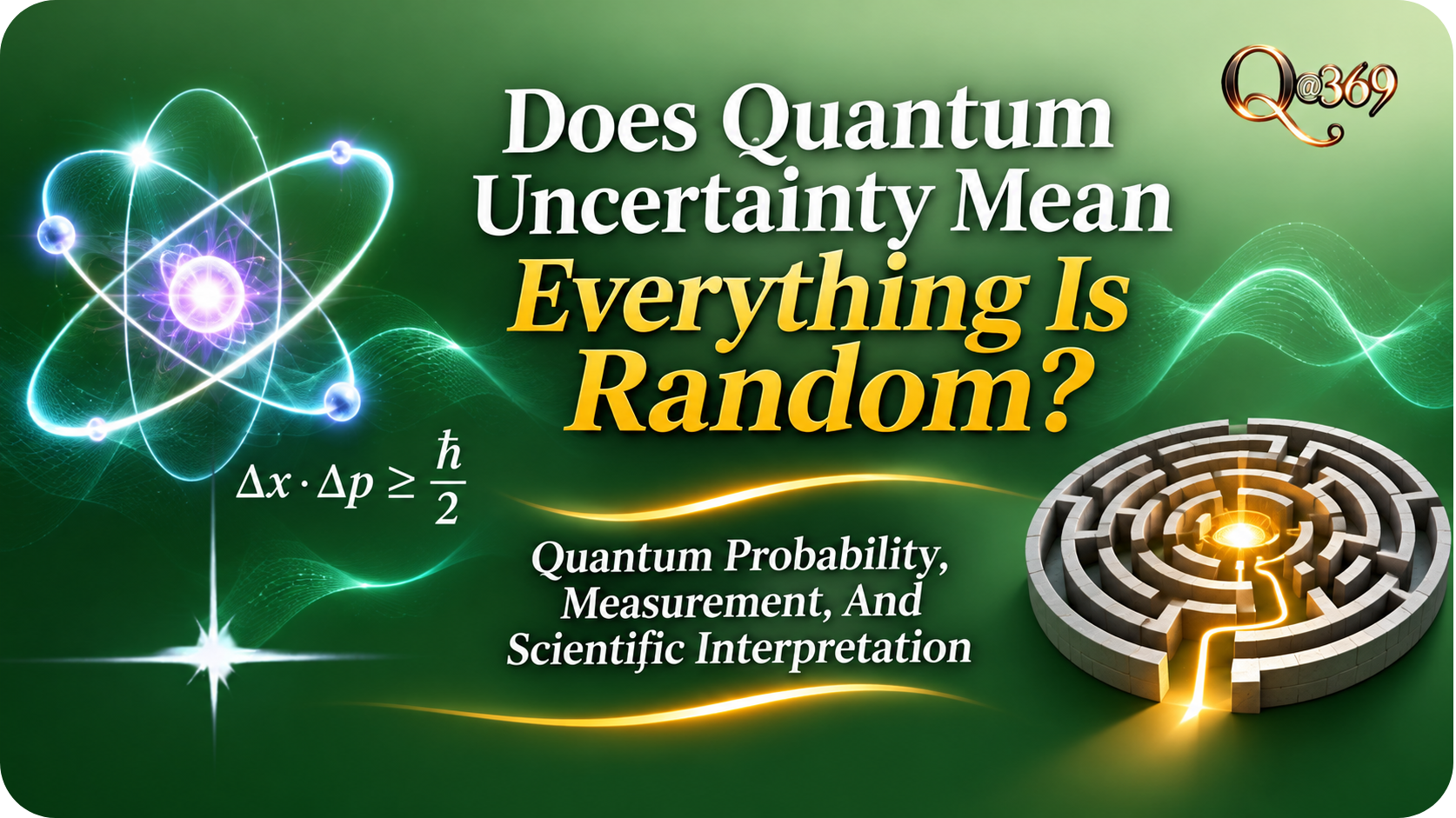
Understanding Quantum Probability, Measurement, And The Limits Of Scientific Prediction
“Uncertainty does not remove the value of knowledge. It reminds us to apply what we know while remaining open to what we may discover.” – Isaac Yue
Is The Universe Governed By Chance?
Does quantum uncertainty mean that everything in the universe happens randomly, without predictable patterns or underlying physical laws?
Quantum mechanics describes a world where individual measurement outcomes can be uncertain, yet their statistical patterns remain remarkably predictable. Understanding this relationship helps us separate scientific findings from philosophical interpretations about randomness and determinism.
The uncertainty principle also reveals important limits on what certain physical quantities can simultaneously reveal. These limits do not mean that nature operates without mathematical structure.
Five Concepts Guide Today’s Exploration:
- Quantum Uncertainty: Understanding fundamental limits on certain simultaneous measurements.
- Quantum Probability: Exploring how mathematics predicts possible measurement outcomes.
- Quantum Measurement: Examining what happens when physical systems interact with measuring instruments.
- Randomness And Determinism: Understanding different scientific interpretations of quantum behavior.
- Practical Awareness: Recognizing uncertainty while making thoughtful decisions in everyday life.
✨Listen to: AUDIO PODCAST or on SPOTIFY
🙏 Join Our Community Today!
💞 Share with Friends and Colleagues
Why Does Quantum Physics Involve Uncertainty?
Classical physics describes many familiar events through mathematical relationships involving position, motion, energy, and forces. Given suitable initial conditions, these relationships can produce remarkably accurate predictions.
Consider a spacecraft traveling through space. Engineers can calculate its trajectory using gravitational forces and other measurable conditions.
Quantum mechanics introduces a different mathematical framework for describing physical systems. It uses quantum states to calculate probabilities for possible measurement outcomes.
For certain measurements, the theory predicts probabilities rather than one guaranteed individual result. However, these probabilities follow precise mathematical rules.
This creates an important question about the physical world. Does uncertainty reflect incomplete knowledge, or does it reveal something fundamental about nature?
Different interpretations of quantum mechanics approach that question differently. The experimentally successful predictions remain central regardless of which interpretation we consider.
What Is Heisenberg’s Uncertainty Principle?
In 1927, Werner Heisenberg introduced the uncertainty principle while developing quantum mechanics. The principle concerns limits on how sharply certain pairs of physical quantities can be specified together.
Position and momentum provide the best known example. A quantum state cannot have arbitrarily narrow distributions for both quantities simultaneously.
The mathematical relationship is commonly expressed as:
Δx · Δp ≥ ħ/2
Here, Δx represents the standard deviation of position measurements. The quantity Δp represents the standard deviation of momentum measurements.
The symbol ħ represents the reduced Planck constant. The equation establishes a lower bound on the product of these uncertainties.
This limitation is not simply caused by imperfect measuring instruments. It follows from the mathematical structure of quantum mechanics.
An important clarification concerns the meaning of measurement. The uncertainty principle describes the statistical distributions associated with a quantum state.
It does not mean every measurement is inaccurate or that scientists cannot obtain precise information. Instead, it limits how sharply certain quantities can be jointly specified.
Does Uncertainty Mean We Cannot Predict Anything?
Quantum mechanics is among the most successful predictive theories in modern science. Its mathematical structure allows physicists to calculate probabilities with extraordinary precision.
Consider an electron prepared in a particular quantum state. Scientists can calculate the probabilities of obtaining different results when measuring a selected property.
An individual outcome may not be predictable with certainty. However, repeated measurements on identically prepared systems can reveal reliable statistical patterns.
This relationship between individual outcomes and collective behavior is essential to quantum physics. Uncertainty at one level does not eliminate predictability at another.
The theory also predicts how quantum states evolve between measurements. For isolated systems, this evolution follows the deterministic Schrödinger equation.
Therefore, quantum mechanics contains both deterministic mathematical evolution and probabilistic measurement predictions. Understanding their relationship is central to the interpretation of quantum theory.
How Does Quantum Probability Work?
Probability describes the mathematical likelihood of possible outcomes. In quantum mechanics, these probabilities are calculated from a system’s quantum state.
Consider an electron whose spin is measured along a chosen direction. A suitable preparation can produce equal probabilities for two possible results.
The theory may predict a 50 percent probability for each outcome. Yet it does not identify which result will occur during a particular measurement.
Repeating the experiment many times reveals the expected statistical distribution. Individual results remain uncertain, while the overall pattern becomes increasingly clear.
This does not mean every quantum experiment produces equal probabilities. Different preparations and measurements lead to different mathematical predictions.
Some quantum states even produce certain outcomes with probability one for particular measurements. Quantum uncertainty does not make every observable property unpredictable.
What Happens During Quantum Measurement?
Quantum measurement involves an interaction between a physical system and a measuring apparatus. The interaction allows information about a selected property to become accessible.
In standard quantum theory, measurement probabilities are calculated using the Born rule. This mathematical rule connects quantum states with possible observed outcomes.
However, the deeper explanation of how one particular outcome becomes definite remains debated. This question is commonly called the quantum measurement problem.
Some interpretations describe measurement through wavefunction collapse. Others explain observed outcomes through different mathematical or physical accounts.
The existence of this debate does not undermine the experimental success of quantum mechanics. It reflects continuing questions about what the mathematical framework tells us about physical reality.
Measurement also does not require a conscious human observer. Physical interactions with instruments and surrounding environments play essential roles in experimental observations.
Is Quantum Randomness Fundamental?
The question of fundamental randomness remains closely connected to interpretations of quantum mechanics. Different interpretations can agree on experimental predictions while describing reality differently.
In commonly taught formulations, measurement outcomes are fundamentally probabilistic. The quantum state determines probabilities rather than a unique result for every measurement.
The many worlds interpretation describes quantum evolution without a fundamental collapse process. Its explanation of observed probabilities differs from collapse based approaches.
Bohmian mechanics provides another interpretation involving deterministic particle trajectories. Its predictions reproduce standard quantum results under appropriate conditions.
These examples demonstrate why the philosophical question requires care. The mathematical predictions do not uniquely settle every question about the underlying nature of reality.
Experiments involving Bell inequalities have also placed strong restrictions on possible hidden variable explanations. They rule out broad classes of local hidden variable models under the relevant experimental assumptions.
However, these findings do not establish that every conceivable deterministic interpretation is impossible. They narrow the possibilities that can remain consistent with observed quantum correlations.
Does Quantum Uncertainty Make Everything Random?
No. Quantum uncertainty does not mean that every event in the universe occurs without structure or predictable relationships.
The physical world contains stable patterns governed by mathematical laws. Quantum mechanics itself provides precise predictions for many measurable phenomena.
Macroscopic systems also exhibit reliable behavior through collective physical processes. The behavior of large objects often can be described accurately using classical approximations.
A bridge does not randomly disappear because quantum uncertainty exists. A spacecraft does not abandon predictable orbital motion because individual quantum outcomes may be uncertain.
Quantum effects can influence larger systems under particular conditions. However, their presence does not eliminate the regularities observed in everyday physical processes.
The important lesson is that uncertainty and physical law are not opposites. A theory can contain probabilistic predictions while remaining mathematically precise.
Isaac Yue Reflection: Applying Knowledge While Remaining Open To Possibilities
Every day, I approach my priorities using the knowledge, skills, and values I have developed through experience. These provide a foundation for making decisions and directing my attention toward meaningful activities.
However, I also recognize that each day introduces circumstances I cannot fully predict. New information, unexpected opportunities, and changing conditions may require adjustments.
I try to remain open minded when these possibilities appear. Rather than treating uncertainty as an obstacle, I approach it with positive awareness.
This does not mean expecting every unexpected event to produce a favorable outcome. It means recognizing that I can respond thoughtfully even when circumstances remain uncertain.
My knowledge helps me evaluate the information available. My skills help me consider possible actions, while my values guide the choices I make.
Together, these qualities provide continuity without requiring complete control over every outcome. I can prepare carefully while remaining receptive to new possibilities.
I find this approach particularly meaningful when considering quantum uncertainty. Physics reminds us that precise mathematical knowledge does not always guarantee a particular individual outcome.
However, I do not interpret quantum uncertainty as evidence that thoughts determine external events. The scientific principles governing quantum measurements should not be confused with personal decision making.
Instead, I appreciate a broader philosophical lesson about uncertainty. We can act responsibly with the information available while accepting that some outcomes remain beyond our prediction.
For me, positive awareness means maintaining curiosity, evaluating new information, and responding constructively. It allows me to remain grounded in my values while continuing to learn from experience.
Can Uncertainty And Order Exist Together?
Nature provides many examples of reliable patterns emerging from processes involving uncertainty. Statistical physics examines how large collections of particles produce predictable macroscopic behavior.
Consider a container filled with gas. Individual molecules move and collide in complicated ways, making their detailed trajectories difficult to track.
Nevertheless, pressure and temperature can be described through reliable statistical relationships. These properties help explain the behavior of gases under different conditions.
Quantum mechanics provides another example of mathematical predictability through statistical descriptions. The probabilities of individual outcomes can combine into stable experimental patterns.
However, classical statistical uncertainty and quantum uncertainty are not necessarily identical. Their physical origins and mathematical descriptions can differ.
Recognizing these differences helps us appreciate the broader relationship between uncertainty and order. Predictability does not always require knowing every individual event.
Quantum Alchemy: Scientific Uncertainty And Personal Meaning
Quantum Alchemy explores connections among science, philosophy, spirituality, and personal experience. Quantum uncertainty provides an opportunity to examine how these perspectives address different questions.
Science investigates measurable physical behavior through mathematical models and experiments. Quantum mechanics provides precise methods for predicting probabilities and testing those predictions.
Philosophy considers what those predictions reveal about causality, determinism, and reality. Different interpretations continue to explore these questions without universal agreement.
Spiritual reflection may examine how people respond to uncertainty in their personal lives. Values, awareness, and a sense of purpose can influence those responses.
However, quantum uncertainty does not scientifically establish that consciousness controls measurement outcomes. Nor does it demonstrate that personal intentions determine physical events.
The connection to everyday life is philosophical rather than experimental. We can appreciate uncertainty without claiming that quantum equations directly explain human choices.
This approach preserves scientific integrity while encouraging meaningful reflection. It allows curiosity and personal awareness to develop alongside respect for evidence.
Reader Engagement: Predict The Pattern
Individual outcomes can be difficult to predict even when overall statistical patterns remain understandable. This activity explores that relationship through a familiar coin experiment.
A coin toss is a classical physical process, not a demonstration of quantum measurement. Its value here is as an analogy for probability and statistical prediction.
First: Make A Prediction
Choose an ordinary coin and consider tossing it 20 times. Before beginning, predict how many heads you expect to observe.
For an approximately fair coin, the expected number is ten. However, ten heads is not guaranteed in any particular sequence.
Second: Observe The Outcomes
Toss the coin 20 times and record each result. Count the number of heads and tails after completing the sequence.
Notice whether consecutive tosses sometimes produce the same result. Such sequences can occur naturally without indicating that the coin has developed a preference.
Third: Examine The Pattern
Compare your results with the expected proportion of heads and tails. Your sequence may contain more heads than tails or the reverse.
A short experiment can differ considerably from the expected average. Larger collections of independent tosses generally produce proportions closer to the underlying probability.
Fourth: Consider The Difference
Reflect on why a statistical prediction does not guarantee an individual outcome. Knowing the expected proportion does not reveal the next result.
The same general mathematical principle helps explain why probabilities can provide useful predictions. However, classical coin tossing and quantum measurement involve different physical mechanisms.
Your Reflection
Consider how you respond when events differ from your expectations. Do you immediately assume that your original reasoning was incorrect?
Sometimes an unexpected result reveals a flawed assumption. Other times, it represents a possible outcome within a sound prediction.
Recognizing the difference can improve practical reasoning. It also encourages patience when evaluating uncertain situations.
Closing Reflection: Uncertainty Does Not Eliminate Understanding
Quantum mechanics reveals that nature cannot always be described through definite predictions of individual measurement outcomes. Yet its mathematical framework provides remarkably reliable statistical predictions.
The uncertainty principle establishes limits on the simultaneous sharpness of certain physical quantities. Quantum probability describes possible outcomes through precise mathematical relationships.
These findings do not establish that everything happens randomly. Nor do they settle every philosophical question about determinism and physical reality.
In everyday life, we also encounter situations where careful preparation cannot guarantee a particular outcome. We can still apply our knowledge, skills, and values to make thoughtful decisions.
Remaining open to new possibilities does not require abandoning sound judgment. Positive awareness allows us to recognize uncertainty while responding constructively.
The next time an outcome differs from your expectations, consider what the experience reveals. Examine the evidence, reconsider your assumptions, and remain receptive to new information.
Understanding uncertainty does not require surrendering to randomness. It encourages us to recognize the limits of prediction while appreciating the patterns that make knowledge possible.
Discussion Question
How do you balance careful planning with remaining open to unexpected possibilities in your everyday life?
Share your reflections in the Quantumarian Community. Your experience may encourage others to approach uncertainty with curiosity, thoughtful reasoning, and positive awareness.
Find Your Quantum

References
- Heisenberg, Werner (1927). On The Perceptual Content Of Quantum Theoretical Kinematics And Mechanics. Introduces the uncertainty principle and examines the relationship between measurable physical quantities in quantum mechanics. https://doi.org/10.1007/BF01397280
- Stanford Encyclopedia Of Philosophy. The Uncertainty Principle. Explains the mathematical foundations, historical development, and interpretations of Heisenberg’s uncertainty principle. https://plato.stanford.edu/entries/qt-uncertainty/
- Stanford Encyclopedia Of Philosophy. The Role Of Decoherence In Quantum Mechanics. Explores quantum measurement, environmental interactions, and the continuing questions surrounding the interpretation of measurement outcomes. https://plato.stanford.edu/entries/qm-decoherence/
See more of QuantumAlchemist369™ selected self-empowerment knowledge selections on the Book Shelf

Pioneers of Quantum Physics

Interactive Live Meetups
Thursday 7PM EDT Live Q&A with Isaac Yue
Join the Live Meetup Community discussion.
QA369 Forum – Empower Your Life
Join the Conversation? Start sharing your insights today! On our Quantumarian Forum Page

Leave a Reply