
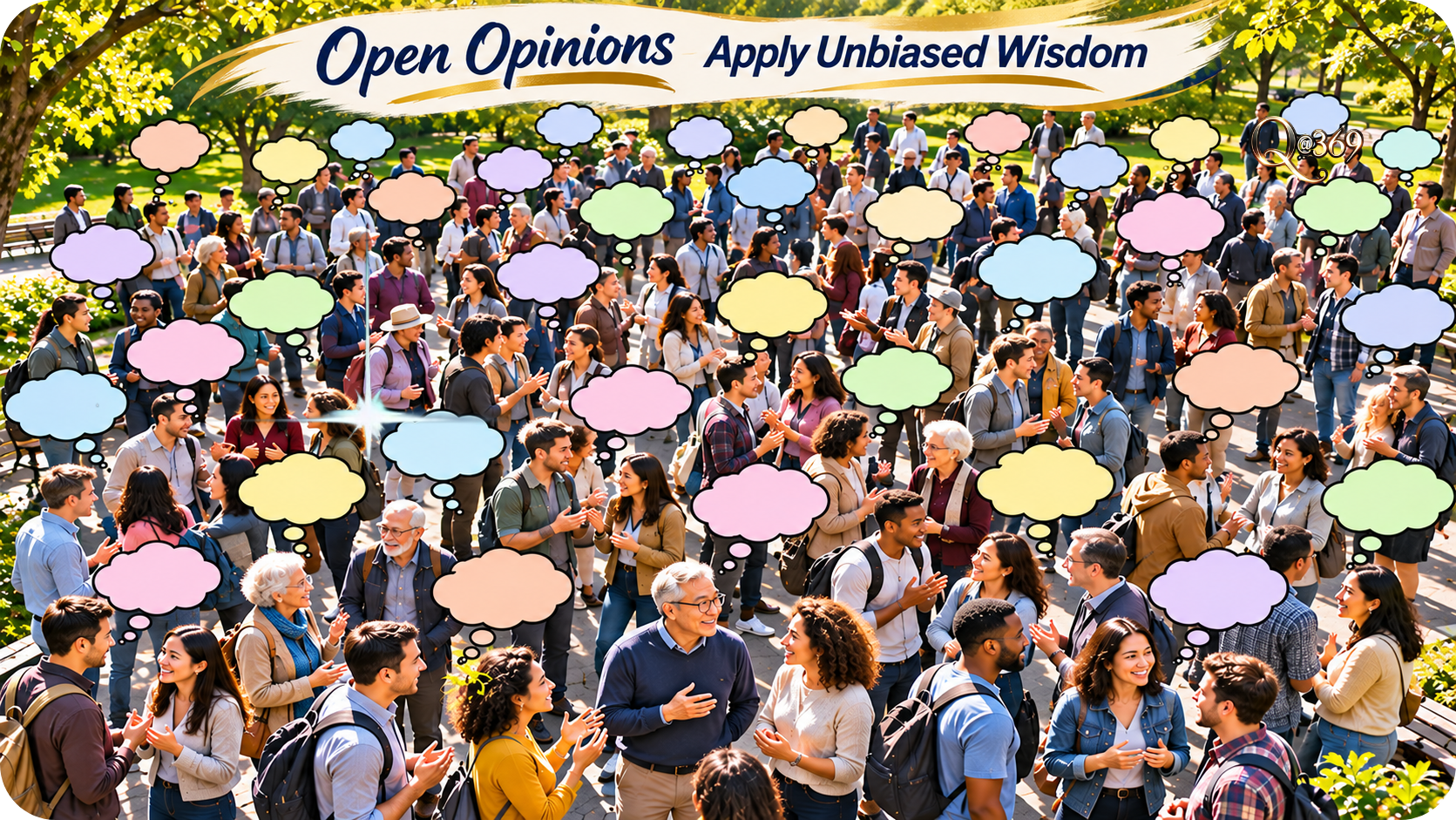
Understanding How Experience, Emotion, And Information Shape Our Views
“Our opinions reflect what we have experienced. Our wisdom grows when we remain willing to question them.” — Isaac Yue
Why do two people experience the same event and develop completely different opinions?
Our opinions emerge through personal experiences, emotions, social influences, and the information we encounter. Understanding these influences helps us evaluate our views, recognize assumptions, and remain open to new evidence.
- How personal experiences influence the opinions we develop.
- Why emotions can strengthen or distort our judgments.
- How family, friends, and communities shape our perspectives.
- The differences between facts, evidence, beliefs, and opinions.
- How thoughtful reflection can help us reconsider an opinion.
✨Listen to: AUDIO PODCAST or on SPOTIFY
🙏 Join Our Community Today!
💞 Share with Friends and Colleagues
Our Opinions Have A History
Think about an opinion you hold strongly. Perhaps it concerns a favorite restaurant, a community issue, or the best way to solve a problem. You probably did not develop that opinion from a single source. Experiences, conversations, emotions, and information contributed to your conclusion.
Opinions often feel personal and independent. However, they develop through ongoing interactions between our minds and the world around us. Understanding this process provides a practical benefit. We can examine why we believe something before deciding how strongly to defend it.
Experience Shapes Our First Impressions
Imagine visiting a new restaurant with friends. Your meal arrives late, the food is disappointing, and the service feels inattentive. You leave with a negative opinion of the restaurant. Your judgment reflects an actual experience, although that experience represents only one visit.
Another customer visits the following evening. The service is excellent, and the food exceeds expectations. Both customers develop opinions based on personal experiences. Neither experience necessarily describes the restaurant’s usual performance.
Our experiences provide valuable information. However, limited experiences can produce conclusions that extend beyond the available evidence. A useful question is whether our experience represents a consistent pattern or an isolated event.
Emotions Influence What We Remember
Emotions affect how we interpret experiences and remember their details. A joyful family gathering may leave us with a favorable impression of a location. A stressful encounter at that same location may produce the opposite response. The physical setting remains unchanged, although our emotional experiences influence the meaning we attach to it.
Psychological research shows that emotions can influence judgment and decision making. Feelings may draw attention toward certain details while reducing attention to others. This does not mean emotions are unreliable or unimportant. They provide information about our concerns, preferences, and experiences.
However, an emotional reaction does not automatically establish whether a factual claim is true. When an opinion feels especially strong, consider whether emotion is influencing your conclusion. Recognizing that influence can help you examine the situation more carefully.
Social Influences Shape Our Perspectives
From childhood, we learn through parents, teachers, friends, and communities. These relationships help us understand customs, expectations, and acceptable behavior. They also introduce opinions that we may adopt without independently examining them.
Consider a family that has supported the same baseball team for generations. Children may develop enthusiasm for that team before attending their first game. Their preference grows through shared experiences and family identity. Over time, personal experiences may reinforce or change that preference.
Social influence is not necessarily harmful. Communities transmit valuable knowledge, traditions, and practical wisdom. Problems arise when belonging becomes more important than evaluating information. We may hesitate to question a familiar opinion when disagreement threatens our sense of acceptance.
Recognizing social influence helps us distinguish personal judgment from inherited assumptions. We can appreciate the people who shaped our views while examining those views independently.
Information Can Strengthen Or Distort An Opinion
We encounter information through books, conversations, podcasts, news reports, and social media. Some information comes from direct observation. Other information reaches us through trusted sources or chains of repeated claims.
The pathway matters, although it does not automatically determine accuracy. Direct observers can misunderstand events, and secondhand reports can accurately communicate established facts. What matters is whether the information can be supported through reliable evidence.
Repeated exposure also influences familiarity. A statement heard many times may begin to feel more credible, even without additional supporting evidence. This phenomenon is associated with the illusory truth effect. Familiarity can influence our confidence without establishing accuracy.
Therefore, information should be evaluated according to its evidence rather than its popularity or familiarity. Before accepting a claim, ask where it originated and whether independent evidence supports it.
Facts, Evidence, Beliefs, And Opinions
These four concepts are related, although they are not interchangeable. Understanding their differences helps us recognize when personal judgment is being presented as established knowledge.
Facts
A fact describes something that is true about the world, regardless of personal preference. For example, Earth completes one orbit around the Sun in approximately one year. This statement concerns an observable physical relationship.
Our knowledge of facts depends on observation, measurement, and reliable methods of investigation. A factual statement remains open to examination, even when supported by extensive scientific evidence.
Evidence
Evidence consists of observations, measurements, records, or other information used to evaluate a claim. Astronomical observations provide evidence about Earth’s orbital motion. Different forms of evidence can strengthen or weaken a proposed explanation.
Evidence does not always establish certainty. Its quality, relevance, and limitations must be considered. Strong conclusions require evidence appropriate to the claim being examined.
Beliefs
A belief is something a person accepts as true. Beliefs may concern scientific claims, personal expectations, moral principles, or spiritual understandings. Some are strongly supported by evidence, while others depend on faith, tradition, or personal interpretation.
A belief can change when new experiences or information challenge its foundation. However, deeply held beliefs may also remain stable despite conflicting information.
Opinions
An opinion expresses a person’s judgment, evaluation, preference, or interpretation. For example, someone may believe that baseball is the most exciting sport. That opinion reflects personal preferences rather than a universally measurable fact.
Other opinions involve factual assumptions that can be tested. A person might argue that a particular community program is effective. Evidence about participation, costs, and outcomes can help evaluate that judgment.
An opinion may be informed by facts without becoming a fact itself.
Understanding these distinctions helps us communicate more accurately. We can identify what we know, what we believe, and what remains open to interpretation.
Why Do We Defend Our Opinions?
Opinions sometimes become connected to personal identity. We may associate a viewpoint with our family, community, accomplishments, or previous decisions. Questioning that opinion can feel uncomfortable, especially when it has influenced important choices.
Psychologists study confirmation bias, our tendency to favor information that supports existing beliefs or expectations. Imagine someone convinced that a particular exercise routine is the most effective. They may remember favorable stories while overlooking evidence that other approaches work equally well for different people.
This selective attention can strengthen confidence without improving accuracy. Recognizing confirmation bias provides an opportunity to examine information more fairly. We can deliberately consider evidence that challenges our current position.
Can Opinions Really Change?
Yes, opinions can change through new experiences, credible information, thoughtful conversations, and personal reflection. However, change is not automatic. People may resist information that conflicts with deeply held beliefs or social identities.
Consider someone who believes that younger and older generations cannot work effectively together. A successful community project involving several generations may challenge that assumption. Direct cooperation provides experiences that the original opinion did not account for.
The person may gradually recognize that individual abilities matter more than age alone. Changing an opinion does not necessarily mean the original judgment was unreasonable. It may reflect the availability of new information.
Intellectual humility allows us to recognize that our understanding can improve. We can remain confident in well supported conclusions while acknowledging the possibility of revision.
A Practical Exercise: Examine One Opinion
Choose an opinion you hold about an everyday subject. Avoid beginning with your most emotionally charged disagreement. Start with something manageable, such as a preferred routine, hobby, or community activity.
Then consider these five questions:
- Origin: Where did this opinion begin?
- Experience: Which personal experiences influenced it?
- Emotion: What feelings strengthen my attachment to it?
- Evidence: What reliable information supports or challenges it?
- Revision: What would reasonably cause me to reconsider?
You do not need to abandon your opinion. The purpose is to understand its foundation and evaluate its strength. Sometimes reflection reinforces a well supported conclusion. Other times, it reveals assumptions that deserve reconsideration.
Both outcomes can improve our understanding. The goal is thoughtful evaluation rather than changing opinions simply for the sake of change.
Quantum Alchemy: Awareness And The Freedom To Reconsider
Quantum Alchemy encourages us to examine how awareness influences our everyday choices. Our opinions emerge from interactions among experience, memory, emotion, and social understanding. These processes belong to psychology and human cognition.
Quantum physics does not establish that our thoughts create external facts. Scientific observations and personal interpretations must remain distinct. However, philosophical reflection can help us consider how our perspectives influence our experiences. When we recognize the influences behind an opinion, we gain greater freedom to evaluate it. Awareness does not require agreement with everyone. It encourages thoughtful judgment and openness to learning.
Isaac Yue Reflection: Learning Through Different Perspectives
I enjoy conversations with people whose experiences differ from my own. Whether discussing community activities, books, or everyday decisions, I often discover perspectives I had not considered. Sometimes a person explains an experience that challenges my original understanding.
I may not immediately change my opinion, although the conversation gives me something valuable to examine. Listening allows me to understand how someone else reached a different conclusion. That understanding can be worthwhile even when our opinions remain different.
I have also noticed how personal enthusiasm can influence judgment. Baseball provides a familiar example. Supporting a team creates excitement, expectations, and emotional investment in every game.
A close play may appear obvious to one group of fans and questionable to another. The event is the same, although emotional attachment influences how people interpret it. These experiences remind me that confidence and accuracy are different qualities.
I value conversations where people can disagree respectfully while remaining curious about one another’s reasoning. Changing an opinion can represent growth rather than defeat. Sometimes the most meaningful discovery is understanding why another person sees something differently.
Your Tuesday Morning Practice
Today, identify one opinion you have held for several years. Ask yourself whether it originated through direct experience, trusted information, or repeated social influence. Then identify one piece of evidence or one alternative perspective worth examining.
You do not need to reach a different conclusion today. Simply practice separating what you know from what you assume. This small exercise can strengthen critical thinking and encourage more meaningful conversations.
Closing Reflection: Opinions Can Evolve With Understanding
Our opinions reflect the experiences, emotions, relationships, and information that shape our lives. Some opinions remain stable through years of examination. Others change when new evidence or meaningful experiences expand our understanding.
The ability to reconsider an opinion is not a weakness. It reflects curiosity, intellectual humility, and a willingness to learn. Thoughtful evaluation allows us to remain confident without becoming closed to new understanding.
A thoughtful mind does not change every opinion. It remains willing to examine every opinion.
What opinion have you changed during your life, and what experience helped you reconsider it? Share your experience in the Quantumarian Community. Your perspective may help another reader examine an assumption from a different direction.
Find Your Quantum

References
- Lerner, J. S., Li, Y., Valdesolo, P., & Kassam, K. S. (2015). Emotion and Decision Making. Annual Review of Psychology, 66, 799–823. DOI: 10.1146/annurev-psych-010213-115043
- Nickerson, R. S. (1998). Confirmation Bias: A Ubiquitous Phenomenon in Many Guises. Review of General Psychology, 2(2), 175–220. DOI: 10.1037/1089-2680.2.2.175
- Hasher, L., Goldstein, D., & Toppino, T. (1977). Frequency and the Conference of Referential Validity. Journal of Verbal Learning and Verbal Behavior, 16(1), 107–112. DOI: 10.1016/S0022-5371(77)80012-1
See more of QuantumAlchemist369™ selected self-empowerment knowledge selections on the Book Shelf

Pioneers of Quantum Physics

Interactive Live Meetups
Thursday 7PM EDT Live Q&A with Isaac Yue
Join the Live Meetup Community discussion.
QA369 Forum – Empower Your Life
Join the Conversation? Start sharing your insights today! On our Quantumarian Forum Page


Leave a Reply