
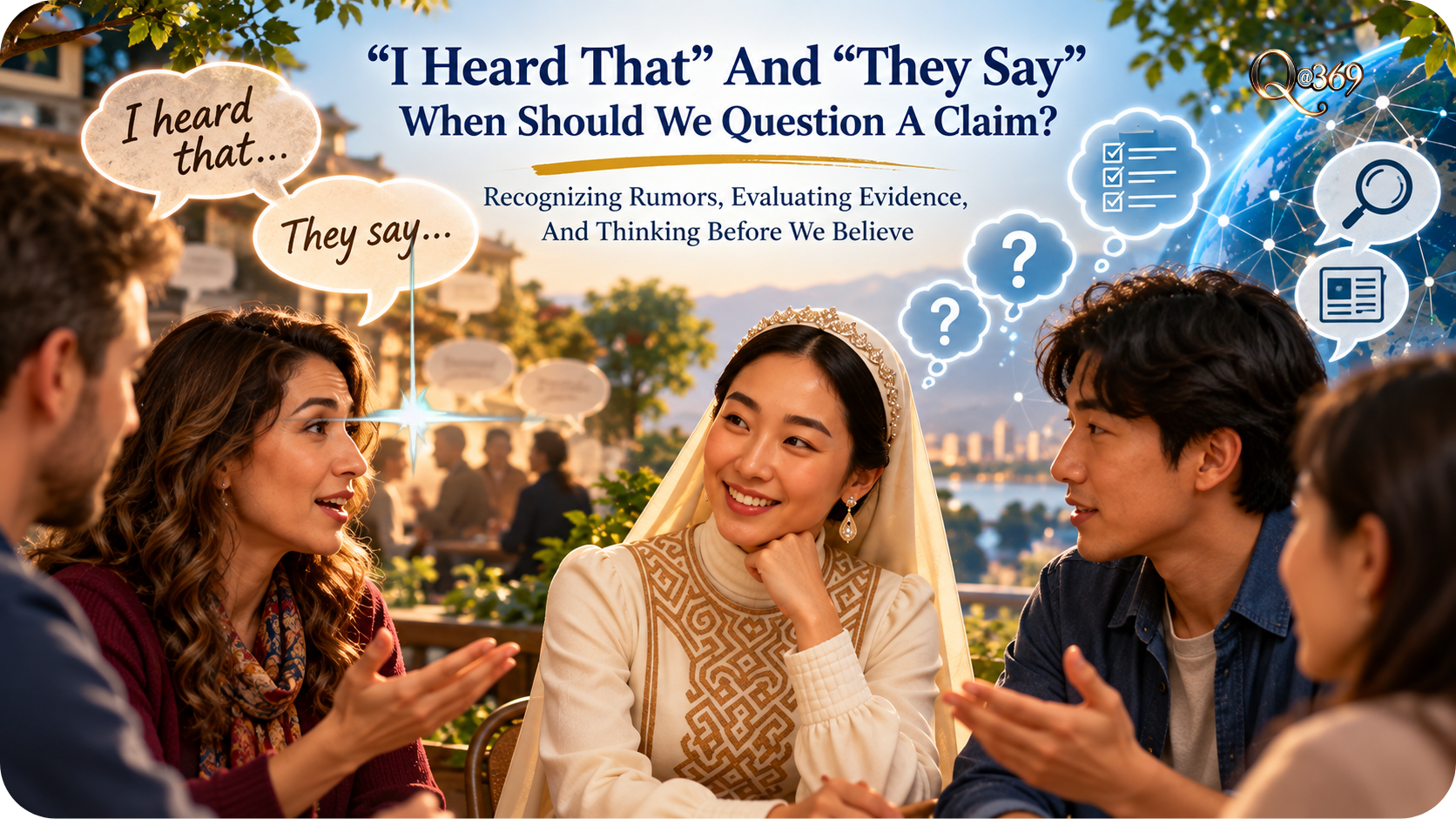
Recognizing Rumors, Evaluating Evidence, And Thinking Before We Believe
“Information is what we receive. Knowledge is what we can reasonably establish as true through evidence, experience, and thoughtful examination.” — Isaac Yue
How often do we accept information simply through hearing someone else repeat it?
Statements beginning with “I heard that” or “They say” can influence our beliefs without providing reliable evidence. Learning to recognize these claims helps us make informed decisions and communicate more responsibly.
- Repeated claims can feel credible even when supporting evidence is missing.
- Familiarity, confidence, and social agreement do not establish factual accuracy.
- Identifying the original source helps distinguish evidence from hearsay.
- Questions about context, expertise, and verification improve critical thinking.
- Responsible communication includes acknowledging uncertainty and correcting mistakes.
✨Listen to: AUDIO PODCAST or on SPOTIFY
🙏 Join Our Community Today!
💞 Share with Friends and Colleagues
The Familiar Sound Of An Unverified Claim
Imagine a conversation with friends. Someone mentions an interesting claim about health, technology, or an event in the community.
The statement begins with familiar words: “I heard that…” Another person responds, “Yes, they say that is true.”
Soon, several people repeat the information. Nobody remembers where the original claim began.
This situation is common in everyday conversations. Information travels through families, workplaces, social networks, and online communities.
We naturally depend on information shared by other people. Nobody can personally investigate every subject or witness every event.
However, trusting others and evaluating evidence are different activities. Recognizing that distinction helps us become more thoughtful listeners.
Why Repetition Can Make Something Feel True
Our minds use familiarity when processing information. Statements encountered repeatedly often become easier to recognize and understand.
Psychologists study this tendency through the illusory truth effect. Repetition can increase a statement’s perceived truthfulness, even without additional supporting evidence.
Consider a rumor circulating through a neighborhood. One person mentions it during a morning walk.
Later, someone repeats the same story at a community gathering. A third person shares it through a neighborhood message group.
By the evening, the claim may feel established. Yet all three accounts might originate from the same unverified conversation.
Three repetitions do not necessarily represent three independent sources. Recognizing this difference can prevent a rumor from becoming an accepted belief.
When Confidence Sounds Like Evidence
Some statements sound convincing through the speaker’s confidence. A firm voice, precise numbers, or technical vocabulary can create an impression of authority.
However, confidence and accuracy are not the same. People can express incorrect information with complete certainty.
Consider someone claiming that a particular food improves memory by 40 percent. The precise number makes the statement sound scientific.
Yet several important questions remain unanswered. What research supports the claim, and how was memory measured?
Who participated in the study? Was the result reproduced by independent researchers?
A credible scientific claim requires more than an impressive statistic. It needs evidence appropriate to the conclusion being presented.
We do not need advanced scientific training to ask these questions. Curiosity and careful attention provide a useful starting point.
Hearsay, Personal Experience, And Verified Information
Hearsay involves information received from another person rather than directly observed or independently verified.
Personal experience provides a different kind of information. Someone may accurately describe what happened to them without establishing a general rule.
Imagine a friend reporting that a particular exercise improved their sleep. Their experience may be genuine and meaningful.
However, one person’s improvement does not establish that the exercise will produce identical results for everyone.
Scientific research can investigate broader patterns through systematic observation and testing. Reliable conclusions depend on research methods, evidence quality, and appropriate interpretation.
These distinctions help us evaluate claims fairly. We can respect someone’s experience without treating it as universal proof.
The Influence Of Social Agreement
People naturally pay attention to the opinions and behavior of others. Social agreement can help us navigate unfamiliar situations.
However, agreement within a group does not guarantee accuracy. People may repeat information to maintain harmony or demonstrate belonging.
Imagine several friends discussing a controversial claim. Everyone appears convinced, although nobody has examined the original evidence.
A person who feels uncertain may remain silent. The group’s apparent agreement becomes stronger without any new information.
This illustrates an important challenge. Social acceptance can influence what we express, even when private doubts remain.
A thoughtful question can change the conversation. Asking where information originated invites examination without attacking the person sharing it.
Five Questions Before Accepting A Claim
Critical thinking does not require rejecting every unfamiliar statement. It involves evaluating information before deciding how much confidence it deserves.
These five questions offer a practical method.
1. Who Is The Original Source?
Identify where the claim first appeared. A named researcher, official document, or firsthand account provides more information than an anonymous rumor.
2. What Evidence Supports It?
Look for observations, records, research, or other relevant documentation. Distinguish evidence from opinions and personal interpretations.
3. Is The Source Qualified And Accountable?
Consider the source’s expertise and whether its claims can be examined. Expertise matters most when it relates directly to the subject.
4. Can Independent Sources Confirm It?
Look for genuinely independent verification. Multiple websites repeating the same unsupported statement do not establish independent confirmation.
5. What Information Might Be Missing?
Consider the original context, important qualifications, and alternative explanations. A technically accurate statement can still mislead when essential details are omitted.
These questions do not guarantee perfect conclusions. They improve our ability to recognize uncertainty and make more informed judgments.
Quantum Alchemy: Awareness Before Acceptance
Quantum Alchemy encourages us to examine how knowledge, experience, and awareness influence our understanding of everyday life.
The difference between hearing a claim and understanding its evidence offers a practical example.
Our minds interpret information through previous experiences, expectations, and social influences. These psychological processes can affect what we accept as credible.
Awareness helps us recognize those influences. We can notice when familiarity, emotion, or group agreement shapes our judgment.
Scientific reasoning then provides methods for evaluating evidence. Philosophical reflection encourages us to consider the limits of our knowledge.
Together, these approaches support intellectual humility. We can remain curious without accepting every claim or dismissing every unfamiliar idea.
Isaac’s Reflection: A Story Shared Among Friends
During conversations with friends and neighbors, I occasionally hear an interesting story introduced with “They say.”
Sometimes the information concerns a community event. Other times, someone shares an unusual claim about science or everyday life.
I enjoy these conversations, especially when people bring different experiences and perspectives. However, I have learned to distinguish an interesting story from an established fact.
A simple question often changes the direction of the discussion. I might ask, “Where did you hear that?”
Sometimes the person remembers a reliable source. Other times, we discover that the story has traveled through several conversations.
I appreciate moments when curiosity replaces certainty. Nobody needs to feel embarrassed about not knowing the complete answer.
We can enjoy sharing ideas while remaining willing to investigate them. That willingness makes conversations more meaningful and respectful.
A Sunday Evening Practice: Follow One Claim
Choose one interesting claim you encountered recently. It might concern health, science, technology, or a community event.
Write the claim in one clear sentence. Then identify where you first encountered it.
Try locating the original source. Examine whether the available evidence supports the statement as presented.
If you find conflicting information, compare the sources and their methods. Notice whether the disagreement concerns facts, interpretations, or missing context.
Finally, consider how confidently you can describe the claim. You may discover that the most accurate answer includes some uncertainty.
This exercise requires only a few minutes. It can strengthen a habit that benefits future conversations and decisions.
Closing Reflection: Curiosity Deserves Evidence
Information reaches us through conversations, news reports, social networks, and personal experiences. Much of it helps us understand the world.
However, repetition and confident presentation do not guarantee accuracy. Reliable understanding requires attention to sources, evidence, context, and uncertainty.
We do not need to challenge every casual remark. We can learn to recognize claims that deserve closer examination.
The next time someone begins with “I heard that” or “They say,” listen with curiosity. Then consider what evidence would help establish the claim.
When was the last time you questioned something everyone around you seemed to accept?
Share your experience in the Quantumarian Community. Your reflection may encourage someone else to examine a familiar assumption.
Find Your Quantum

References
- Hasher, L., Goldstein, D., & Toppino, T. (1977). Frequency and the Conference of Referential Validity. Journal of Verbal Learning and Verbal Behavior, 16(1), 107–112. https://doi.org/10.1016/S0022-5371(77)80012-1
- Cialdini, R. B., & Goldstein, N. J. (2004). Social Influence: Compliance and Conformity. Annual Review of Psychology, 55, 591–621. https://doi.org/10.1146/annurev.psych.55.090902.142015
- Pennycook, G., & Rand, D. G. (2019). Lazy, Not Biased: Susceptibility to Partisan Fake News Is Better Explained by Lack of Reasoning Than by Motivated Reasoning. Cognition, 188, 39–50. https://doi.org/10.1016/j.cognition.2018.06.011
See more of QuantumAlchemist369™ selected self-empowerment knowledge selections on the Book Shelf

Pioneers of Quantum Physics

Interactive Live Meetups
Thursday 7PM EDT Live Q&A with Isaac Yue
Join the Live Meetup Community discussion.
QA369 Forum – Empower Your Life
Join the Conversation? Start sharing your insights today! On our Quantumarian Forum Page


Leave a Reply