
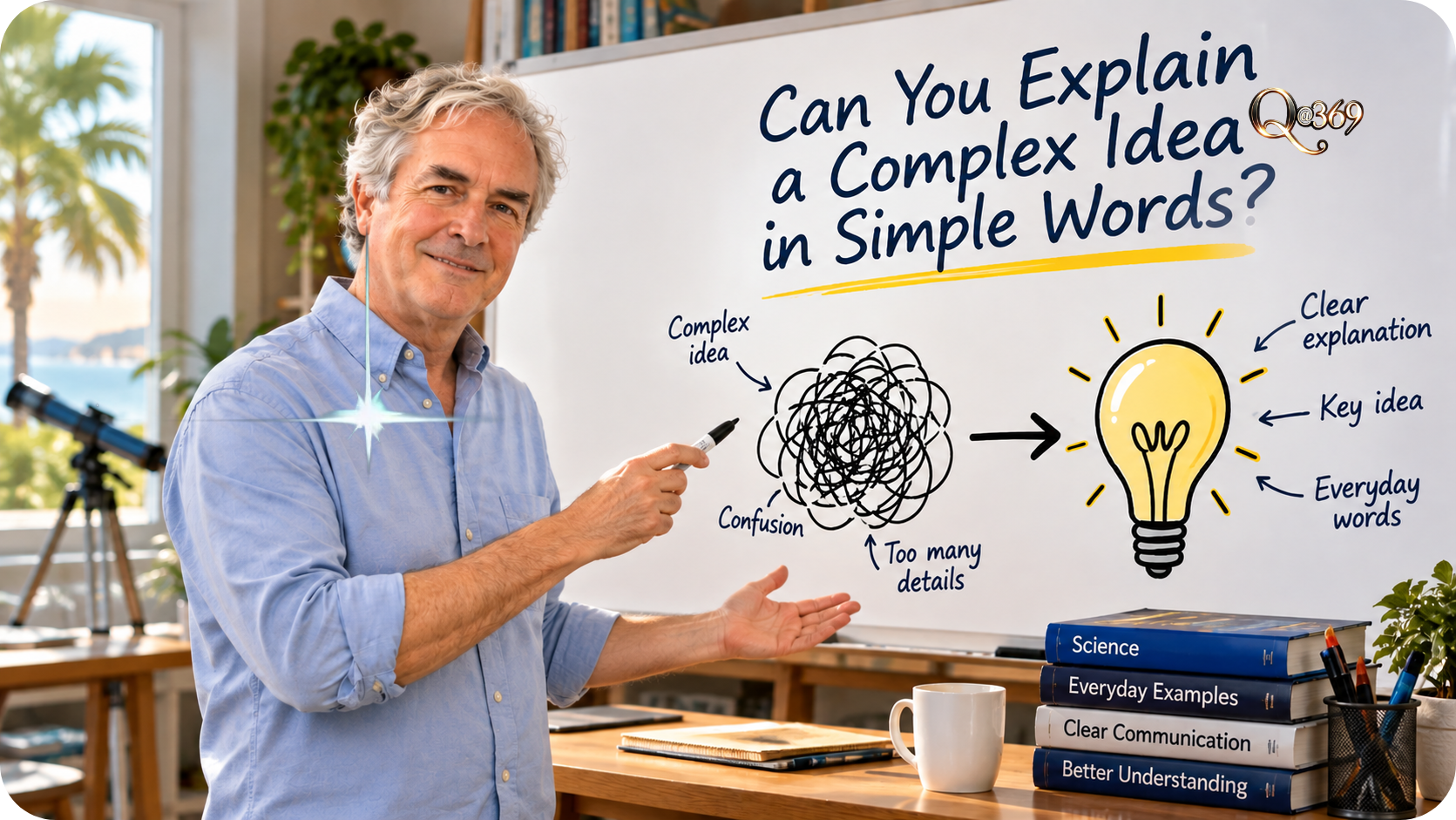
Why Clear Explanations Reveal What We Understand And What We Still Need To Learn

If you understand something well enough to use it, does that mean you can explain it clearly to someone else?
Explain an idea simply reveals what we understand, exposes missing connections, and helps others learn without unnecessary confusion.
- Clarity: Simple explanations make important ideas easier to understand without removing essential meaning.
- Self Explanation: Explaining how something works can strengthen learning and reveal gaps in understanding.
- Cognitive Load: Unnecessary complexity can consume mental resources needed for learning.
- The Illusion Of Understanding: Familiarity with a subject does not always mean we can explain its underlying mechanisms.
- Everyday Communication: Clear explanations improve conversations, teamwork, teaching, and decision making.
- Practical Benefit: Testing an explanation with another person helps identify what needs further learning.
✨Listen to: AUDIO PODCAST or on SPOTIFY
🙏 Join Our Community Today!
💞 Share with Friends and Colleagues
Knowing The Words Is Not The Same As Understanding The Idea
Imagine someone asking you to explain how a bicycle stays balanced while moving. You have probably seen thousands of bicycles, and you may have ridden one for years. The question sounds simple until you try explaining the underlying mechanisms.
You might mention the wheels, handlebars, speed, and balance. Yet explaining how these elements interact requires more than naming familiar parts. You must connect the ideas in a way another person can follow.
This difference appears in many everyday situations. We may know how to operate a smartphone, follow a recipe, or use a financial service. Explaining how these systems actually work can reveal unexpected gaps in our knowledge.
Familiarity makes an idea recognizable. Understanding helps us explain relationships, causes, and consequences.
Why Complex Explanations Can Become Confusing
Some subjects are genuinely complicated. Medicine, economics, engineering, and physics often involve relationships that require careful explanation. Making these subjects accessible does not mean pretending their complexity has disappeared.
The challenge is deciding which information the listener needs first. An explanation filled with unfamiliar terminology can overwhelm someone before the central idea becomes clear. Too many details may also distract from the relationship we are trying to communicate.
Cognitive load theory examines how the limits of working memory influence learning. When explanations require learners to process unnecessary information, fewer mental resources remain available for understanding essential concepts.
A clear explanation introduces the main idea, establishes useful connections, and adds detail when needed. This sequence helps learners build understanding without confronting every complication at once.
What Happens When We Try To Explain Something?
Psychologists Leonid Rozenblit and Frank Keil investigated a phenomenon called the illusion of explanatory depth. Their research found that people often believe they understand familiar systems more completely than they actually do.
Participants initially rated their understanding of everyday mechanisms. After attempting detailed explanations, many recognized that their knowledge was less complete than they had assumed.
The research reveals an important distinction between recognizing an object and explaining its operation. We can feel confident about familiar subjects without understanding every relevant connection.
Trying to explain an idea can therefore become a useful learning exercise. It helps us discover where confidence exceeds our ability to describe how something works.
Simple Words Require Careful Thinking
Consider two explanations of a household thermostat.
The first might describe sensors, electronic controls, temperature thresholds, and heating system activation. These details may be appropriate for someone studying the equipment.
A simpler explanation begins with the main relationship.
A thermostat measures the surrounding temperature and compares it with the temperature you selected. When the room becomes too cold, it can signal the heating system to turn on. When the desired temperature is reached, it can signal the system to stop heating.
This explanation does not cover every type of thermostat or heating system. It establishes the central function before introducing additional technical details.
The goal is not to eliminate important information. It is to organize information so the listener can understand one meaningful connection at a time.
Why Explaining Can Improve Learning
Research on self explanation examines what happens when learners explain material to themselves while studying. Instead of merely repeating information, they consider how new ideas connect with what they already know.
Michelene Chi and colleagues studied students learning about human circulation. Their research found that students who generated more useful self explanations developed stronger understanding of the material.
Explaining requires us to identify relationships that passive reading may leave unexamined. We must decide what causes an event, how a process develops, and which information supports our conclusions.
This does not mean that every explanation improves learning automatically. An incorrect explanation can reinforce a misunderstanding when it is never checked. Verification remains an essential part of the process.
The Difference Between Simplicity And Oversimplification
A simple explanation should preserve the most important relationships. Oversimplification occurs when removing details creates a misleading understanding.
For example, we often describe electricity as water flowing through a pipe. This comparison can introduce the idea of current moving through a circuit. Yet electrical systems involve physical processes that the water comparison cannot represent accurately.
Analogies are useful starting points when their limitations are understood. They help connect unfamiliar concepts with familiar experiences, although they are not complete descriptions.
A responsible explanation identifies where a comparison works and where it stops working. Scientific accuracy remains important even when the language is simple.
Isaac Yue Reflection | Explaining Ideas To Different People
Writing for QuantumAlchemist369 has made me more attentive to the difference between knowing a subject and communicating it. Readers arrive with different experiences, interests, and levels of familiarity. An explanation that works for one person may confuse another.
When I write about science, I often begin by asking what practical question a reader might have. I then consider which scientific details are essential for answering that question. This approach helps me avoid introducing technical language before establishing its meaning.
I have also found that conversations with people from different backgrounds can improve my explanations. Their questions reveal assumptions I may have overlooked. Sometimes the most useful question is simply, “What does that mean in everyday life?”
For me, Quantum Alchemy includes making useful knowledge accessible. Awareness grows when we can connect an idea with something meaningful in our daily experiences.
A Practical Method For Explaining Complex Ideas
The next time someone asks you to explain a difficult subject, try this four step approach.
1. Begin With The Central Idea
Describe the subject in one or two clear sentences. Identify what it does, why it matters, or what problem it addresses.
Avoid beginning with a long history or unfamiliar terminology. Establish the main concept before introducing supporting details.
2. Connect It With Something Familiar
Choose an everyday example that illustrates an important relationship. A useful comparison can help the listener connect new information with existing knowledge.
Explain the comparison’s limitations when necessary. Familiar examples should support accuracy rather than replace it.
3. Explain One Connection At A Time
Describe how the important parts relate to one another. Introduce technical terms only when they help clarify the explanation.
Notice whether each sentence prepares the listener for the next idea. If the explanation becomes difficult to follow, return to the central concept.
4. Invite Questions And Check Understanding
Ask the listener what remains unclear. Encourage them to describe the idea using their own words.
Their response may reveal missing connections in your explanation. If necessary, revise the explanation and verify important details against reliable information.
When A Simple Explanation Is Not Enough
Some ideas cannot be explained completely in a few sentences. A medical diagnosis, scientific theory, or financial agreement may require considerable detail. Important qualifications should not disappear merely to make an explanation shorter.
A useful explanation can begin simply and become more detailed as understanding develops. The listener first learns the central relationship, then examines exceptions, evidence, and limitations.
Clarity is not measured only by the number of words used. It is measured by whether the explanation communicates the intended meaning accurately.
Sometimes the clearest answer includes an admission that further investigation is needed. Recognizing what we do not yet understand is part of responsible learning.
The Quantumarian Connection | Understanding Through Clarity
Quantum Alchemy encourages curiosity, evidence based thinking, and practical awareness. Clear explanations support these principles by making ideas easier to examine and discuss.
When we explain something to another person, we also examine our own understanding. Questions may reveal missing information, unsupported assumptions, or a better way to organize what we know.
This is especially important when discussing quantum physics. Scientific concepts should remain connected to established evidence, even when everyday examples make them easier to understand.
Understanding is not demonstrated by complicated vocabulary. It becomes more useful when we can communicate an idea accurately and recognize its limitations.
Conclusion | Clarity Is A Test Of Understanding
Explaining a complex idea in simple words requires more than shortening sentences. We must identify essential relationships, organize information, and consider what another person needs to understand.
The process can also reveal gaps in our own knowledge. When an explanation becomes difficult, the problem may involve missing understanding rather than missing vocabulary.
We do not need to know everything before sharing an idea. We do need the curiosity to question our explanations and the willingness to improve them.
Reflection Question: What familiar subject would become surprisingly difficult if someone asked you to explain exactly how it works?
Today’s Practical Action: Choose one idea you believe you understand. Explain it aloud in sixty seconds, using everyday language. Identify one question you cannot answer confidently, then investigate it.
Clearer explanations can improve both our learning and our connections with others.
Find Your Quantum.

References
- Rozenblit, L., & Keil, F. (2002). The Misunderstood Limits Of Folk Science: An Illusion Of Explanatory Depth..Cognitive Science, 26(5), 521–562..https://doi.org/10.1207/s15516709cog2605_1
- Chi, M. T. H., de Leeuw, N., Chiu, M. H., & LaVancher, C. (1994)..Eliciting Self Explanations Improves Understanding..Cognitive Science, 18(3), 439–477..https://doi.org/10.1207/s15516709cog1803_3
- Sweller, J. (1988)..Cognitive Load During Problem Solving: Effects On Learning..Cognitive Science, 12(2), 257–285..https://doi.org/10.1207/s15516709cog1202_4
See more of QuantumAlchemist369™ selected self-empowerment knowledge selections on the Book Shelf


Interactive Live Meetups
Thursday 7PM EDT Live Q&A with Isaac Yue
Join the Live Meetup Community discussion.
QA369 Forum – Empower Your Life
Join the Conversation? Start sharing your insights today! On our Quantumarian Forum Page


Leave a Reply