
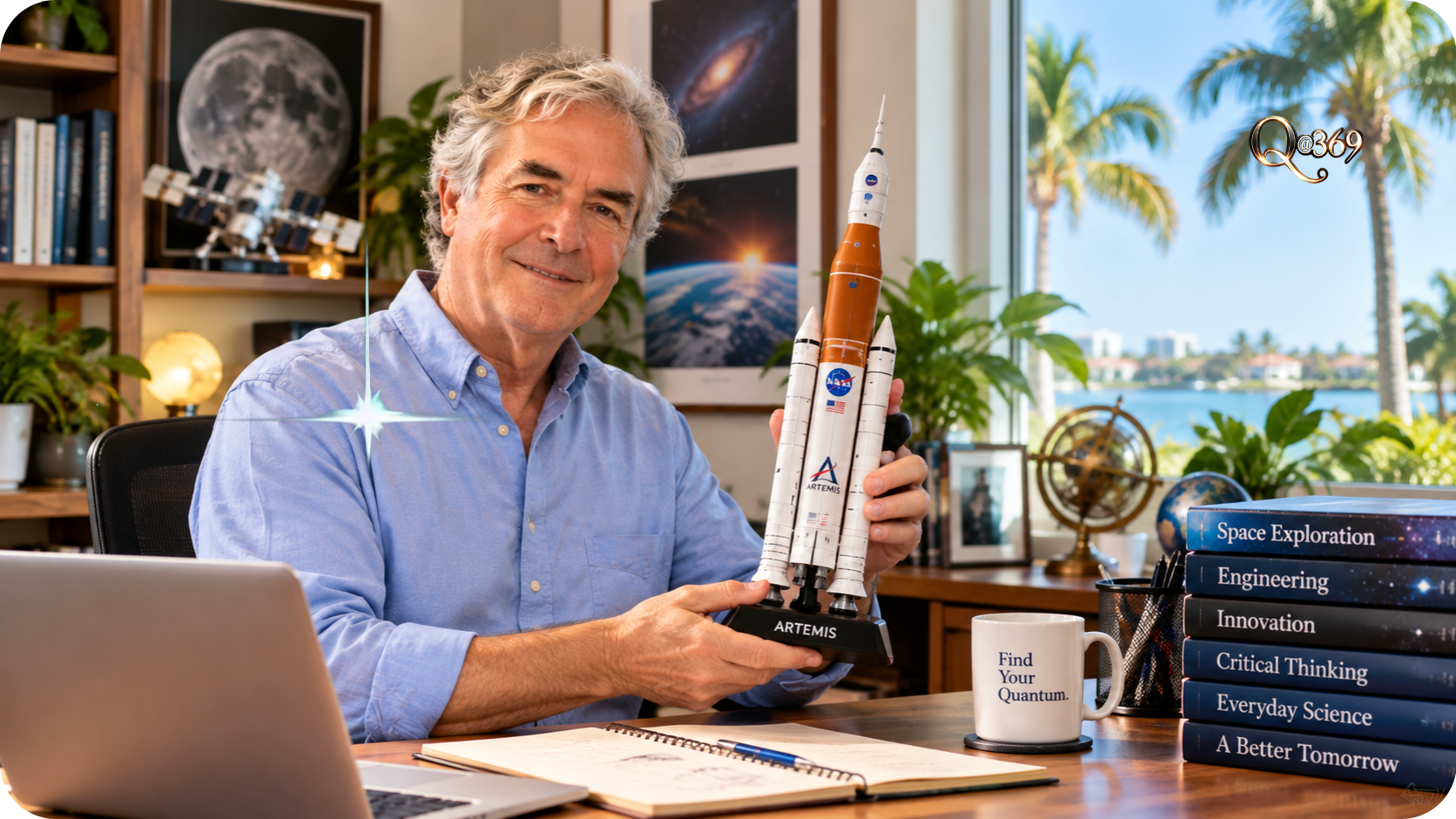
From Asking Questions And Testing Ideas To A Lifetime Of Curiosity And Quantum Alchemy

What if the most valuable result of your career is not what you accomplished, but how it prepared you for something unexpected?
Engineering taught me to question assumptions, validate results, and remain curious while discovering new ways to apply knowledge.
- Questioning Assumptions: Asking thoughtful questions helps reveal what we know and what still needs investigation.
- Evidence And Validation: Testing results provides a stronger foundation for decisions than confidence alone.
- Logical Thinking: Organizing information helps us reach conclusions supported by evidence.
- Continuous Learning: New technologies and unfamiliar experiences create opportunities for personal growth.
- Open Mindedness: Experience becomes more valuable when we remain willing to reconsider our understanding.
- Quantum Alchemy: Scientific thinking can support practical awareness, curiosity, and thoughtful everyday living.
✨Listen to: AUDIO PODCAST or on SPOTIFY
🙏 Join Our Community Today!
💞 Share with Friends and Colleagues
Engineering Taught Me To Begin With Questions
When I began working in engineering, I expected to spend much of my career solving technical problems. I soon discovered that finding solutions required more than understanding how equipment and systems operated. The most important work often began before anyone attempted a solution.
It began with asking questions.
What is the problem we are actually trying to solve? What information do we have? Which assumptions are we making, and how can we determine whether they are correct?
These questions became familiar companions throughout my career. They helped me organize complicated situations into smaller problems that could be investigated. They also taught me that a confident answer is not necessarily a correct answer.
I learned to approach problems with curiosity before reaching conclusions. That habit gradually became part of how I think beyond engineering.
A Good Question Is More Valuable Than A Quick Answer
Technical problems do not always reveal their causes immediately. A system may behave differently from expectations, even when every component appears to be functioning correctly. The first explanation that comes to mind may not identify the actual problem.
I learned to resist the temptation to accept the most convenient explanation. Instead, I would examine the available information, identify possible causes, and determine what additional evidence was needed. Each useful question helped narrow the possibilities.
This approach required patience. Sometimes the investigation revealed that an assumption I had accepted was incorrect. Other times, the problem involved a relationship that had not been considered.
The experience taught me something that remains useful today. Asking a question does not demonstrate a lack of knowledge. It creates an opportunity to improve our understanding.
Learning New Technology Opened Unexpected Possibilities
Some of my most rewarding engineering experiences involved difficult problems that required unfamiliar technology. Existing methods did not always provide the results we wanted. Finding another approach meant learning something new.
I would study the technology, explore its capabilities, and consider how it might address the problem. Understanding its principles was only the beginning. The real challenge involved applying that knowledge and determining whether the results supported the approach.
There was particular satisfaction in seeing exceptional results after investing the effort to learn. A difficult problem could become an opportunity to discover a better method. The experience often revealed possibilities that had not been apparent at the beginning.
Those moments reinforced my belief in continuous learning. Knowledge becomes especially valuable when we remain willing to expand it and apply it in unfamiliar situations.
Why Validating Results Became Essential
Engineering taught me that an explanation should be supported by evidence. An idea may sound reasonable and still fail when tested. A result may appear successful until further examination reveals an important limitation.
Validation helps distinguish what we expect from what actually occurs. It may involve measurements, repeated tests, comparisons, or independent review. The specific method depends on the question being investigated.
Over time, I developed a habit of organizing information before forming conclusions. I wanted to understand what the evidence established and where uncertainty remained. This process helped me avoid treating assumptions as facts.
The same distinction matters in everyday life. We encounter claims about health, technology, relationships, and personal success. Before accepting an explanation, we can ask what evidence supports it and whether another interpretation is reasonable.
Logical Thinking Requires An Open Mind
Early in a technical investigation, it is tempting to become attached to a promising explanation. We invest time developing an idea, and that investment can make reconsidering it uncomfortable. Yet evidence does not change simply to accommodate our expectations.
Psychological research on confirmation bias shows that people can favor information supporting their existing beliefs. This tendency can affect professionals and beginners alike. Expertise does not make anyone automatically immune to biased judgment.
Engineering experience helped me appreciate the importance of testing conclusions rather than defending them. When new evidence challenged an earlier assumption, reconsidering the explanation became part of the work. A better conclusion was more valuable than preserving the original one.
As the years passed, I became more open minded about subjects beyond technology. I recognized that experience should expand our perspective rather than limit it. What we already know can provide a foundation for discovering what we have not yet considered.
Curiosity Did Not Remain At The Workplace
I gradually recognized that curiosity was influencing many parts of my life. I enjoyed learning unfamiliar subjects, trying new activities, and understanding how different ideas connected. The habit of asking questions followed me into everyday experiences.
Nature offers countless opportunities for this kind of observation. During a walk, I may notice changes in the sky, the behavior of wildlife, or patterns in the surrounding environment. Each observation can lead to another question.
Conversations provide a different opportunity to learn. People bring experiences and perspectives that cannot always be understood through technical analysis. Listening carefully often reveals information I would not have discovered by relying only on my own assumptions.
I have learned that curiosity is not limited to solving problems. Sometimes its greatest value comes from appreciating something unfamiliar without needing an immediate answer.
Scientific Thinking Has A Place In Everyday Living
Science and engineering rely on observation, evidence, and explanations that can be examined. These habits are useful far beyond laboratories and technical workplaces. They can help us make more informed decisions and recognize the limitations of our knowledge.
Yet everyday living involves more than technical reasoning. Relationships require empathy, patience, and respect for individual experiences. Personal choices also involve values, emotions, and priorities that cannot always be reduced to measurements.
I have become increasingly interested in how these different ways of understanding can work together. Scientific knowledge can help explain physical processes and human behavior. Personal awareness helps us consider how that knowledge may be applied responsibly. The goal is not to approach every conversation as an engineering problem. It is to carry useful habits of curiosity and careful reasoning into life while recognizing the importance of human experience.
Isaac Yue Reflection | Engineering Prepared Me For Something Unexpected
Engineering taught me to begin with questions rather than assumptions. When facing a difficult problem, I learned to investigate the evidence, validate results, and develop conclusions that could withstand careful examination. Those habits became part of how I approached unfamiliar situations.
Some of my most rewarding experiences involved learning new technologies and applying them to challenging problems. Discovering an unfamiliar approach required curiosity, patience, and a willingness to reconsider what I already knew. Seeing exceptional results from that effort reinforced the value of continuous learning.
Over the years, my thinking also became more open minded. I recognized that technical knowledge was only one part of understanding the world. People, relationships, nature, and everyday experiences offered opportunities to learn that were equally meaningful.
I did not anticipate that these experiences would eventually lead me toward QuantumAlchemist369. What began as a career in engineering has become a foundation for exploring science, sharing ideas, and connecting knowledge with practical living.
Today, I find satisfaction in applying what I have learned to a different purpose. Rather than solving only technical problems, I can encourage others to ask questions, examine evidence, and discover possibilities in their own lives. Perhaps the most valuable lesson engineering taught me is that learning does not end when a project is completed or a career changes direction. Curiosity can continue opening doors throughout our lives.
From Engineering To QuantumAlchemist369
QuantumAlchemist369 represents an unexpected opportunity to apply accumulated knowledge and experience in a different way. Instead of concentrating primarily on technical projects, I now explore questions that connect science with everyday life. Writing allows me to share what I have learned while continuing to investigate unfamiliar ideas.
A scientific concept may begin as a question about how nature works. Its practical connection may involve observation, communication, decision making, or personal awareness. These connections become more meaningful when they are explained clearly and supported by reliable evidence.
I also recognize that sharing knowledge is not a one direction process. Readers bring their own questions, experiences, and interpretations. Their curiosity can reveal new directions for discussion and further learning.
This exchange is an important part of my purpose today. I hope to make scientific thinking more accessible while encouraging people to discover how curiosity can enrich their lives.
The Quantumarian Connection | Science Meets Practical Living
Quantum Alchemy brings together scientific curiosity, mindful awareness, and practical personal growth. It is a philosophy for approaching everyday life, not a scientific theory about controlling physical reality. Its value comes from how we examine information and make thoughtful choices.
Engineering provided habits that support this approach. Asking questions encourages curiosity. Validating results supports accuracy, while remaining open minded creates opportunities to reconsider our conclusions.
Yet Quantum Alchemy also reminds me to look beyond technical explanations. Knowledge becomes meaningful when it helps us understand our experiences, communicate more clearly, and make decisions aligned with our values.
The connection between science and practical living does not require every personal experience to have a quantum explanation. It requires intellectual curiosity, scientific integrity, and a willingness to keep learning.
Four Habits Anyone Can Practice
You do not need an engineering background to benefit from these habits. They can help you approach unfamiliar situations with greater clarity and confidence.
1. Begin With A Question
When something does not make sense, identify what you want to understand. A clear question helps direct your attention toward useful information.
2. Examine The Evidence
Distinguish observations from assumptions. Consider whether the available information supports your conclusion or whether further investigation is needed.
3. Remain Open To A Different Explanation
New information may challenge what you previously believed. Reconsidering a conclusion can be evidence of learning rather than a sign of weakness.
4. Keep Learning And Applying What You Discover
Explore unfamiliar subjects, develop new skills, and try experiences outside your usual routine. Look for practical ways to apply what you learn.
These habits do not guarantee exceptional results in every situation. They create opportunities to improve our understanding and respond more thoughtfully.
Conclusion | Curiosity Continues Beyond A Career
Looking back, engineering shaped much more than my professional abilities. It influenced how I ask questions, examine evidence, and organize my thinking. It also helped me recognize the value of continuous learning.
Over time, I discovered that open mindedness matters as much as accumulated knowledge. Experience gives us useful tools, yet curiosity helps us discover where those tools may lead next.
QuantumAlchemist369 has become an unexpected opportunity to continue that journey. I can draw upon decades of experience while exploring new questions and sharing ideas with people from many backgrounds.
A career may eventually change direction. The ability to learn, remain curious, and discover new possibilities can continue throughout life.
Reflection Question: What habit or skill from your own life experiences could help you discover an unexpected new purpose?
Today’s Practical Action: Choose something unfamiliar that interests you. Ask one meaningful question, investigate a reliable source, and consider how the answer might improve your everyday life.
Your accumulated experience may have prepared you for opportunities you have not yet imagined.
Find Your Quantum.

References
- Nickerson, R. S. (1998). Confirmation Bias: A Ubiquitous Phenomenon In Many Guises. Review of General Psychology, 2(2), 175–220. https://doi.org/10.1037/1089-2680.2.2.175.
- Dunlosky, J., Rawson, K. A., Marsh, E. J., Nathan, M. J., & Willingham, D. T. (2013). Improving Students’ Learning With Effective Learning Techniques: Promising Directions From Cognitive And Educational Psychology. Psychological Science in the Public Interest, 14(1), 4–58. https://doi.org/10.1177/1529100612453266
- Kashdan, T. B., Rose, P., & Fincham, F. D. (2004). Curiosity And Exploration: Facilitating Positive Subjective Experiences And Personal Growth Opportunities. Journal of Personality Assessment, 82(3), 291–305. https://doi.org/10.1207/s15327752jpa8203_05
See more of QuantumAlchemist369™ selected self-empowerment knowledge selections on the Book Shelf


Interactive Live Meetups
Thursday 7PM EDT Live Q&A with Isaac Yue
Join the Live Meetup Community discussion.
QA369 Forum – Empower Your Life
Join the Conversation? Start sharing your insights today! On our Quantumarian Forum Page


Leave a Reply