
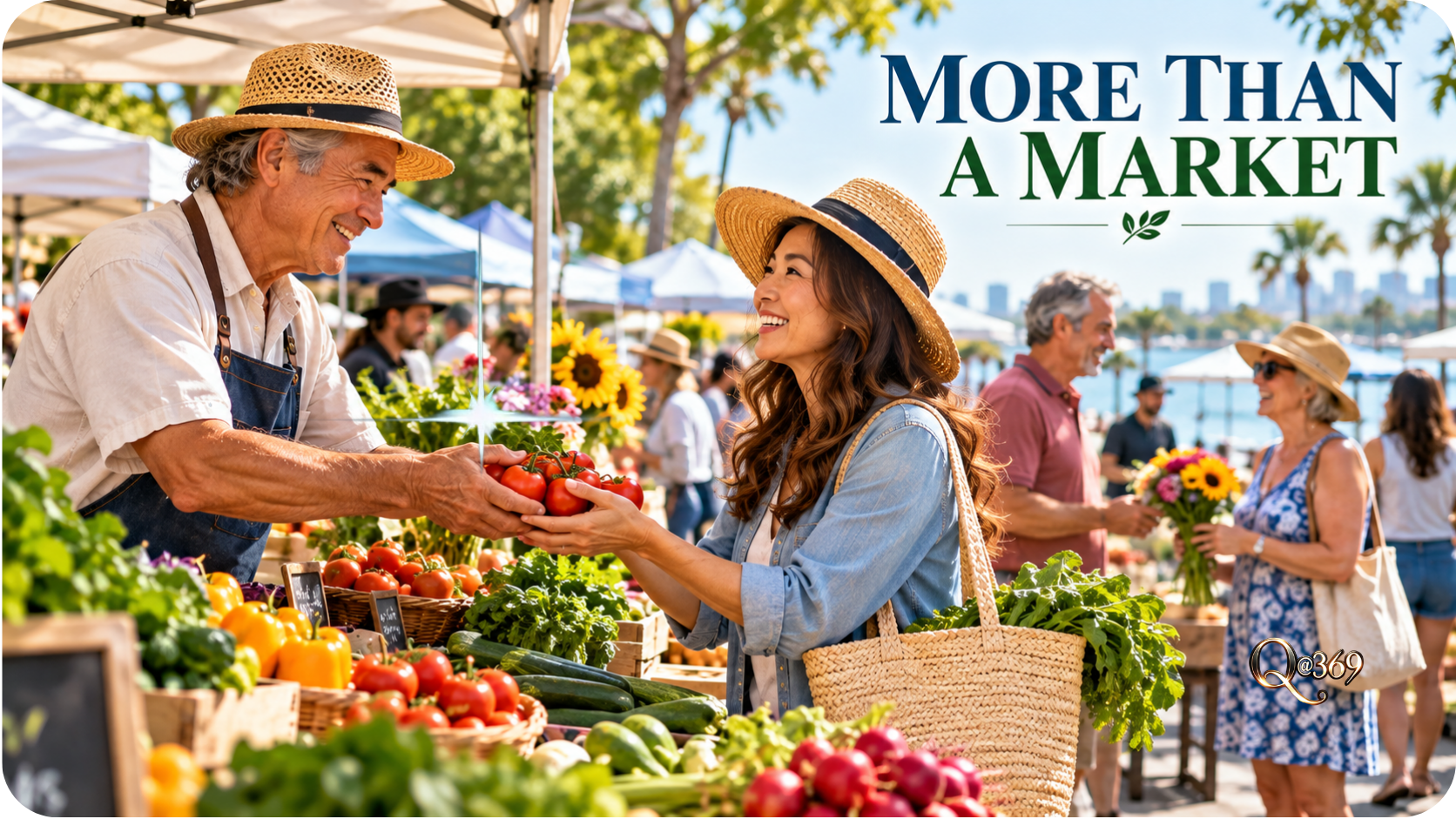
How Familiar Faces, Local Producers, And Everyday Conversations Turn Shopping Into Community Connection

What makes buying tomatoes from someone at a farmers market feel different from selecting them from a grocery store shelf?
Repeated encounters, personal conversations, and shared experiences can turn ordinary shopping into meaningful farmers markets, community participation.
- Community Connection: Familiar encounters help neighbors, shoppers, and local producers develop relationships.
- Human Connection: Meeting the people behind products adds personal meaning to everyday purchases.
- Sensory Experience: Colors, aromas, sounds, and conversations create a distinctive shopping environment.
- Local Identity: Markets can reflect regional traditions, creativity, and the people who contribute to a community.
- Social Wellbeing: Informal gathering places provide opportunities for recognition, belonging, and interaction.
- Practical Awareness: Returning regularly and starting simple conversations can make familiar activities more meaningful.
✨Listen to: AUDIO PODCAST or on SPOTIFY
🙏 Join Our Community Today!
💞 Share with Friends and Colleagues
Shopping For More Than Groceries
Imagine arriving at a farmers market on a Saturday morning. Fresh vegetables fill colorful displays, and the aroma of baked bread drifts between the stalls. A musician plays nearby while shoppers explore the market.
A vendor greets a returning customer by name. Two neighbors stop to exchange news, and a family examines an unfamiliar vegetable. A farmer explains how to prepare it.
You came to buy tomatoes. Twenty minutes later, you have discovered a recipe, learned something about local farming, and enjoyed an unexpected conversation. The tomatoes brought you to the market, while the experience gives you another reason to return.
Grocery stores can also offer friendly service and meaningful relationships. Farmers markets often create additional opportunities for personal interaction through their organization, atmosphere, and direct connections with producers.
The People Behind The Products
At a grocery store, we usually encounter products through labels, packaging, and organized displays. We may know where something was grown without knowing much about the person who produced it.
At a farmers market, the person selling vegetables may also be the person who grew them. A baker might explain how a family recipe developed over several generations. An artist may describe the inspiration behind a handmade creation.
These conversations add information that cannot always fit on a product label. They connect everyday purchases with individual experiences, skills, and traditions.
The relationship can also become more personal over time. Instead of remembering only a product, we begin recognizing the people whose work contributes to our community.
Why Familiar Faces Matter
Think about visiting the same market several Saturdays in a row. During your first visit, you exchange only a few words with a vendor. The following week, you recognize the face and return to the same stand.
Eventually, the vendor remembers which vegetables you purchased. You ask how the growing season is progressing, and a longer conversation develops. A simple transaction gradually becomes a familiar interaction.
Social psychology provides insight into this process. Research on repeated exposure and familiarity indicates that regular encounters can influence how comfortable people become with others. Positive experiences and the surrounding circumstances help determine whether familiarity develops into connection.
Repeated contact does not automatically create friendship. However, regular opportunities for friendly interaction can make relationships easier to establish.
We encounter this process in many settings. Neighbors recognize one another during morning walks, volunteers become familiar through shared activities, and customers develop relationships with local business owners.
Community relationships often begin with recognition before developing into meaningful conversation.
A Different Sensory Experience
Farmers markets engage several senses at once. Bright produce displays attract attention, fresh herbs provide distinctive aromas, and conversations contribute to the atmosphere. Outdoor lighting and seasonal changes add another dimension to the experience.
A market may feel different during a cool autumn morning than during a warm summer afternoon. Seasonal produce changes, vendors introduce new products, and visitors encounter different activities. These variations can make each visit feel distinctive.
The environment also encourages exploration. A shopper may notice an unfamiliar fruit, ask about its flavor, and discover something new. Another visitor might stop to listen to a musician or examine handmade pottery.
Grocery stores provide important advantages through convenience, organization, and predictable availability. Farmers markets often place greater emphasis on discovery, conversation, and direct encounters with producers.
Neither shopping experience needs to replace the other. Each offers different benefits that can complement our everyday routines.
Markets Reflect Local Identity
A farmers market can reveal something about the community surrounding it. Local produce reflects regional growing conditions, while prepared foods may represent family traditions and cultural influences. Artists and craftspeople contribute their own creative expressions.
A market in a coastal community may differ from one in a farming region or urban neighborhood. Products, seasonal activities, and conversations help shape each location’s character.
Visitors encounter more than merchandise. They meet people participating in the economic, social, and cultural life of their community.
These experiences can strengthen our awareness of where we live. They also provide opportunities to appreciate traditions and skills we might otherwise overlook.
Why Informal Gathering Places Matter
Community connections do not develop exclusively through organized meetings or formal events. Many relationships begin during ordinary activities that bring people together repeatedly.
A neighborhood café, public library, park, or farmers market can provide opportunities for informal interaction. People arrive for different reasons while sharing the same environment.
Sociologist Ray Oldenburg described the importance of informal public gathering places in community life. His concept of third places emphasizes accessible settings where people can gather outside home and work.
Farmers markets can serve a similar social function. Shoppers may encounter neighbors, exchange recommendations, or begin conversations with people they have never met.
A customer might ask another shopper how to prepare an unfamiliar vegetable. A vendor may introduce two people who share an interest in gardening. Children may learn about food production through conversations with farmers.
These interactions may seem insignificant individually. Over time, repeated positive encounters can contribute to a stronger sense of community familiarity.
The Science Of Social Connection
Human relationships play an important role in psychological and social wellbeing. Research has found associations between social relationships and important health outcomes.
A major meta-analysis by Holt-Lunstad and colleagues examined findings from 148 studies. The researchers found that stronger social relationships were associated with a greater likelihood of survival during the periods studied.
This research demonstrates the broader importance of social connection. It does not establish that visiting farmers markets directly improves health or increases longevity.
The distinction matters when applying scientific findings to everyday activities. A brief conversation with a vendor is not equivalent to a close friendship or supportive family relationship.
However, markets can provide opportunities for social interaction. Repeated friendly encounters may gradually create familiarity, trust, and a sense of belonging.
The potential benefit comes from the relationships people develop, not simply from being present in a particular location.
Isaac Yue Reflection | The Value Of A Familiar Greeting
I enjoy places where ordinary activities create opportunities to meet people and hear their stories. A farmers market offers that possibility without requiring a formal introduction or scheduled gathering.
A conversation might begin with a question about tomatoes, fresh bread, or a handmade product. Sometimes it ends after a friendly exchange, while other conversations reveal something unexpected about a person’s experience.
I find these moments particularly meaningful when they develop naturally. People arrive with different interests and backgrounds, yet a shared activity gives them something to discuss.
These encounters remind me that community is not always created through large events. It often develops through small interactions repeated over time.
I recognize a similar principle in the Quantumarian Way. Awareness includes noticing the people who contribute to our everyday experiences and appreciating their efforts.
A friendly greeting may seem ordinary. Yet it can become the beginning of recognition, understanding, and a stronger sense of belonging.
How Shopping Becomes Community Participation
Consider the difference between completing a transaction and participating in a community activity. A transaction focuses primarily on exchanging money for goods. Community participation adds recognition, conversation, shared experiences, and relationships.
The two activities can occur together. Someone may visit a farmers market primarily to purchase vegetables and gradually become familiar with several vendors.
Over time, the shopping trip develops an additional purpose. The customer becomes part of a recurring social environment where people recognize one another.
This process does not require long conversations or an outgoing personality. Brief, respectful interactions can create familiarity when people encounter one another regularly.
A simple progression illustrates how these relationships may develop.
Visit → Recognize → Converse → Return → Connect
The process is not automatic or identical for everyone. Each encounter provides an opportunity to build upon a previous positive experience.
Bringing The Farmers Market Experience Into Everyday Life
The most useful lesson does not require access to a farmers market. Similar opportunities exist in grocery stores, neighborhood shops, libraries, parks, and community events.
Begin by noticing people you encounter regularly. Recognize familiar faces, learn names when appropriate, and acknowledge the work others contribute.
A genuine question can create an opportunity for conversation. Ask a baker about a recipe, a gardener about a plant, or a local artist about a creation.
Returning to places where positive interactions occur can gradually build familiarity. These relationships develop more naturally when we remain respectful of other people’s time and preferences.
There is no need to turn every shopping trip into a social event. A friendly greeting or thoughtful exchange may be enough to make an ordinary activity more meaningful.
The objective is simply to recognize opportunities for connection within activities we already enjoy.
Conclusion | A Market Is Also A Meeting Place
Farmers markets provide opportunities to purchase food, discover handmade products, and meet the people behind them. They can also connect neighbors and reflect the character of their surrounding communities.
Repeated encounters help unfamiliar faces become recognizable. Conversations provide opportunities to learn about people, products, and local traditions.
These experiences remind us that community participation often develops through ordinary activities. We do not always need special occasions or organized events to build connections.
Sometimes the opportunity begins beside a basket of fresh tomatoes.
Reflection Question
Where in your community do familiar faces and repeated conversations make an ordinary activity feel more meaningful?
Practical Action
During your next shopping trip, visit a familiar vendor or neighborhood business. Begin one genuine conversation about a product, someone’s work, or a shared interest.
Notice whether the experience feels different when you give the interaction more attention. Consider returning another day and continuing the conversation when the opportunity arises.
A stronger sense of community can begin with one ordinary conversation.

References
- Oldenburg, R. (1999). The Great Good Place. Da Capo Press. Explores the importance of informal public gathering places, often called third places, in building social relationships and community life. Relevant to understanding farmers markets as places for conversation and repeated encounters. Book Information
- Brown, C., & Miller, S. (2008). The Impacts Of Local Markets: A Review Of Research On Farmers Markets And Community Supported Agriculture (CSA). American Journal of Agricultural Economics, 90(5), 1298–1302. Reviews research on farmers markets and community supported agriculture, including their economic and social contributions. Relevant to the relationship between local producers, consumers, and community participation. DOI: 10.1111/j.1467-8276.2008.01220.x
- Holt-Lunstad, J., Smith, T. B., & Layton, J. B. (2010). Social Relationships And Mortality Risk: A Meta-Analytic Review. PLOS Medicine, 7(7), e1000316. A meta-analysis examining the association between social relationships and mortality risk. Supports the broader importance of social connection, although it does not establish specific health benefits from farmers market visits. DOI: 10.1371/journal.pmed.1000316
See more of QuantumAlchemist369™ selected self-empowerment knowledge selections on the Book Shelf
QA 369Shop

Physics Legends Matte Poster — Einstein & Pioneers Art Print
Frame Not Included, Poster Only

Interactive Live Meetups
Thursday 7PM EDT Live Q&A with Isaac Yue
Join the Live Meetup Community discussion.
2026 Community Feedback Now Open
You are invited to help build QuantumAlchemist369. Take a few minutes to complete the Quantumarian Community Review 2026.


Leave a Reply