
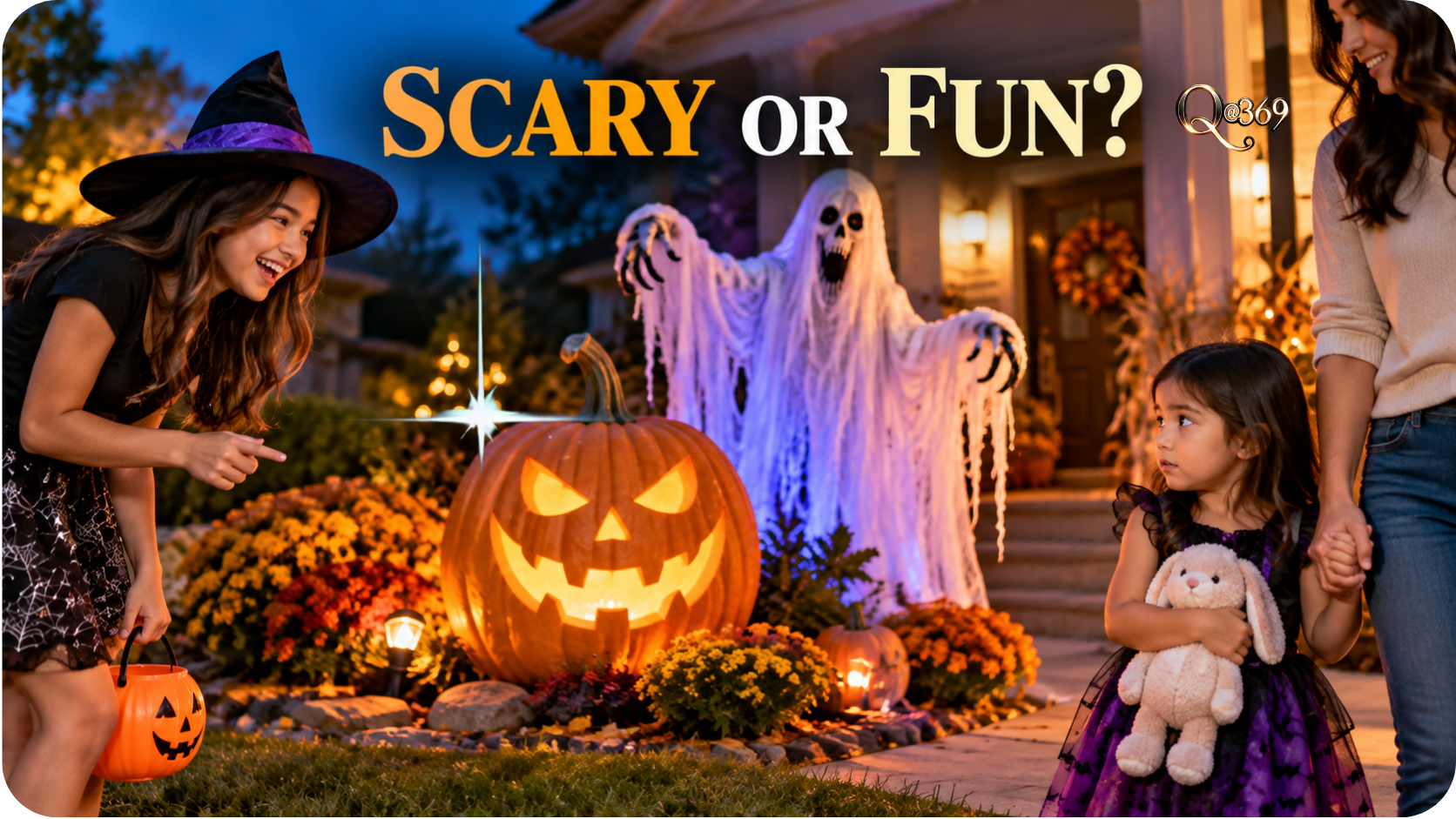
How Halloween Displays Reveal The Different Ways We Experience Fear, Excitement, And Safety

Why can one Halloween decoration make someone laugh while another person wants to cross the street?
Our response to something scary depends on how the brain interprets danger, safety, experience, and the surrounding situation.
- The same Halloween display can produce excitement, amusement, discomfort, or genuine fear.
- The brain evaluates potential threats using sensory information, memories, expectations, and context.
- Controlled fear can become enjoyable when a person feels sufficiently safe.
- Children and adults may interpret frightening displays differently.
- Personal experiences and family traditions influence emotional reactions.
- Empathy begins when we respect reactions that differ from our own.
✨Listen to: AUDIO PODCAST or on SPOTIFY
🙏 Join Our Community Today!
💞 Share with Friends and Colleagues
One Display, Several Different Experiences
Imagine walking through a neighborhood decorated for Halloween.
One house has friendly pumpkins, colorful lights, and smiling ghosts. Another has skeletons, realistic monsters, flashing lights, and sudden frightening sounds.
A group of teenagers approaches the second house laughing. They eagerly wait for the next unexpected surprise.
A younger child stops walking and holds a parent’s hand. Another child watches with curiosity, while an adult decides to continue down the street.
Everyone sees the same display. Yet each person experiences something different.
The decorations have not changed. Their meaning depends partly on the person encountering them.
The Brain Does More Than Recognize Danger
Fear begins with more than simply seeing something frightening.
The brain processes incoming sensory information and evaluates its possible significance. Networks involving the amygdala, hippocampus, and prefrontal cortex contribute to threat learning, memory, and emotional regulation.
These systems help us respond to uncertain situations.
A sudden movement might indicate danger. A loud sound may demand attention, even when its source is harmless.
Our response also depends on what we already know.
When we recognize a skeleton as a plastic decoration, that knowledge can reduce our sense of danger. Yet an unexpected movement may still produce a startled reaction.
Recognizing something as harmless does not always prevent an immediate emotional response.
When Fear Becomes Entertainment
Why do people voluntarily visit haunted houses or watch frightening movies?
One explanation involves controlled fear.
A frightening experience can become enjoyable when someone believes the situation is sufficiently safe. The excitement comes from experiencing arousal without expecting serious harm.
A haunted attraction provides an interesting example.
Visitors understand that actors, lighting, sound effects, and mechanical surprises create the experience. They may still scream when something unexpected happens.
Their bodies respond to the sudden event, while their understanding of the situation helps them interpret it as entertainment.
For some people, that combination creates excitement.
For others, the discomfort outweighs the enjoyment.
Neither response requires an explanation based on personal courage.
Expectations Change The Experience
Imagine approaching a house with a sign announcing a friendly Halloween display for young children.
You expect cheerful decorations and gentle surprises.
Now imagine approaching a haunted attraction advertised as extremely frightening.
You expect darkness, sudden movements, and disturbing images.
The same unexpected sound can feel different in those two settings.
Expectations prepare us to interpret what happens next. They can influence whether an event feels amusing, surprising, or threatening.
This is why context matters.
A realistic monster standing motionless in a store may attract curiosity. The same monster suddenly appearing beside a dark pathway may trigger fear.
The object is familiar.
The situation changes its meaning.
Children Experience Halloween Differently
Young children are still developing their ability to distinguish appearances, imagined threats, and actual danger across different situations.
A child may understand that a costume is pretend while still feeling frightened by its appearance.
Age alone does not determine the response.
Temperament, familiarity, previous experiences, sensory sensitivity, and the surrounding environment also matter.
One child may enjoy a friendly ghost display. Another may find even a smiling mask uncomfortable.
Adults sometimes assume children should enjoy whatever the adults consider harmless.
A more useful approach is to observe the child’s response and adjust the experience accordingly.
Families Bring Different Traditions
Halloween does not mean the same thing to every family.
Some households celebrate with elaborate decorations, costumes, parties, and neighborhood walks. Others prefer simple pumpkins, seasonal activities, or no frightening decorations.
Family traditions help shape expectations.
Children who grow up enjoying playful Halloween activities may become comfortable with familiar decorations. Children without those experiences may respond differently when encountering them.
Culture and personal history also influence how people interpret frightening imagery.
A decoration intended as harmless entertainment may carry a different meaning for someone else.
Understanding these differences helps communities celebrate without assuming everyone shares the same preferences.
A Frightening Surprise Is Not Always Fun
Surprise can be an enjoyable part of Halloween.
Yet there is an important difference between inviting someone into a frightening experience and forcing that experience upon them.
A person who enters a haunted attraction has generally chosen to participate. Someone walking along a public sidewalk may not expect a frightening figure to suddenly approach.
The difference involves choice and control.
When people can decide whether to participate, they have more opportunity to manage their experience.
This matters especially for young children and people who find intense sensory experiences uncomfortable.
Respecting a person’s boundaries does not eliminate Halloween fun.
It makes the celebration more welcoming.
The Same Body Response Can Have Different Meanings
Fear and excitement can share physical characteristics.
Heart rate may increase. Breathing can change. Attention becomes more focused.
Yet similar bodily responses do not always produce the same emotional experience.
Someone anticipating a roller coaster may interpret increased arousal as excitement. Another person may experience the same situation as distressing.
Context, expectations, perceived control, and personal experience influence that interpretation.
This helps explain why frightening entertainment attracts some people while others prefer calmer activities.
Enjoyment is not determined simply by how strongly the body responds.
It also depends on how the experience is understood.
Isaac Yue Reflection | Different Reactions Deserve Respect

One pleasure of walking through neighborhoods is observing how people express creativity and celebrate together.
Halloween brings that creativity into public view. Families decorate homes, children choose costumes, and neighbors create experiences for others to enjoy.
I find the different reactions particularly interesting.
One person admires a realistic monster. Another laughs at a dancing skeleton. A child may prefer the friendly pumpkin beside the front door.
Those differences remind me that sharing an experience does not mean sharing the same emotional response.
We do not need everyone to enjoy the same decorations.
We can appreciate the creativity while remaining attentive to the people experiencing it.
Designing Halloween Fun For More People
A welcoming Halloween display can offer different levels of excitement.
Friendly decorations near the sidewalk can create an inviting first impression. More frightening elements can occupy a clearly identified area for visitors who want that experience.
Lighting and visible pathways help people understand where they are going.
Avoiding unexpected physical contact and providing a clear way around intense displays can make participation more comfortable.
Families can also prepare children before approaching unfamiliar decorations.
Explaining that a monster is a costume or mechanical figure may help some children feel more secure.
Others may still prefer to watch from a distance.
That choice deserves respect.
A Simple Way To Understand Different Reactions
The next time two people respond differently to the same frightening display, consider four influences:
Perception → Experience → Context → Response
Perception: What does the person believe they are seeing?
Experience: What memories or previous encounters influence their interpretation?
Context: Does the setting feel safe, predictable, and voluntary?
Response: Does the person experience amusement, curiosity, excitement, discomfort, or fear?
These influences interact rather than operating as a fixed sequence.
They help explain why one person’s entertainment can become another person’s uncomfortable experience.
Try A Different Perspective This Halloween
As Halloween decorations begin appearing around your neighborhood, notice how people respond.
Watch how children approach unfamiliar displays. Observe how adults guide them and how different families choose their activities.
Instead of assuming that everyone should react similarly, consider what may influence each person’s experience.
If you decorate your home, consider offering visitors a choice between friendly and frightening elements.
A small adjustment can help more people participate comfortably.
Conclusion | Fun And Fear Depend On The Person
The same Halloween display can create very different experiences.
Our brains interpret potential threats using sensory information, expectations, memories, and surrounding circumstances.
A frightening experience may become enjoyable when someone feels safe and chooses to participate.
Another person may experience discomfort even while understanding that the display is harmless.
Recognizing these differences helps us respond with greater empathy.
Halloween can remain creative, surprising, and entertaining without requiring everyone to enjoy the same level of fear.
Reflection Question
When have you enjoyed an experience that someone else found uncomfortable, and how did you respond to their reaction?
Practical Action
During your next neighborhood walk, notice one Halloween display from two different perspectives.
Consider how an excited teenager and a cautious young child might experience it.
Then identify one small change that could make the experience more welcoming without removing its creativity.
Understanding another person’s reaction can make shared celebrations more enjoyable for everyone.

References
- Andersen et al. (2020) | Playing With Fear: A Field Study In Recreational Horror Psychological Science, 31(12), 1497–1510. A study of haunted house visitors examining how fear, physical arousal, and enjoyment interact. Particularly relevant to why frightening experiences can be entertaining for some people. https://doi.org/10.1177/0956797620972116
- Mobbs et al. (2015) | The Ecology Of Human Fear: Survival Optimization And The Nervous System Frontiers in Neuroscience, 9, Article 55. Explains how the nervous system evaluates threats and adjusts defensive responses according to context and perceived danger. https://doi.org/10.3389/fnins.2015.00055
- Rapee, Schniering & Hudson (2009) | Anxiety Disorders During Childhood And Adolescence: Origins And Treatment Annual Review of Clinical Psychology, 5, 311–341. Reviews how temperament, family influences, and individual experiences contribute to differences in childhood fear and anxiety. It provides background for understanding children’s reactions, rather than Halloween specifically. https://doi.org/10.1146/annurev.clinpsy.032408.153628
See more of QuantumAlchemist369™ selected self-empowerment knowledge selections on the Book Shelf
QA 369Shop

Physics Legends Matte Poster — Einstein & Pioneers Art Print
Frame Not Included, Poster Only

Interactive Live Meetups
Thursday 7PM EDT Live Q&A with Isaac Yue
Join the Live Meetup Community discussion.
2026 Community Feedback Now Open
You are invited to help build QuantumAlchemist369. Take a few minutes to complete the Quantumarian Community Review 2026.


Leave a Reply