
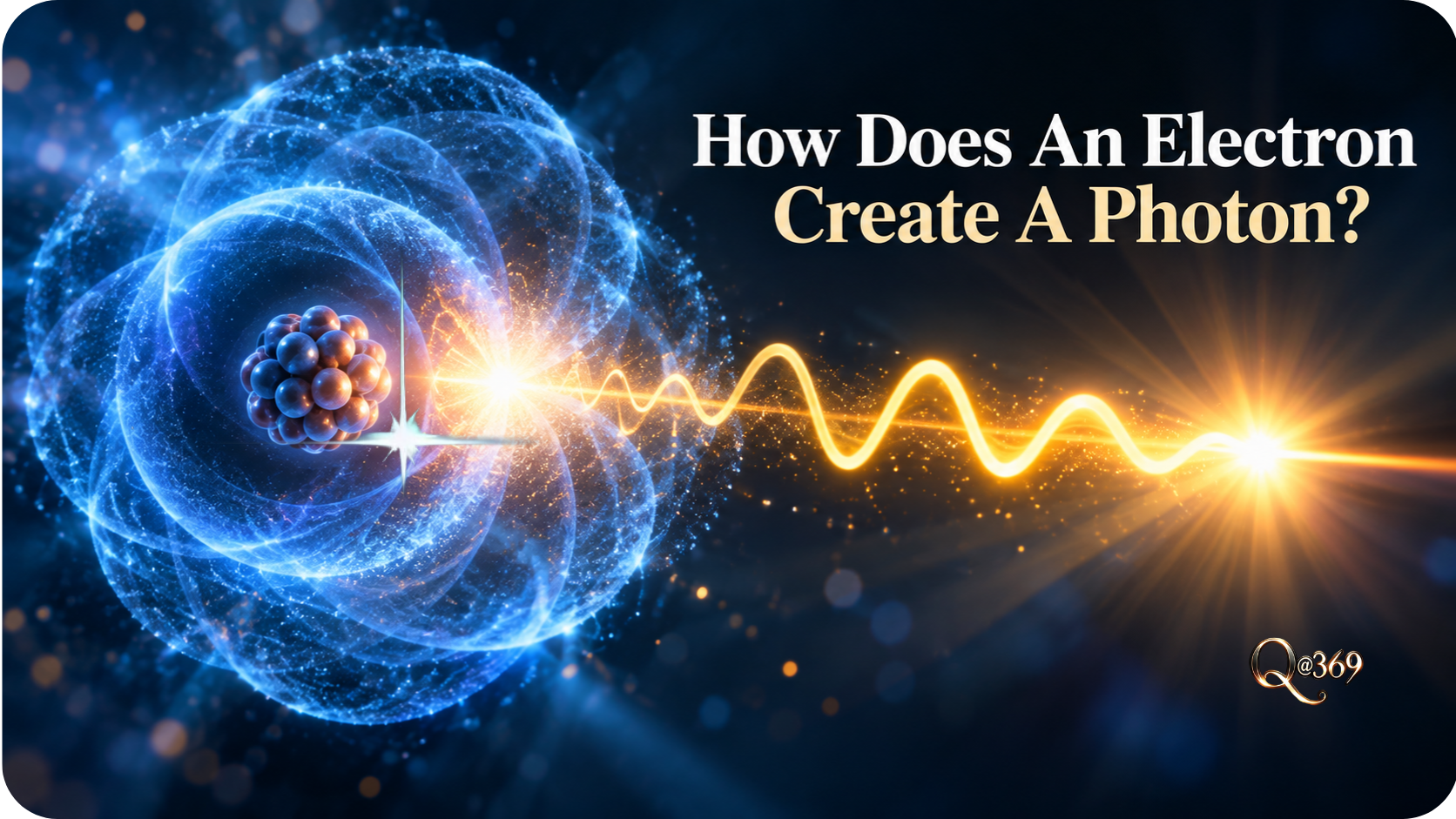
Why Light Emerges From Quantum Energy Transitions Rather Than An Electron Manufacturing A Particle

When an atom releases light, does an electron actually manufacture a photon?
Photon emission occurs when an electromagnetic quantum system releases energy through an allowed transition.
- Electrons in atoms occupy quantum states rather than tiny planetary orbits.
- Atomic states can have specific allowed energies.
- A transition to a lower energy state can release energy as a photon.
- Photon energy corresponds to the energy difference involved in the transition.
- Electromagnetic interactions influence which transitions can occur and how likely they are.
- An electron does not physically assemble a photon from smaller pieces.
✨Listen to: AUDIO PODCAST or on SPOTIFY
🙏 Join Our Community Today!
💞 Share with Friends and Colleagues
The Familiar Picture Creates A Problem
We often describe photon emission with a simple picture.
An electron sits at a high energy level. It drops to a lower level and releases a photon.
That picture can be useful. It can also create the impression that the electron carries light inside itself.
The electron does not contain a supply of photons. It does not manufacture light from hidden components.
Something more interesting is happening.
An Electron In An Atom Is Not A Tiny Planet
The familiar drawing of electrons circling a nucleus helped generations of students picture atoms.
Modern quantum mechanics gives us a different description.
A bound electron is described by a quantum state. That state helps determine the probabilities associated with possible measurement outcomes.
Certain atomic states have specific energies. This creates the familiar energy levels shown in physics diagrams.
The lines represent allowed energy states. They are not physical shelves inside the atom.
An electron does not sit on one shelf and jump through empty space to another. The quantum state of the system changes.
Energy Differences Matter
Imagine an atom in an excited state.
It has more energy than it would have in a lower available state.
Suppose the system transitions from an initial state with energy Ei to a lower state with energy Ef.
The energy difference can be written in a Microsoft Word friendly form:
Energy difference = Ei – Ef
Or, using the standard symbol:
ΔE = Ei – Ef
When a photon is emitted, its energy is related to its frequency:
Photon energy = h × frequency
In standard notation:
Ephoton = hν
Here, h is Planck’s constant and ν represents the photon’s frequency.
For a simplified isolated atomic transition:
hν = Ei – Ef
This equation connects the change in atomic energy with the frequency of the emitted photon.
A larger energy difference produces a higher photon frequency. A smaller energy difference produces a lower frequency.
Where Does The Photon Come From?
This is where everyday language begins to struggle.
We may ask where the photon was before the electron changed states.
That question assumes the photon must have existed somewhere as a separate object waiting to escape.
Quantum electrodynamics provides a richer framework.
Electrons interact with the quantized electromagnetic field. Photons are quanta of that electromagnetic field.
During emission, the combined quantum state of matter and the electromagnetic field changes.
We can begin with an excited atom and no photon in the relevant field mode. After emission, the atom occupies a lower energy state and the electromagnetic field contains an additional photon.
The photon was not assembled piece by piece inside the electron.
It appears as part of the quantum transition involving matter and the electromagnetic field.
The Whole System Matters
Saying “the electron creates a photon” is convenient shorthand.
A more accurate description involves the interacting quantum system.
During photon emission, the matter system changes state while the electromagnetic field gains a photon.
Energy must be conserved. Momentum and angular momentum also matter.
Quantum physics therefore describes more than an electron moving from one location to another. It describes a transition between quantum states of an interacting system.
Why Atoms Produce Characteristic Colors
This helps explain why different atoms produce characteristic spectra.
Different atoms have different structures and allowed energy states. Their possible energy differences therefore vary.
When excited atoms undergo allowed transitions, the emitted photons can have characteristic frequencies.
Those frequencies produce spectral lines.
Scientists can examine those lines and identify elements from their electromagnetic signatures.
Hydrogen has one pattern. Helium has another. Sodium produces its own familiar spectral features.
Light can therefore carry information about the quantum structure of the matter that produced it.
Not Every Transition Happens Equally
Having two energy states does not automatically mean a transition between them will occur readily.
Quantum mechanics includes rules governing transition probabilities.
The structure and symmetry of the states matter. Conservation of angular momentum matters.
The interaction between the system and electromagnetic field also matters.
Some transitions are strongly allowed. Others are much less probable through a particular interaction.
This helps explain why excited states can have different lifetimes.
Some decay very quickly. Others can persist much longer before emission occurs.
Spontaneous Emission Still Involves The Electromagnetic Field
Another interesting question appears here.
What makes an excited atom emit a photon when nobody shines light on it?
This process is called spontaneous emission.
A complete quantum description treats the electromagnetic field itself as quantized. Even its vacuum state remains part of the physical description.
Interaction between the excited atomic system and the quantized electromagnetic field allows spontaneous emission.
The process does not require a tiny internal mechanism pushing a photon outward. It follows from the quantum interaction between matter and the field.
Stimulated Emission Adds Another Possibility
Photon emission can also be stimulated.
Suppose an atom is already in an appropriate excited state. An electromagnetic field at a suitable frequency interacts with it.
That interaction can increase the probability of a transition that emits an additional photon.
Stimulated emission is fundamental to laser operation.
The acronym LASER originally comes from Light Amplification by Stimulated Emission of Radiation.
Once again, the electron is not manufacturing a tiny object. The interacting quantum system is changing states.
Light Is Not A Little Ball Flying Out Of An Electron
Photons are often drawn as tiny dots or wavy arrows.
Those diagrams are communication tools.
A photon is a quantum excitation of the electromagnetic field. It carries energy and momentum and can produce localized detection events.
The particle description is extremely useful. Imagining a photon as a miniature classical ball can still create misconceptions.
Quantum objects do not always behave according to categories developed from everyday objects.
That is part of what makes quantum physics challenging and useful.
From Energy Levels To The Light Around Us
Quantum transitions are not remote curiosities.
They help explain much of the light we encounter.
Gas discharge lamps, lasers, astronomical spectra, fluorescent materials, and many laboratory instruments depend on interactions between matter and electromagnetic radiation.
When scientists analyze light from a distant star, they can learn about the matter interacting with that radiation.
The light carries information across enormous distances.
A quantum transition occurring far away can therefore contribute to a measurement made here.
Quantum Alchemy Reflection | Change Can Reveal A Different View Of A System
Photon emission offers an interesting philosophical image when we keep science and reflection clearly separated.
Physics tells us that a quantum system can transition between states while exchanging energy with the electromagnetic field.
Quantum Alchemy can use that scientific picture as inspiration without claiming that human thoughts behave as atomic transitions.
The reflection is simpler.
Change does not always mean rearranging pieces that already existed in their final form. Sometimes understanding a process requires examining interactions and the complete system.
That distinction can improve how we think about complex systems beyond this particular example.
A Better Mental Picture
Instead of imagining an electron manufacturing a photon, picture three stages:
Excited Quantum State → Electromagnetic Interaction → Lower State + Photon
For a simplified atomic transition, the central energy relationship is:
Photon energy = Energy difference between states
Or:
Ephoton = ΔE
Since photon energy also depends on frequency:
Ephoton = hν
Therefore:
hν = ΔE
And for the transition described earlier:
hν = Ei – Ef
These formulas describe an energy relationship.
They do not describe an electron physically constructing a photon.
Look At Light Differently
The next time you see a glowing sign, a laser, or a spectrum, consider what the light represents.
Somewhere, matter and the electromagnetic field interacted. Quantum states changed.
Energy moved through an allowed physical process.
What reaches your eyes or an instrument can carry information about that transition.
A photon may be detected as a single event. Its origin is still best understood through the quantum system and electromagnetic interaction that produced it.
Conclusion | A Photon Is Part Of The Transition
An electron does not create a photon by assembling light from smaller components.
In atomic emission, a quantum system changes from a higher energy state to a lower one while interacting with the electromagnetic field.
The emitted photon carries energy associated with that transition.
That correction changes the mental picture. Instead of imagining an electron as a microscopic photon factory, we can understand emission as a quantum interaction involving matter, energy, and the electromagnetic field.
Reflection Question
How does your picture of light change when you think of photon emission as a quantum transition rather than microscopic construction?
Practical Action
The next time you encounter an energy level diagram, do not picture physical shelves and a falling electron.
Read it as a map of possible quantum states and energy differences. That small change creates a more accurate foundation for understanding atoms, spectra, lasers, and light.

References
- NIST | Atomic Spectroscopy Introduction This is the strongest technical reference for the article. NIST explains photon energy in relation to transitions between upper and lower atomic energy levels. NIST NIST Atomic Spectroscopy Introduction
- OpenStax | Atomic Spectra And X Rays This university physics reference directly explains photon emission through atomic energy transitions. It also covers energy differences, photon frequency, and quantum mechanical selection rules. OpenStax OpenStax: Atomic Spectra And X Rays
- NIST | Atomic Spectra Database The NIST Atomic Spectra Database provides critically evaluated data for atomic energy levels, wavelengths, spectral lines, and transition probabilities. It gives readers a direct connection between the article’s explanation and experimentally measured atomic spectra. NIST DOI: https://doi.org/10.18434/T4W30F
See more of QuantumAlchemist369™ selected self-empowerment knowledge selections on the Book Shelf
QA 369Shop

Physics Legends Matte Poster — Einstein & Pioneers Art Print
Frame Not Included, Poster Only

Interactive Live Meetups
Thursday 7PM EDT Live Q&A with Isaac Yue
Join the Live Meetup Community discussion.
2026 Community Feedback Now Open
You are invited to help build QuantumAlchemist369. Take a few minutes to complete the Quantumarian Community Review 2026.


Leave a Reply