
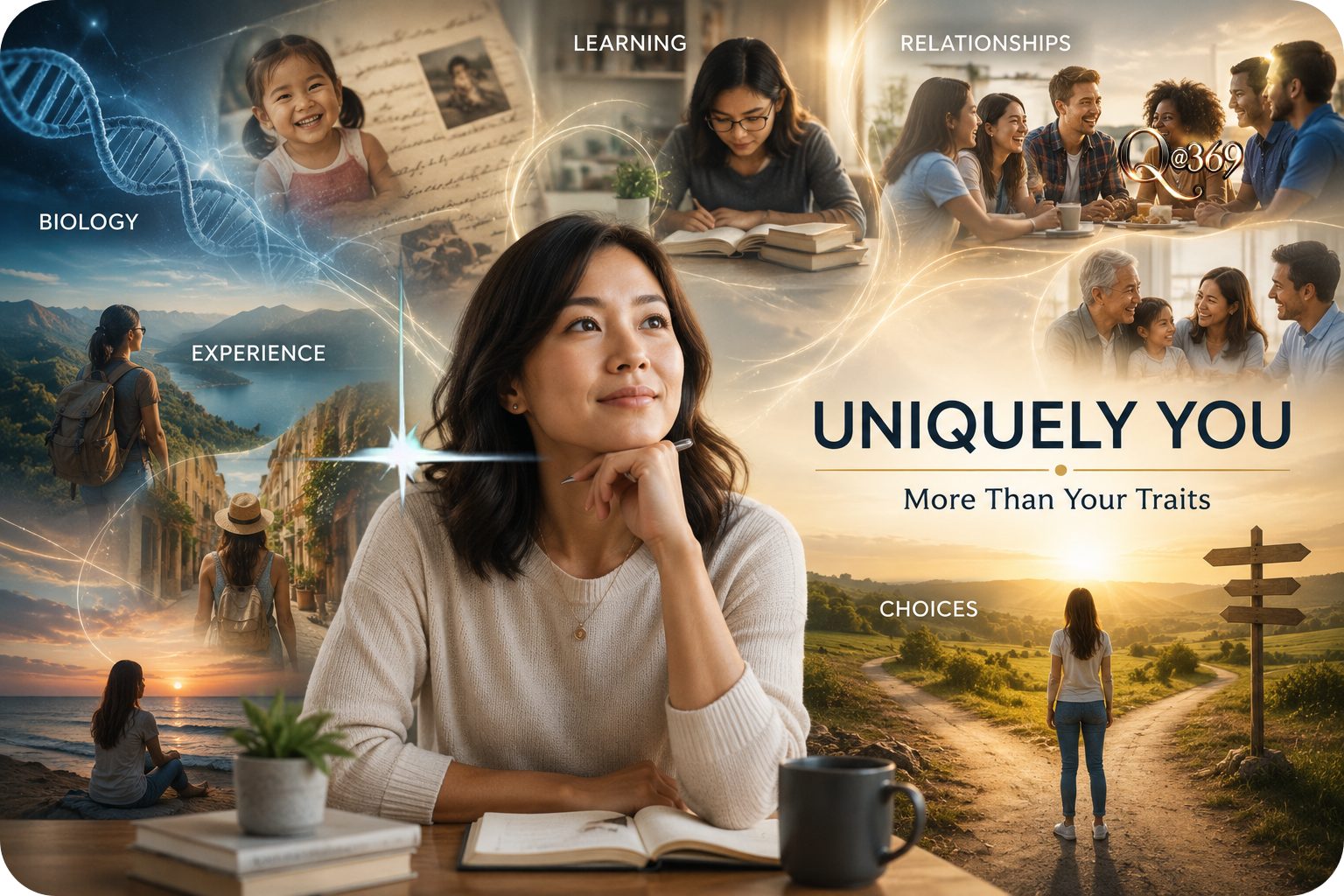
Your Life Is More Than A Collection Of Traits

What makes uniquely you different from every other person who has ever lived?
Individuality develops through biology, experience, learning, relationships, environment, and the choices we continue making throughout life.
- Biology provides part of the foundation for individuality.
- Personality develops through both inherited tendencies and experience.
- Memories and learning influence how we interpret new situations.
- Relationships become part of our developing identity.
- Personal choices can gradually influence who we become.
- Being unique does not require being extraordinary.
✨ AUDIO: Listen to “What makes uniquely you different from every other person who has ever lived?” by Isaac Yue
🎯 Also Available on SPOTIFY
🙏 Join Our Enlightened Community Today!
💞 Share with Friends and Colleagues
More Than A List Of Traits
Describe yourself in ten words.
Perhaps you would choose curious, patient, independent, creative, practical, cautious, humorous, ambitious, compassionate, or stubborn. Those words might describe genuine parts of your personality, although they cannot explain the complete person reading this sentence.
Your identity is not a checklist assembled once and permanently stored. It develops through countless interactions among biology, experience, learning, relationships, circumstances, and choices.
Two people can share many personality traits without becoming interchangeable. The way those traits developed and interact within each life creates something far more individual.
That is where the interesting question begins.
Biology Gives Us A Starting Point
Every person begins life with biological characteristics influenced by genetics. Genes contribute to physical characteristics while also influencing aspects of brain development, temperament, and behavioral tendencies.
Biology, however, is not a completed personality delivered at birth. Genetic influences operate within environments, while development continuously changes the brain and body.
Even identical twins provide an important illustration. They share nearly identical DNA, yet they do not experience perfectly identical lives. Different relationships, illnesses, opportunities, decisions, and experiences can gradually contribute to meaningful differences.
Biology helps establish the starting conditions. Life continues working with them.
Personality Is Both Stable And Flexible
Psychologists often describe personality through relatively enduring patterns of thought, emotion, and behavior. Traits can show considerable stability, especially during adulthood, while research also finds that personality can change across the lifespan.
That combination is important. You can recognize yourself across many years without remaining exactly the same person.
Someone who was extremely shy at twenty may become more socially confident through work and relationships. A highly impulsive young adult may develop greater self control through experience and responsibility.
Change does not erase identity. It becomes part of identity.
Your Experiences Become Part Of You
Consider two people walking into the same unfamiliar room.
One immediately notices the people. Another studies the exits, furniture, lighting, or artwork. Someone else notices the music playing quietly in the background.
The room is the same. Their histories are not.
Past experiences help influence what receives attention and what carries meaning. Memories provide context that the brain can use when interpreting current situations.
This does not mean every reaction can be traced neatly to one past event. Human behavior is considerably more complicated.
It means we do not enter each new experience with an empty mind. We arrive carrying what we have already learned.
Learning Continues Building The Person
Education changes more than what we know.
Learning a language can provide access to another culture. Studying science can change how we evaluate evidence. Learning music can alter how we hear patterns that another listener may barely notice.
Practical skills matter too. Cooking, gardening, repairing equipment, raising children, managing people, traveling, volunteering, and solving everyday problems all create knowledge through experience.
Some lessons arrive intentionally. Others appear through mistakes.
Each becomes another influence on how we understand what happens next.
Relationships Help Shape Identity
Other people also become part of our development.
Parents, siblings, teachers, friends, partners, coworkers, children, mentors, and strangers can influence what we learn about ourselves. Some relationships strengthen confidence, while others challenge assumptions or reveal weaknesses we had not noticed.
We also behave differently within different relationships. You may be a parent in one room, a manager in another, a student somewhere else, and a lifelong friend later that evening.
None of those roles necessarily represents a false version of you. They reveal different relationships between your identity and your circumstances.
We become ourselves partly through being connected with others.
Culture Provides Context
Individuality does not develop separately from culture.
Language, traditions, family expectations, social customs, education, religion, media, geography, and economic circumstances can influence what people consider normal or desirable.
Culture provides possibilities and expectations. Individuals then interpret, accept, modify, combine, or reject some of them.
This creates an interesting balance. We can belong to families and communities while remaining distinct individuals within them.
Being unique does not require rejecting everything we inherited. Sometimes individuality appears in how we make inherited traditions personally meaningful.
Choices Add Another Layer
Experience influences us, although we are not merely passive collections of things that happened.
We make choices.
We choose which interests to pursue, which relationships to maintain, what skills to develop, and how to respond after mistakes. Circumstances can limit those choices, although decisions still contribute to the direction of a life.
Small choices can accumulate.
Reading one book may create curiosity about another subject. Taking one class may reveal an unexpected ability. Starting one conversation may eventually produce a friendship lasting decades.
Identity develops partly through what happens to us and partly through what we repeatedly choose to do next.
Your Brain Continues Changing
Learning and experience also have physical consequences.
The brain remains capable of change through neuroplasticity, the capacity of neural systems to adapt through experience, learning, and other influences. Neural connections can strengthen, weaken, and reorganize as we interact with the world.
This gives individuality a biological dimension that continues beyond our genes. Experience does not simply create stories we remember. It can participate in changes within the nervous system supporting learning and behavior.
That does not mean we can become anything simply through positive thinking. Biology, age, circumstances, opportunity, and many other constraints remain real.
It means development continues.
You Are Also The Meaning You Create
Two people can experience similar events and interpret them very differently.
A difficult project might become evidence of failure for one person. Another person may eventually remember the same kind of difficulty as the experience that taught persistence.
The event matters. The meaning assigned to it matters too.
Reflection allows us to revisit experiences and consider what they taught us. Sometimes that process changes how an old event participates in our present identity.
We cannot rewrite what happened. We can continue learning from what happened.
Unique Does Not Mean Better
There is an important distinction in any discussion about individuality.
Being unique does not mean being superior.
Every human being has a combination of biology, experiences, relationships, learning, memories, circumstances, and choices. Individuality gives us difference without automatically creating hierarchy.
You do not need an extraordinary talent, unusual career, dramatic history, or remarkable achievement to qualify as unique. Ordinary lives contain combinations of experiences that cannot be perfectly reproduced.
Individuality is not a competition.
It is a condition of being human.
Stop Comparing Complete Lives With Visible Traits
Comparison can make individuality difficult to appreciate.
We see someone else’s confidence, career, appearance, home, creativity, education, or relationships. We then compare one visible feature of that person’s life with a much larger judgment about our own.
That comparison is incomplete.
You are comparing traits while living an entire history.
The person you are today includes successes, disappointments, people you have loved, things you learned late, ideas you abandoned, mistakes you corrected, and choices nobody else witnessed.
A list cannot capture that.
A Simple Identity Exercise
Take a blank page and write your name in the center.
Around it, identify several influences that contributed to the person you are today. Include experiences, relationships, skills, places, choices, interests, traditions, challenges, and lessons.
Then look for connections among them.
Perhaps one teacher encouraged an interest that became a career. A difficult experience may have influenced how you later treated someone facing the same problem.
The purpose is not to document your entire life. It is to recognize that identity emerges from relationships among many influences rather than one defining trait.
Isaac Yue Reflection
I could describe myself using labels and roles. Engineer, writer, husband, father, grandfather, Quantum Chef, and lifelong learner would identify parts of my life.
None would explain me completely.
My engineering career influenced how I approach problems and evidence. Writing taught me to examine ideas from another perspective, while cooking gave me another way to experiment, create, and connect with people.
Family, travel, conversations, mistakes, successes, curiosity, and years of ordinary experiences contributed other pieces. Some influences arrived through deliberate choices, while others appeared unexpectedly.
I do not think our individuality comes from finding one special characteristic that separates us from everyone else. I think it emerges from the combination of what we inherit, experience, learn, value, and choose.
That combination continues changing.
Tomorrow I may learn something that changes how I understand something I believed yesterday. A conversation may introduce another perspective, while a new experience may reveal an ability I never had reason to discover.
For me, that makes individuality more interesting than simply asking what makes someone different.We are not finished collections of traits. We are continuing stories shaped by what we do with what life gives us.
You Are Still Becoming You
Your past matters, although it does not contain the complete definition of who you are.
Biology provides influences. Experience adds context. Relationships create connections. Learning expands possibilities, while choices contribute direction.
Together, these influences create a person who cannot be adequately described by a personality test, job title, demographic category, or collection of adjectives.
Appreciating your individuality does not require believing you are better than anyone else. It means recognizing that your particular combination of influences has never developed in exactly the same way before.
You are uniquely you.
You are also still becoming you.
Reflection Question
Which experience, relationship, or choice has influenced who you became more than you originally expected?
Practical Action
Write down five influences that helped shape who you are today. Choose at least one relationship, one experience, one learned skill, one personal choice, and one characteristic you believe has biological roots.
Then consider how those influences interact rather than viewing them separately. You may discover that what makes you unique is not one remarkable trait, but the connections among many ordinary ones.

References
- Roberts, B. W., & Mroczek, D. (2008). “Personality Trait Change in Adulthood.” Current Directions in Psychological Science, 17(1), 31–35.
This review supports an important article theme: personality has meaningful stability, yet personality traits can continue changing throughout adulthood. The authors also report individual differences in how personality develops across the lifespan. (Sage Journals)
DOI: 10.1111/j.1467-8721.2008.00543.x - Briley, D. A., & Tucker-Drob, E. M. (2014). “Genetic and Environmental Continuity in Personality Development: A Meta Analysis.” Psychological Bulletin, 140(5), 1303–1331.
This meta analysis combined 24 longitudinal behavioral genetic studies involving more than 21,000 sibling pairs. It found contributions from both genetic and environmental influences, while environmental mechanisms become increasingly important contributors to personality stability across development. (PubMed)
DOI: 10.1037/a0037091 - Lövdén, M., Wenger, E., Mårtensson, J., Lindenberger, U., & Bäckman, L. (2013). “Structural Brain Plasticity in Adult Learning and Development.” Neuroscience & Biobehavioral Reviews, 37(9), 2296–2310.
This review examines evidence that learning and changing experiential demands can produce measurable structural changes in the adult brain. It provides strong support for the article section explaining that experience and learning can continue influencing us biologically through neuroplasticity. (PubMed)
DOI: 10.1016/j.neubiorev.2013.02.014
See more of QuantumAlchemist369™ selected self-empowerment knowledge selections on the Book Shelf
Interactive Live Meetups
Thursday 7PM EDT Live Q&A with Isaac Yue
Join the Live Meetup Community discussion.
2026 Community Feedback Now Open
You are invited to help build QuantumAlchemist369. Take a few minutes to complete the Quantumarian Community Review 2026.
“Quantum Alchemy: The Convergence of Science, Spirit, and Enlightenment”
Second Edition – Refined & Expanded


Leave a Reply