
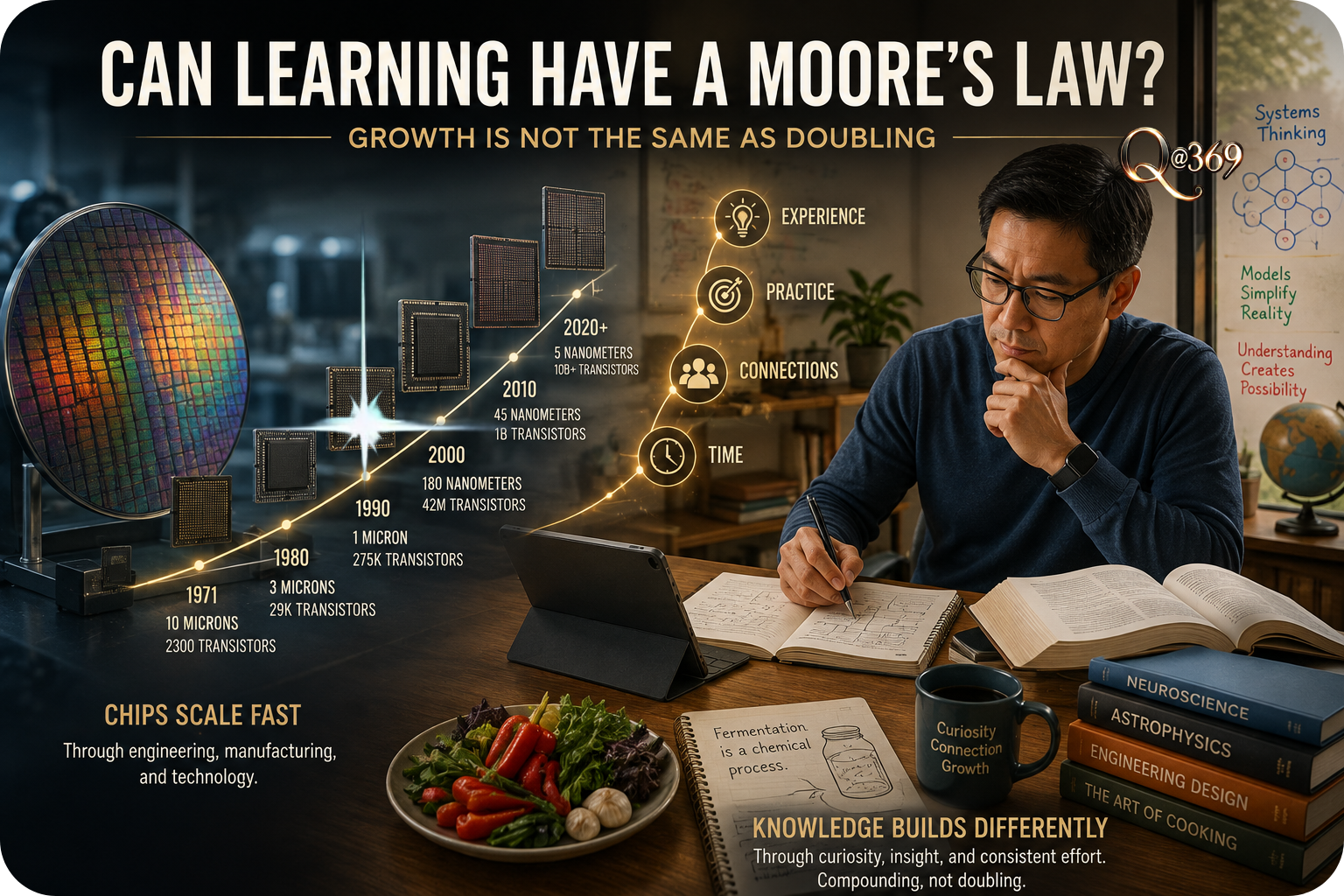
Why Human Learning Does Not Follow The Same Curve As Computer Chips
What happens when we apply one of computing’s most famous growth patterns to our own ability to learn?

Knowledge can compound across a lifetime, although human learning does not increase exponentially without biological and practical limits.
- Moore’s Law describes a historical trend in semiconductor technology, not human intelligence.
- Learning can become more efficient as existing knowledge helps organize new information.
- Neural plasticity allows the brain to adapt through learning and experience.
- Attention, memory, sleep, time, and cognitive load create real limits.
- Tools can increase what we accomplish without increasing the brain’s raw capacity at the same rate.
- Sustainable learning depends more on connection and practice than endless acceleration.
✨ AUDIO: Listen to “What happens when we apply one of computing’s most famous growth patterns to our own ability to learn?” by Isaac Yue
🎯 Also Available on SPOTIFY
🙏 Join Our Enlightened Community Today!
💞 Share with Friends and Colleagues
A Fascinating Engineering Comparison
Engineers are accustomed to asking what happens when performance improves generation after generation. Computing provides one of the most famous examples through Moore’s Law.
Gordon Moore observed in 1965 that semiconductor component density was increasing rapidly. His observation later became associated with the remarkable long term growth of computing capability.
Now consider a very different system.
Your brain.
If computers could improve so dramatically across decades, could your personal ability to learn follow something remotely similar?
The comparison is tempting. It is also where we need to separate a useful analogy from scientific reality.
What Moore’s Law Actually Describes
Moore’s Law is sometimes described casually as computers becoming twice as powerful every two years. That description misses an important distinction.
Moore originally discussed the number of components that could economically fit onto integrated circuits. The observation evolved as semiconductor manufacturing advanced.
It was never a biological law. It does not claim that every technological capability automatically doubles at a fixed interval.
That distinction matters before applying the idea to learning.
A semiconductor industry can redesign manufacturing processes, shrink transistors, change architectures, and manufacture billions of nearly identical components. Your brain operates under very different conditions.
Your Brain Is Not A Processor Upgrade
Human learning depends on biological systems shaped through development and evolution.
Neurons communicate through complex networks. Learning can alter the strength and organization of neural connections through processes associated with neuroplasticity.
That adaptability is remarkable, although it is not unlimited.
You cannot install twice as many neurons every eighteen months. Your working memory does not automatically double because you studied diligently for two years.
Biological learning follows different rules.
Knowledge Can Still Compound
Here is where the comparison becomes more useful.
Imagine learning your first few concepts in astronomy. Every unfamiliar term requires effort because you have little existing knowledge available for context.
Continue studying and something changes.
A new concept can connect with ideas you already understand. Gravity connects with orbital motion. Orbital motion connects with planetary systems. Spectroscopy connects light with chemistry.
Your accumulated knowledge creates structure.
New information no longer arrives alone. It has somewhere to connect.
This can make learning feel faster without requiring the brain’s basic processing capacity to double.
Expertise Changes What You See
Experience can also change how efficiently we interpret information.
A beginning chess player may see many individual pieces. An experienced player can recognize meaningful configurations because years of learning created organized knowledge.
Something similar happens across many fields.
An experienced engineer may look at a manufacturing problem and recognize patterns that a newcomer must analyze individually. A musician can hear structure where another listener hears only a pleasant song.
The expert did not necessarily acquire a dramatically faster brain.
The expert acquired better organized knowledge.
That distinction is important.
Learning Has Bottlenecks
Human learning also encounters constraints that semiconductor manufacturing does not share.
Attention is limited. Working memory can handle only a restricted amount of information simultaneously. Fatigue reduces performance, while distraction competes for cognitive resources.
Sleep matters because memory consolidation continues after active study. Practice requires time, and meaningful understanding often requires repeated exposure.
There is also interference.
Learning too much related information too quickly can sometimes make retrieval harder. More input does not automatically create more understanding.
These limitations prevent learning from following an unrestricted exponential curve.
More Hours Are Not Always Better
Suppose you decide to double your learning.
You read twice as many books, watch twice as many lectures, subscribe to twice as many podcasts, and save twice as many articles.
You have doubled your information intake.
You have not necessarily doubled your learning.
Information becomes useful when attention, understanding, memory, practice, and retrieval work together. Without those processes, accumulating material can become another form of clutter.
Effective learning requires selection.
Sometimes learning more begins by consuming less.
Technology Changes The Equation
There is another reason the Moore’s Law comparison remains interesting.
Human beings increasingly learn with technological assistance.
Search engines provide rapid access to information. Digital libraries place enormous collections within reach. Simulations allow learners to explore systems that would be expensive or dangerous to reproduce physically.
Artificial intelligence adds another layer.
These tools can explain unfamiliar concepts, organize information, generate practice questions, compare perspectives, and help someone explore a subject more efficiently.
The tool does not automatically make the learner more knowledgeable.
It can reduce some barriers between curiosity and understanding.
The Extended Learning System
This creates a useful distinction between personal biological capacity and effective learning capability.
Your brain may not double its processing ability every two years. The system surrounding your brain can become considerably more capable.
Better tools can improve access.
Experience improves pattern recognition. Existing knowledge provides context. Good study methods improve retrieval, while collaboration gives access to knowledge held by other people.
Together, these resources can increase what one person can accomplish.
The growth belongs to the combined system rather than the brain alone.
There Is A Better Curve
Perhaps we are asking the wrong question when we wonder whether learning has a Moore’s Law.
The goal does not need to be doubling how much you know every few years.
A more practical goal is improving the connections among what you already know.
One new idea can change the usefulness of several older ideas. A skill learned for one purpose may unexpectedly help solve a completely different problem.
Knowledge can therefore create increasing value without increasing at an exponential rate.
That is a more realistic form of compounding.
Curiosity Creates Direction
Learning also differs from computing because humans decide what deserves attention.
You cannot study everything.
Curiosity helps provide direction. Purpose helps determine which information deserves deeper attention, while reflection helps separate useful knowledge from interesting noise.
This creates a relationship among curiosity, intention, action, and observation.
Ask a question. Explore it. Practice what you learn. Observe what changes. Then allow the result to create the next question.
Growth becomes an ongoing process rather than a race toward maximum information.
Isaac Yue Reflection
As an engineer, I find Moore’s Law fascinating because it represents more than smaller transistors. It represents decades of accumulated knowledge, experimentation, manufacturing improvement, and problem solving.
That may be the better comparison with human learning.
I do not expect my brain to become twice as capable every two years. I do expect what I learned yesterday to help me understand something tomorrow.
Engineering taught me concepts that later influenced my writing. Writing made me examine how clearly I understood ideas that once seemed familiar.
Cooking introduced another form of experimentation. Travel, family, reading, conversations, successes, and mistakes added knowledge that no engineering textbook could provide.
The value came from connections.
One area of learning occasionally made another area more useful.
That is the kind of compounding I want to continue.
Build Connections Instead Of Chasing Volume
There is a practical lesson here.
Do not measure learning only by books completed, courses taken, videos watched, or information collected.
Ask what you can connect.
When learning something new, identify one idea you already understand that relates to it. Then explain the connection in your own words.
Use the idea.
Teach it to someone. Apply it to a problem. Compare it with another concept. Return to it after some time has passed.
These activities require more effort than simply consuming information. They also give knowledge greater opportunity to become useful.
Your Personal Learning Curve
Human learning does not have a Moore’s Law.
Our brains face biological limits. Our days contain only so many hours, and attention remains a valuable resource.
Yet that does not make lifelong learning disappointing.
Knowledge can accumulate. Skills can improve. Experience can create pattern recognition, while technology can extend access to information and analytical tools.
Most importantly, new knowledge can increase the usefulness of knowledge already acquired.
Perhaps your personal learning curve should not ask:
How quickly can I double what I know?
A better question is:
How can what I learn today make what I already know more useful tomorrow?
Practical Action
Choose one idea you learned recently. Connect it with something you already understand from another part of your life.
Write down the connection and one practical use for it.
You do not need your knowledge to double.
You need it to become increasingly connected, accessible, and useful.

References
- 1. Moore, G. E. (1965). “Cramming More Components onto Integrated Circuits.” Electronics, 38(8). This is the original article behind what became known as Moore’s Law. Moore described rapidly increasing integrated circuit complexity and projected that component counts could reach about 65,000 per chip by 1975. The Computer History Museum notes that Moore later revised the expected pace to approximately doubling every two years. (CHM)
- 2. Lövdén, M., Wenger, E., Mårtensson, J., Lindenberger, U., & Bäckman, L. (2013). “Structural Brain Plasticity in Adult Learning and Development.” Neuroscience & Biobehavioral Reviews, 37(9), 2296–2310. This review examines evidence for experience dependent structural changes in the adult human brain. It supports the article’s discussion of neuroplasticity while avoiding the misleading implication that human learning capacity simply doubles over predictable intervals. (PubMed)
- 3. Dunlosky, J., Rawson, K. A., Marsh, E. J., Nathan, M. J., & Willingham, D. T. (2013). “Improving Students’ Learning With Effective Learning Techniques: Promising Directions From Cognitive and Educational Psychology.” Psychological Science in the Public Interest, 14(1), 4–58. This extensive review evaluates learning techniques through cognitive and educational psychology. It supports the article’s practical argument that effective learning depends on how information is studied and retrieved rather than simply increasing information consumption. (Sage Journals)
See more of QuantumAlchemist369™ selected self-empowerment knowledge selections on the Book Shelf
Interactive Live Meetups
Thursday 7PM EDT Live Q&A with Isaac Yue
Join the Live Meetup Community discussion.
2026 Community Feedback Now Open
You are invited to help build QuantumAlchemist369. Take a few minutes to complete the Quantumarian Community Review 2026.
“Quantum Alchemy: The Convergence of Science, Spirit, and Enlightenment”
Second Edition – Refined & Expanded


Leave a Reply