
Why can a failed prediction disappear from attention while the next frightening prediction quickly captures our curiosity?

Doomsday predictions combine uncertainty, emotion, probability, and storytelling in ways that naturally attract human attention.
In This Article You Will Discover:
- Why threatening predictions capture attention so effectively.
- How uncertainty can make dramatic explanations attractive.
- Why failed predictions do not necessarily change beliefs.
- How probability differs from possibility.
- How critical thinking can evaluate extraordinary predictions.
- Why uncertainty can be accepted without expecting catastrophe.
✨ AUDIO: Listen to “Why can a failed prediction disappear from attention” by Isaac Yue
🎯 Also Available on SPOTIFY
🙏 Join Our Enlightened Community Today!
💞 Share with Friends and Colleagues
The Prediction Changes, The Pattern Remains
Human history contains no shortage of predicted endings. Religious prophecies, astronomical events, technological fears, calendar interpretations, environmental concerns, and social changes have all inspired catastrophic predictions.
The details change. The underlying pattern remains remarkably familiar.
Someone identifies a real event, unusual observation, ancient text, scientific development, or social concern. An interpretation follows, uncertainty grows, and eventually someone announces a date or catastrophic outcome.
The doomsday predictions attract attention because the consequences sound enormous.
Then the date arrives.
Life continues.
Soon another prediction takes its place.
Your Brain Pays Attention To Threats
There is a practical reason frightening predictions are difficult to ignore.
Human attention is sensitive to potential threats. Missing harmless information usually carries little cost. Missing genuine danger can carry much greater consequences.
This does not mean humans automatically believe every frightening claim. It means threatening information can receive more attention than its probability deserves.
A headline announcing that nothing unusual will happen tomorrow has little emotional power.
A claim that tomorrow could change everything creates uncertainty.
Our attention has already been recruited before we evaluate the evidence.
Possibility Is Not Probability
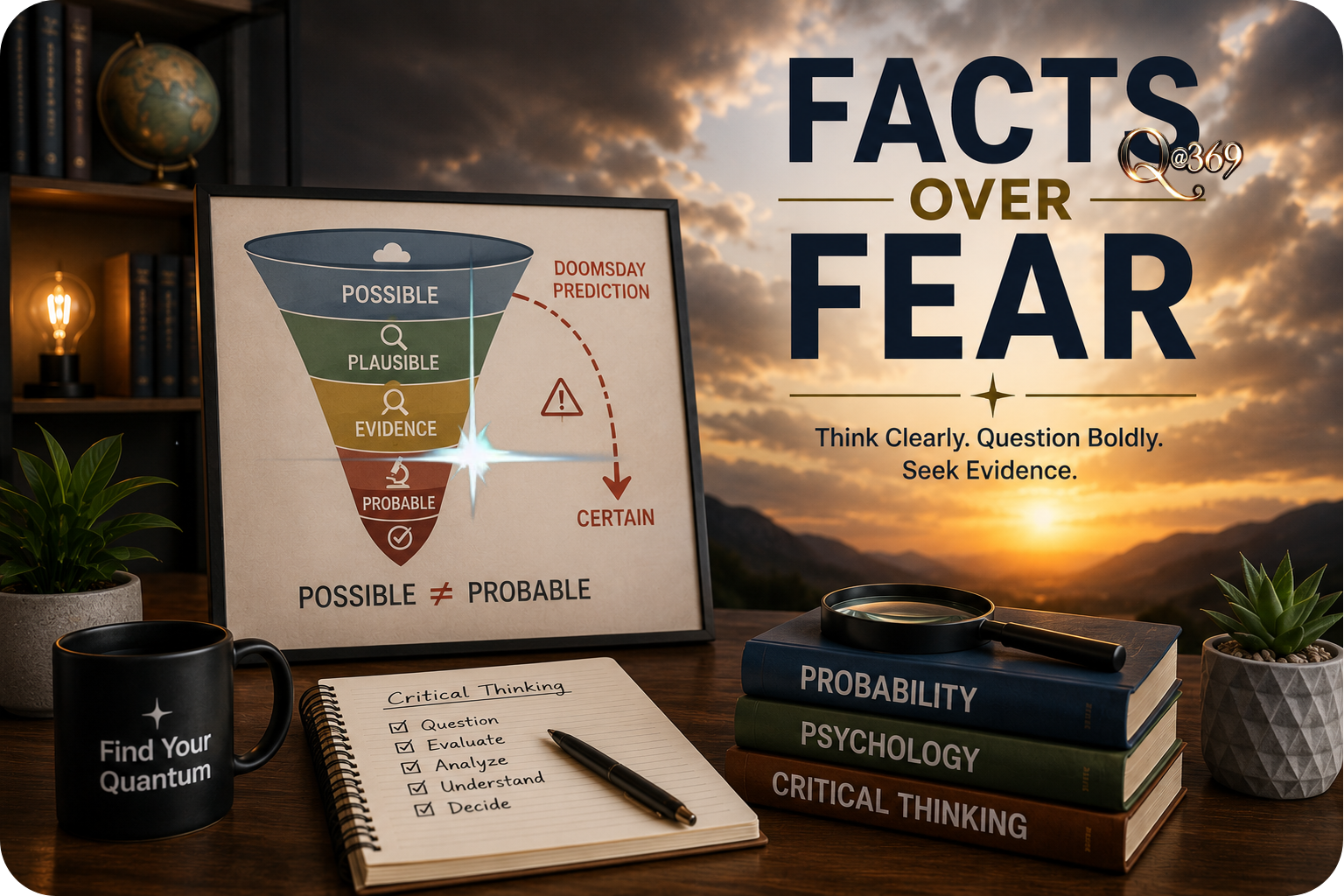
One of the most useful distinctions in critical thinking is the difference between possible and probable.
Many events are physically possible while remaining extraordinarily unlikely.
Imagine someone says a large asteroid could eventually strike Earth. That statement describes a genuine category of natural risk.
Now imagine someone claims a particular asteroid will destroy civilization next Tuesday.
That is a very different claim.
The second statement requires evidence supporting the object, trajectory, timing, probability, and predicted consequences.
Simply proving that asteroid impacts are possible does not establish that a specific catastrophe is probable.
This distinction applies far beyond doomsday predictions.
“Could happen” is not evidence that “will happen.”
Why Failed Predictions Can Survive
We might expect a failed prediction to permanently discredit the underlying belief.
Human psychology is more complicated.
People can reinterpret what happened. Perhaps the date was calculated incorrectly. Maybe the prediction was symbolic. Perhaps some action prevented the outcome.
Others simply move their attention toward a new claim.
Memory contributes too. Dramatic predictions receive intense attention before their deadline, while their quiet failure may receive much less attention afterward.
The prediction becomes memorable.
Its failure becomes forgettable.
Uncertainty Creates Space For Stories
Uncertainty can be uncomfortable because the future cannot be completely known.
Stories provide structure.
They offer causes, timelines, villains, warnings, and conclusions. A complicated world suddenly appears easier to explain.
But a satisfying explanation is not necessarily an accurate explanation.
Science approaches uncertainty differently. Researchers estimate probabilities, compare competing explanations, collect evidence, revise models, and acknowledge what remains unknown.
That process can feel less emotionally satisfying than certainty.
It is also one of our strongest protections against confident predictions unsupported by evidence.
A Simple Doomsday Test
The next time you encounter a dramatic prediction, resist the urge to immediately believe or dismiss it.
Ask four questions:
What exactly is being predicted?
A useful claim should be specific enough to evaluate.
What evidence supports the prediction?
Look beyond repetition, popularity, screenshots, testimonials, and dramatic language.
What probability is actually established?
Possibility alone tells us very little about likelihood.
What happens if the prediction fails?
Will the person acknowledge the error, or will the explanation simply change?
That final question can reveal whether you are evaluating a testable prediction or an idea designed to survive every possible outcome.
Critical Thinking Does Not Require Cynicism
Critical thinking does not mean automatically rejecting unusual ideas.
It means allowing the strength of our conclusions to follow the strength of the evidence.
Some low probability events do happen. New risks emerge. Scientific understanding changes as better evidence becomes available.
We should remain curious about those possibilities.
But curiosity does not require fear.
We can investigate extraordinary claims without surrendering our judgment to them.
Isaac Yue Reflection

I do not want to become cynical about doomsday predictions. However, I have observed that dramatic doomsday predictions become connected with attention, influence, or financial opportunity. When the predicted event fails to occur, the claim quietly fades away with little accountability.
My day to day mantra is simple: “It is all good.” That does not mean everything will always turn out the way I want. It reminds me to take today as it comes, consider what I actually know, and respond rather than react when uncertainty appears.
I also think the phrase “end of times” can distort our perspective. Humanity occupies only a very small portion of Earth’s approximately 4.5 billion year history. Our presence feels enormously important to us, but it represents a brief moment in the planet’s timeline.
Earth has endured extraordinary changes long before humans appeared. It will continue changing long after our individual lives have passed. On astronomical timescales, the Sun itself will eventually transform Earth’s future.
That perspective does not make human life insignificant. To me, it makes today more significant.
We cannot know everything that tomorrow will bring. We can examine the evidence, accept uncertainty, make thoughtful decisions, and appreciate the day we actually have.
“It is all good.”
Practical Application
The next time a frightening prediction appears in your news feed, pause before sharing it.
Identify the specific claim. Find its original source. Separate what is possible from what is probable. Then look for evidence that could prove the prediction wrong.
If no imaginable outcome could ever prove it wrong, that itself tells you something important.
You do not need absolute certainty before deciding how much attention a claim deserves.
Reflection Question
Think about the last dramatic prediction that captured your attention.
What made it compelling before you had examined the evidence supporting it?
The answer may reveal something useful about how uncertainty, emotion, and curiosity compete for your attention.
Final Takeaway
Doomsday predictions probably will not disappear because uncertainty will not disappear.
Neither will human curiosity.
The goal is not to become uninterested in extraordinary possibilities. It is to become better at distinguishing an interesting possibility from a supported prediction.
Stay curious enough to investigate. Stay skeptical enough to ask for evidence. Stay comfortable enough with uncertainty to wait for the facts.

Forum Discussion
Thursday 7PM EDT Live Q&A with Isaac Yue
Join the Quantumarian Forum Community discussion.
2026 Community Feedback Now Open
You are invited to help build QuantumAlchemist369. Take a few minutes to complete the Quantumarian Community Review 2026.


Leave a Reply