
Why is summer a special moment of reflection and growth?
Summer often arrives with long days, warm sunshine, family gatherings, vacations, and outdoor adventures. Yet for many people, the season also becomes surprisingly busy. Calendars fill with activities, weekends disappear, and the opportunity to simply rest quietly slips away.
Nature offers a different invitation.
Instead of asking us to accomplish more, summer gently encourages us to slow down, spend time outdoors, and reconnect with rhythms that restore both body and mind.
Science increasingly confirms what many families have experienced for generations. Moderate sunlight helps regulate our circadian rhythm and supports vitamin D production. Green spaces reduce mental fatigue, while time outdoors encourages physical activity, lowers stress, and improves emotional well being.
Today we will explore why summer may be nature’s greatest season for restoring balance, renewing our energy, and appreciating life’s quieter moments.
Where Did “The Dog Days Of Summer” Come From?
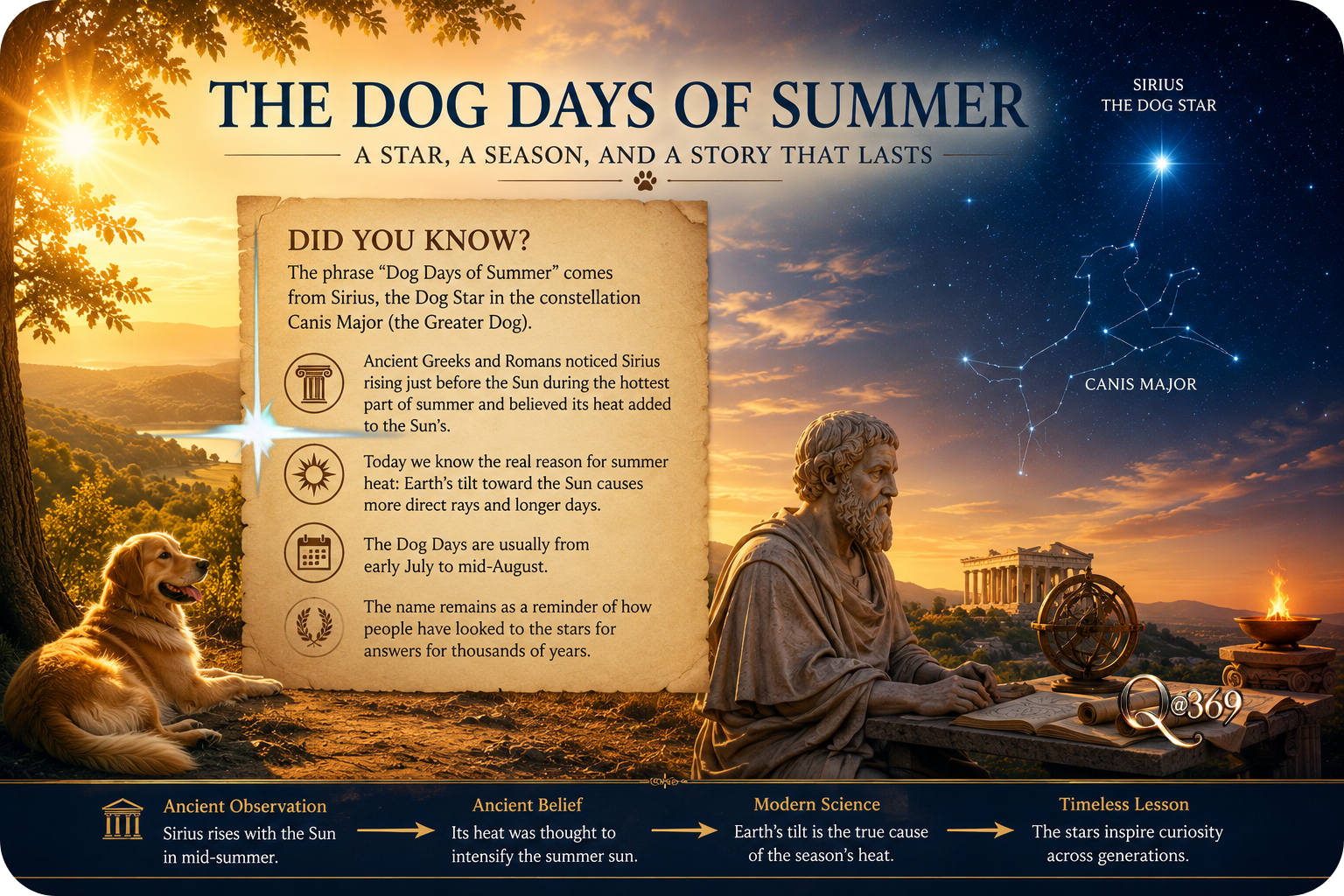
The phrase “Dog Days of Summer” does not refer to tired dogs lying in the shade. It comes from Sirius, the brilliant Dog Star in the constellation Canis Major. Ancient Greeks and Romans noticed Sirius rising before the Sun during the hottest weeks of summer and believed its light added to the Sun’s heat.
Modern astronomy tells us otherwise. Summer temperatures are caused by the Earth’s tilt toward the Sun, not by Sirius. Even so, the expression has survived for more than two thousand years and remains one of the oldest astronomical sayings still used in everyday conversation.
I think this would make an excellent “Did You Know?” sidebar in your Summer Is Nature’s Invitation To Slow Down article because it naturally blends astronomy, history, and science in the QuantumAlchemist369 style.
Nature Knows No Hurry
Walk through a park on a warm summer morning and notice what you do not see.
Trees are not trying to grow faster. Wildflowers bloom according to their season, birds greet the sunrise without checking a schedule, and gentle breezes move through the leaves with quiet consistency.
Nature accomplishes remarkable things without appearing rushed.
Perhaps there is wisdom in that observation. Our modern lives often reward constant productivity, yet biology reminds us that every healthy system depends upon cycles of activity followed by recovery. Summer quietly reminds us that slowing down is not falling behind.
Aylin Sat Beneath The Old Oak Tree

One warm afternoon, Aylin finished tending her small vegetable garden while her young granddaughter happily gathered ripe tomatoes into a woven basket. Together they carried their harvest toward the shade of the old oak tree that had stood beside the family home for generations.
Aylin poured two glasses of cool water, and they sat together beneath the broad branches without saying very much. Butterflies drifted from flower to flower, birds sang from the nearby fence, and a gentle breeze carried the scent of freshly cut grass across the yard.
After several quiet minutes, her granddaughter looked up and asked, “Grandmother, why are we just sitting here? There is still so much we could be doing.”
Aylin smiled warmly.
“We are doing something.”
“We are noticing.”
The little girl became still and looked around more carefully. She noticed the patterns of sunlight dancing through the leaves. She heard insects buzzing softly among the flowers. She watched two butterflies circle one another before disappearing into the garden.
After a while she took a deep breath and quietly smiled.
“It feels peaceful here.”
Aylin nodded.
“Sometimes the most important thing we accomplish is giving our minds permission to rest.”
When they finally stood to return home, the granddaughter carried more than a basket of vegetables.
She carried a memory that would remain with her for many summers to come.
Your Brain Appreciates Green Spaces
Neuroscientists have discovered that natural environments influence the brain in remarkable ways. Time spent in parks, forests, gardens, and other green spaces has been associated with reduced mental fatigue, improved attention, better mood, and lower perceived stress.
Unlike busy urban environments that constantly demand focused attention, natural settings gently engage our senses without overwhelming them. The brain receives an opportunity to recover, allowing our ability to concentrate and think clearly to gradually return after periods of sustained mental effort.
Perhaps this explains why many of our best ideas appear during a quiet walk rather than while sitting behind a computer.
Sunlight Helps Regulate Our Internal Clock
Sunlight provides far more than warmth.
Morning exposure to natural daylight helps regulate the body’s circadian rhythm, the internal biological clock that influences sleep, hormone production, alertness, and energy throughout the day. Regular exposure to daylight also helps the brain distinguish between daytime and nighttime, supporting healthier sleep and more consistent daily energy.
Like every aspect of wellness, balance remains important. Moderate sunlight, appropriate skin protection, hydration, and avoiding excessive heat allow us to enjoy the season safely while receiving its many benefits.
Nature has always offered opportunities for renewal.
Science simply helps us understand why.
The Science Of Rest
Many people think of rest as the absence of productivity.
The brain views it differently.
Neuroscientists have discovered that periods of quiet reflection help the brain process information, strengthen memories, and restore attention after sustained mental effort. During restful moments, the brain continues organizing experiences, solving problems, and forming new connections even though we may appear to be doing very little.
This helps explain why solutions sometimes appear during a walk, while gardening, or after simply sitting quietly beneath a tree.
Rest is not the opposite of productivity.
It is one of the conditions that makes productivity possible.
Doing Less Can Help You Think Better
Our culture often celebrates being busy.
We admire full calendars and long hours, sometimes believing that constant activity automatically leads to greater success.
Biology tells a more balanced story.
Just as muscles require recovery after exercise, the brain benefits from periods of reduced stimulation. Constant notifications, endless scrolling, and multitasking place continuous demands upon our attention, making it more difficult to think deeply or creatively.
Summer provides a natural opportunity to interrupt that cycle.
Reading on a porch, walking through a botanical garden, enjoying an evening sunset, or sharing quiet conversation with family all encourage the mind to slow its pace and regain perspective.
Nature Encourages Mindfulness
Mindfulness does not require a meditation cushion or a silent retreat.
It begins with paying attention.
Summer offers countless opportunities to practice that awareness. Feeling warm sunlight on your face, noticing the fragrance of flowers after a summer rain, listening to birdsong at sunrise, or watching clouds drift across a blue sky all gently bring attention back to the present moment.
These experiences may seem ordinary.
Yet ordinary moments often become the ones we remember most because they allow us to fully experience life instead of rushing through it.
Aylin understood this beneath the old oak tree.
She was teaching her granddaughter that noticing is sometimes more valuable than hurrying.
Isaac’s Perspective
Throughout my engineering career, I learned that every reliable system requires maintenance.
Machines perform best when they receive proper lubrication, calibration, inspection, and occasional downtime for preventive care. Ignoring those needs eventually reduces performance and increases the likelihood of failure.
The human body follows a similar principle.
Sleep restores the brain.
Physical activity strengthens muscles and the cardiovascular system.
Quiet reflection helps restore mental clarity.
Time outdoors supports emotional well being.
Although people are infinitely more complex than machines, both remind us that sustainable performance depends upon regular periods of renewal.
Perhaps nature has understood this all along.
“Nature rarely rushes, yet it never forgets to grow. Perhaps we can learn something from that rhythm.” — Isaac Yue
Summer Is An Invitation
Summer does not ask us to become less productive.
It invites us to become more intentional.
Instead of filling every free hour with another obligation, perhaps we can leave space for a family picnic, a morning walk, gardening, reading beneath a favorite tree, or simply watching the sunset without checking the time.
Those moments are not interruptions to life.
They are part of living well.
The granddaughter in Aylin’s story may not remember every chore they completed that afternoon.
She will almost certainly remember sitting beneath the old oak tree beside her grandmother, learning that peace can be found by simply paying attention.
Sometimes the greatest gift summer offers is permission to slow down long enough to notice the beauty that has been waiting for us all along.
Reflection
Think back to your favorite summer memory.
Was it connected to buying something new?
Or did it happen during a simple moment with family or friends?
Perhaps it was sitting on a porch after dinner, watching fireflies appear at dusk. Perhaps it was walking along the beach, listening to waves, or sharing fresh vegetables from a backyard garden with someone you loved.
The moments we treasure most are often the ones that required the least planning.
They simply required our presence.
Summer gently reminds us that slowing down is not wasting time.
Sometimes it is the very thing that allows us to experience life more fully.
Practical Challenge
Choose one hour this week to enjoy summer without a schedule.
Visit a local park.
Walk beneath mature trees.
Read a book outside.
Enjoy a quiet meal on the patio.
Sit beneath a favorite tree with someone you love.
Leave your phone in your pocket.
Instead of asking, “What should I accomplish next?”
Ask yourself,
“What can I notice right now?”
Allow nature to set the pace.
You may return feeling more refreshed than after hours spent trying to stay busy.
Closing Thoughts
Summer has always been one of nature’s greatest teachers.
It reminds us that healthy living is not measured only by productivity, but also by restoration. Just as fields require seasons of growth and renewal, our minds and bodies benefit from moments of quiet reflection, meaningful relationships, and time spent outdoors.
Modern neuroscience continues confirming what many families have practiced for generations. Natural environments help restore attention. Moderate sunlight supports healthy biological rhythms. Physical movement, fresh air, and green spaces contribute to both emotional and physical well being.
Science explains why these experiences matter.
Nature quietly invites us to enjoy them.
Perhaps that is why Aylin chose to sit beneath the old oak tree instead of immediately beginning another task. She understood that her granddaughter would remember far more than the vegetables they harvested.
She would remember the peaceful afternoon.
The butterflies.
The breeze.
The birdsong.
The feeling of being completely present beside someone she loved.
Those are the moments that quietly shape a lifetime.
As another summer unfolds, may we accept nature’s invitation.
Slow your pace.
Take a deep breath.
Spend time outdoors.
Notice the beauty already surrounding you.
Sometimes the greatest progress we make begins with a moment of peaceful stillness.
Research in environmental psychology and neuroscience shows that spending time in natural environments can improve attention, reduce perceived stress, enhance mood, and support cognitive recovery after prolonged mental effort. Morning daylight also helps regulate circadian rhythms that influence sleep quality, hormone production, alertness, and overall well being.

References
- National Institute of Environmental Health Sciences. Nature and Health
https://www.niehs.nih.gov/health/topics/agents/green-space - National Institutes of Health. Benefits of Spending Time in Nature
https://newsinhealth.nih.gov - American Psychological Association. How Nature Improves Mental Health
https://www.apa.org - Centers for Disease Control and Prevention. Benefits of Physical Activity Outdoors
https://www.cdc.gov/physicalactivity
See more of QuantumAlchemist369™ selected self-empowerment knowledge selections on the Book Shelf
Quantum Alchemy: The Convergence of Science, Spirit, and Enlightenment
Second Edition – Refined & Expanded

- Discover the practical link of modern science to ancient wisdom
- Read Sample Pages on Amazon
- Follow the Link to Learn More
- Available in Print, Kindle and Audio.
A Kind Request From the Author
Please give us your feedback.
Leave your comments below. We would love to hear your thoughts
More Summer
Benefits of Joining Our Community
By joining QuantumAlchemist369™, you will love to stay informed and connected with us and the Quantum Alchemist community. Join us and receive free daily email updates of blogs, events, and useful insights.
Leave a Comment
We would love to hear your thoughts. Please leave a comment and share how this content resonates with your own mindful journey.
Forum Discussion
Join the Quantumarian Forum Community discussion.
Sustain the Alchemy
If the insights here have sparked something within you…We invite you to Sustain the Alchemy
You Will Want to Explore
All the items, books and graphic designs, available in our QuantumAlchemist369 Shop
2026 Community Feedback Now Open
You are invited to help build QuantumAlchemist369. Take a few minutes to complete the Quantumarian Community Review 2026.


Leave a Reply