
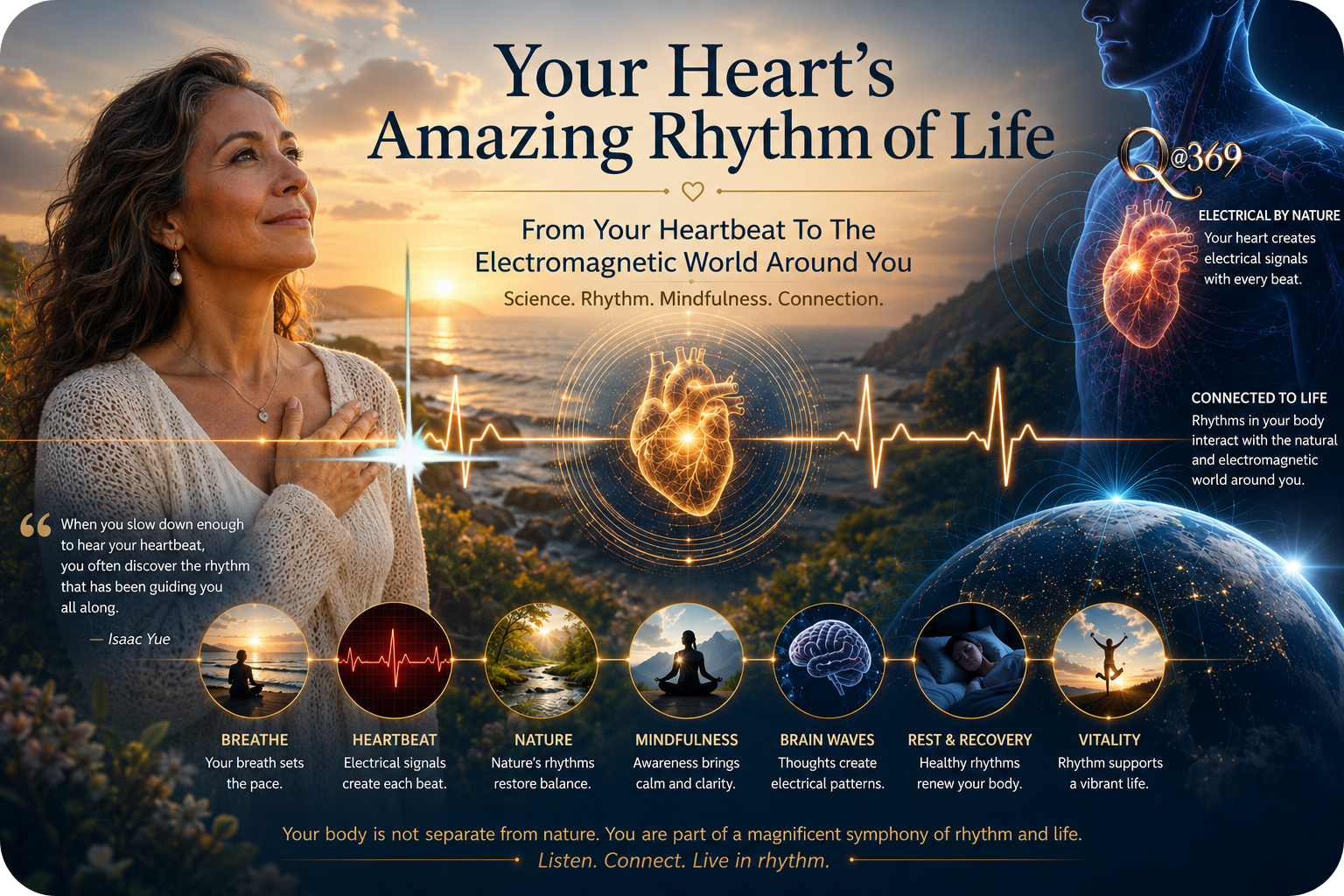
How is every moment of your life guided by rhythm?
Your heart beats without conscious effort. Your lungs expand and contract in steady cycles. Your brain produces electrical patterns that change as you think, sleep, learn, and dream. Even the Earth itself follows predictable rhythms through its rotation, seasons, tides, and the daily cycle of sunlight and darkness The amazing rhythm of life is not random.
They are part of the remarkable organization found throughout nature.
When we recognize these natural patterns, we begin appreciating that our bodies are not isolated from the world around us. We exist within a universe filled with measurable cycles, electrical activity, magnetic fields, and biological rhythms that continually interact with our daily lives.
Today we will explore what science tells us about the rhythms of the human body, how bioelectricity and the heart contribute to our health, and how becoming more aware of these natural patterns can encourage calmer, more intentional living.
Take a moment and simply listen.
You may hear the gentle sound of your breathing.
If you place your hand over your chest, you will feel the steady rhythm of your heartbeat.
Outside, waves reach the shore in repeating patterns. Birds greet the morning with familiar songs. Day follows night with remarkable consistency, and the changing seasons quietly remind us that nature rarely rushes.
Rhythm surrounds us because rhythm is one of nature’s most fundamental characteristics.
Astronomers observe rhythmic planetary motion.
Physicists study repeating wave patterns.
Biologists examine circadian rhythms that regulate sleep, hormones, and metabolism.
Our bodies participate in these natural cycles every second of every day.
Isaac Listened To His Heart

One quiet morning, We were walking along a Florida beach shortly after sunrise.
The air was cool, the waves moved gently across the sand, and the only sounds were seabirds and the steady rhythm of the ocean.
Without thinking about it, I slowed my pace.
My breathing became deeper.
My shoulders relaxed.
For a few moments I simply listened.
I could hear the waves.
I could hear my footsteps.
Then I became aware of something I usually ignored.
My own heartbeat.
It had been working faithfully since long before I could remember, yet I rarely stopped to appreciate it.
As I continued walking, I realized that my breathing, my pace, and my heartbeat had gradually become synchronized. Nothing mystical had occurred.
My body had simply responded to a quieter environment and a slower pace.
That experience reminded me that many of life’s greatest moments do not require adding more activity.
Sometimes they begin by paying closer attention to what is already happening.
“When you slow down enough to hear your heartbeat, you often discover the rhythm that has been guiding you all along.” — Isaac Yue
Your Heart Is An Electrical Organ
Many people think of the heart only as a muscular pump.
It certainly performs that remarkable mechanical task, circulating thousands of liters of blood throughout the body every day.
Yet the heart is also an electrical organ.
Each heartbeat begins with a tiny electrical impulse generated by specialized cells within the heart’s natural pacemaker. That electrical signal spreads through the heart muscle in an organized sequence, allowing the chambers to contract with extraordinary precision.
Those electrical signals are so consistent that physicians can measure them using an electrocardiogram, commonly called an ECG or EKG.
The heart’s electrical activity reminds us that life depends upon carefully coordinated patterns rather than random movement.
Rhythm Supports Health
Researchers continue studying how healthy biological rhythms influence overall well being.
Regular sleep supports memory, learning, and hormone regulation.
Steady breathing can help activate the parasympathetic nervous system, encouraging relaxation after stressful experiences.
Regular physical activity strengthens the cardiovascular system while improving mood and energy.
These rhythms do not guarantee perfect health.
They do demonstrate that our bodies function best when many natural systems work together in balance.
Perhaps that is one reason mindful practices often begin with something remarkably simple.
Pay attention to your breathing.
Listen to your heartbeat.
Become present.
The Body’s Electrical Symphony
Every heartbeat begins with an electrical signal.
Every thought depends upon electrical communication between billions of neurons.
Every muscle movement, from lifting a cup of coffee to taking your next step, is coordinated by tiny electrical impulses traveling through the nervous system.
Electricity is not something added to the human body.
It is part of how the body naturally functions.
Scientists measure these electrical signals every day using electrocardiograms to monitor the heart, electroencephalograms to observe brain activity, and electromyograms to evaluate muscle function. These technologies demonstrate that life depends upon highly organized electrical communication occurring every moment.
The Heart Produces A Measurable Magnetic Field
Electrical activity naturally produces magnetic fields.
Because the heart generates the body’s strongest electrical signal, it also produces the strongest measurable magnetic field generated by the human body. Extremely sensitive scientific instruments called magnetometers can detect this magnetic field outside the body.
This is well established physiology.
Researchers continue investigating how changes in heart rhythm reflect different physical and emotional states. While many questions remain under active study, the existence of the heart’s electrical and magnetic activity is firmly supported by decades of cardiovascular research.
Separating established science from ongoing investigation allows us to appreciate these discoveries without making claims that extend beyond current evidence.
Coherence Begins With Rhythm
One interesting area of research examines how breathing influences heart rhythm.
When breathing becomes slower and more regular, heart rate naturally changes with each breath through a normal physiological process called respiratory sinus arrhythmia. During calm, relaxed breathing, these rhythms often become more synchronized, creating what researchers commonly describe as increased physiological coherence.
Coherence is not a mystical state.
It is a measurable pattern reflecting healthy interaction between breathing, heart rhythm, and the autonomic nervous system.
This helps explain why many mindfulness practices begin with slow, intentional breathing.
The breathing itself does not create magic.
It simply supports normal biological processes that help the body recover from stress and restore balance.
Nature Helps Restore Rhythm
Many people notice they feel calmer after spending time outdoors.
Science offers several possible explanations.
Natural environments reduce unnecessary sensory stimulation.
Walking encourages steady breathing.
Birdsong, ocean waves, rainfall, and rustling leaves all present gentle repeating rhythms that many people experience as calming.
Even exposure to natural daylight helps regulate circadian rhythms that influence sleep, hormone production, mood, and alertness.
Perhaps this is one reason people throughout history have sought quiet places in nature when they needed clarity.
Sometimes the mind becomes quieter because the environment becomes simpler.
Isaac’s Perspective
One lesson I learned throughout my engineering career is that every successful system depends upon rhythm and timing.
Whether designing electronic equipment, improving manufacturing processes, or troubleshooting complex assemblies, stable systems rarely operate through random events. They depend upon signals arriving at the proper time, components working together, and small variations remaining within acceptable limits.
The human body demonstrates a similar principle.
Our heart, lungs, nervous system, and countless biological processes operate through extraordinary coordination. Although the body is vastly more complex than any machine we could build, both remind us that organization, rhythm, and balance contribute to reliable performance.
That realization has influenced how I approach daily life.
When I become overwhelmed, I rarely begin by trying to solve every problem immediately.
Instead, I slow my breathing.
I take a walk.
I listen to my heartbeat.
I reconnect with the natural rhythms that have quietly supported me since the day I was born.
Sometimes the first step toward clearer thinking is not moving faster.
It is slowing down enough to hear the remarkable rhythm that has always been there.
Reflection
Pause for a moment and place your hand over your heart.
Without trying to change anything, simply notice its steady rhythm.
How often do you stop and appreciate that your heart has been faithfully beating every moment of your life? Most of us rarely think about it until something interrupts its normal rhythm.
Perhaps one lesson nature quietly teaches is that many of the most important things in life happen consistently, without demanding our attention.
The heartbeat reminds us that stability, balance, and rhythm often accomplish more than constant activity.
Practical Challenge
Sometime today, spend five uninterrupted minutes reconnecting with your body’s natural rhythms.
Find a quiet place.
Take slow, comfortable breaths.
If possible, place one hand over your heart and simply notice your breathing without trying to control it.
If you are outdoors, listen to the wind, the birds, or the waves.
Allow your attention to rest upon the steady rhythms that already surround you.
You may discover that clarity often appears when distractions begin to fade.
Closing Thoughts
Our modern world encourages constant movement.
Notifications arrive without pause.
Schedules become crowded.
Attention shifts from one responsibility to another.
Amid all that activity, it becomes easy to forget that our bodies continue following rhythms that have supported human life for thousands of generations.
Our hearts beat.
Our lungs breathe.
Our brains produce electrical activity.
Our biological clocks regulate sleep, energy, and recovery.
These remarkable systems operate with extraordinary precision, quietly reminding us that life depends upon balance rather than constant acceleration.
Science helps us appreciate these rhythms through measurable electrical signals, cardiovascular physiology, neuroscience, and circadian biology.
Mindfulness invites us to become more aware of them.
Together they encourage a simple yet powerful realization.
Sometimes improving our lives does not begin by adding more.
Sometimes it begins by noticing more.
Throughout my engineering career, I learned that reliable systems depend upon timing, coordination, and stability. The human body demonstrates these same principles with a level of complexity that continues inspiring scientists around the world.
The next time life feels hurried, pause for a few moments.
Listen to your breathing.
Notice your heartbeat.
Take a slow walk.
Reconnect with the remarkable rhythm that has been quietly supporting you since your very first day.
The heart produces the body’s strongest measurable electrical signal and generates a corresponding magnetic field that can be detected using specialized instruments such as magnetocardiography. Research also shows that slow, relaxed breathing influences heart rate variability through normal autonomic nervous system function, supporting healthy cardiovascular regulation and improved stress recovery.

References
- American Heart Association. How the Heart Works.
https://www.heart.org - National Heart, Lung, and Blood Institute. How the Heart Works.
https://www.nhlbi.nih.gov - National Institute of General Medical Sciences. Circadian Rhythms.
https://www.nigms.nih.gov - National Institutes of Health. Heart Rate Variability Research.
https://www.nih.gov - Harvard Medical School. Relaxation Response and Stress Management.
https://www.health.harvard.edu
See more of QuantumAlchemist369™ selected self-empowerment knowledge selections on the Book Shelf
Quantum Alchemy: The Convergence of Science, Spirit, and Enlightenment
Second Edition – Refined & Expanded

- Discover the practical link of modern science to ancient wisdom
- Read Sample Pages on Amazon
- Follow the Link to Learn More
- Available in Print, Kindle and Audio.
A Kind Request From the Author
Please give us your feedback.
Leave your comments below. We would love to hear your thoughts
More Amazing Rhythm
Benefits of Joining Our Community
By joining QuantumAlchemist369™, you will love to stay informed and connected with us and the Quantum Alchemist community. Join us and receive free daily email updates of blogs, events, and useful insights.
Leave a Comment
We would love to hear your thoughts. Please leave a comment and share how this content resonates with your own mindful journey.
Forum Discussion
Join the Quantumarian Forum Community discussion.
Sustain the Alchemy
If the insights here have sparked something within you…We invite you to Sustain the Alchemy
You Will Want to Explore
All the items, books and graphic designs, available in our QuantumAlchemist369 Shop
2026 Community Feedback Now Open
You are invited to help build QuantumAlchemist369. Take a few minutes to complete the Quantumarian Community Review 2026.
Featured Offering on 369 Shop


Leave a Reply