
How do you answer the question,
Who are you?
Most people begin with a name, a profession, or the place they call home. Yet our identity develops long before we choose a career or form opinions about the world. It begins much closer to home through the people who raise us, the neighbors who greet us, the communities that support us, and the shared experiences that quietly shape our understanding of belonging.
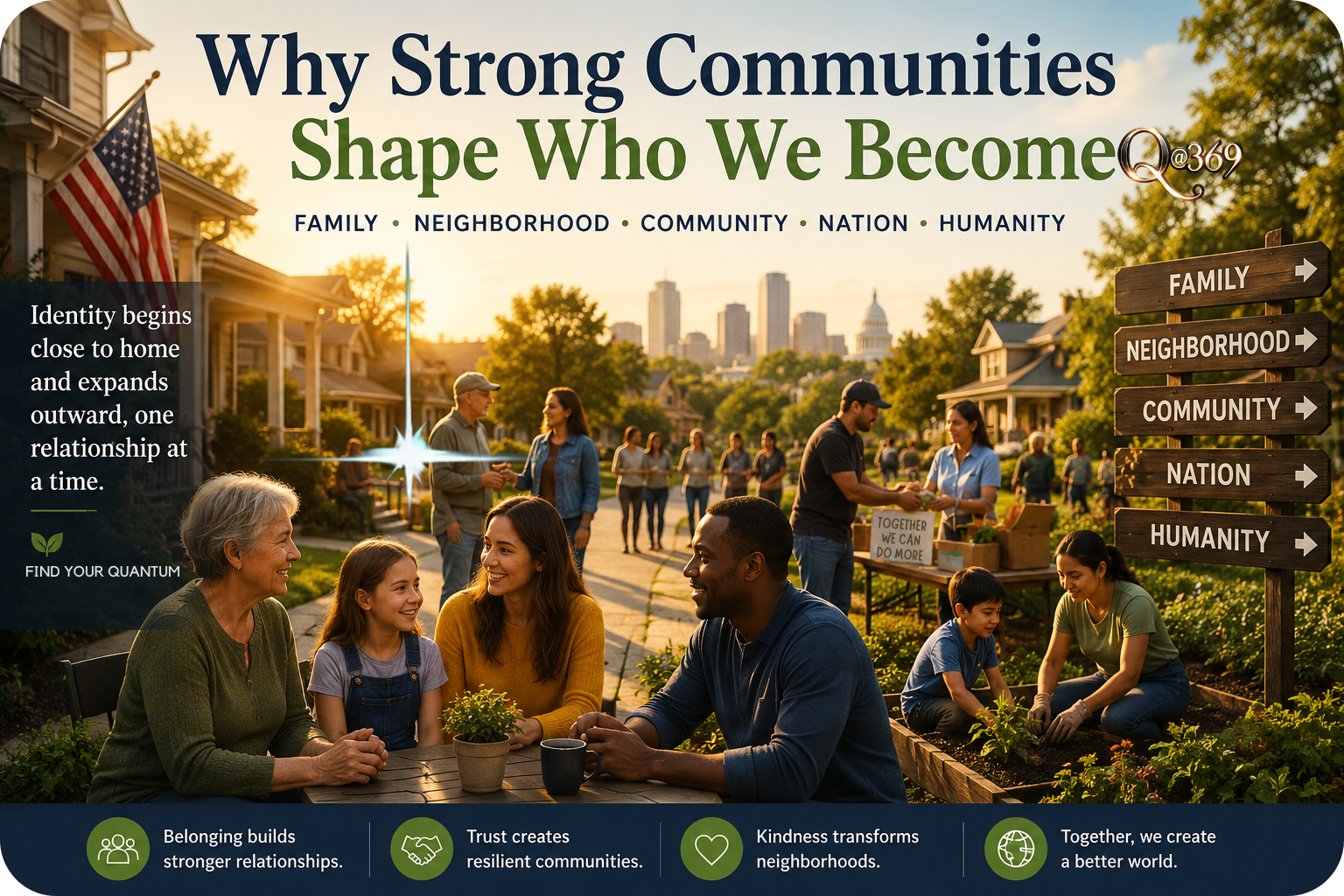
Over time, these circles expand. Family becomes neighborhood. Neighborhood becomes community. Community becomes state. State becomes nation. Eventually we recognize that every person also belongs to one larger human family. Appreciating each layer helps us build stronger relationships, wiser perspectives, and healthier communities.
Throughout my years as an engineer, I have worked alongside people from many cultures, languages, and backgrounds. Although our traditions sometimes differed, I repeatedly discovered that nearly everyone valued kindness, trust, purpose, and a place where they felt they belonged. That observation has remained with me for decades.
Today we will explore how social psychology helps explain the importance of belonging, why communities shape our identity, and how strengthening the connections closest to us often creates positive change that reaches much farther than we imagine.
Identity Begins With Belonging
Long before children understand geography or history, they begin learning who they are through everyday experiences. They watch how family members treat one another. They notice how neighbors interact. They observe kindness, patience, generosity, disagreement, forgiveness, and cooperation.
These experiences become part of their developing identity. Social psychologists describe this process as socialization, the gradual learning of values, behaviors, expectations, and cultural norms through interaction with other people. Our earliest communities quietly become our first teachers.
This helps explain why belonging matters so deeply. Feeling accepted by family, friends, neighbors, or community members provides more than emotional comfort. It creates stability during uncertain times and encourages confidence as we grow.
Modern society often celebrates independence, yet healthy independence develops most naturally from strong connections. Knowing that others care about us allows us to explore the world with greater confidence because we know we have a place to return.
Julie Ann Knew Every Neighbor

Julie Ann enjoyed evening walks through her neighborhood after finishing work each day. She rarely hurried. Instead, she smiled, waved, and stopped whenever someone wanted to talk.
She knew which neighbor had recently welcomed a new grandchild. She remembered who had lost a beloved pet.
She knew which family enjoyed gardening and which retired couple spent every Saturday volunteering at the local food pantry.
One afternoon a severe thunderstorm moved through the neighborhood. Strong winds scattered tree branches across several yards and temporarily blocked part of the street. Before local crews arrived, neighbors quietly began helping one another.
Someone brought chainsaws.
Another family carried bottled water.
Children gathered fallen branches into neat piles while adults checked on older residents living alone.
Julie Ann noticed something remarkable.
No one waited to be asked.
They already knew one another well enough to recognize who might need assistance.
As the afternoon came to an end, the neighborhood looked much the same as it had before the storm. Yet something important had changed. Everyone felt a little closer because they had shared the experience together.
Later that evening Julie Ann reflected on what had happened.
Communities do not become strong only because people live near one another.
Communities become strong because neighbors gradually become friends.
The Science Behind Belonging
Researchers have spent decades studying how social relationships influence physical and emotional well being. One consistent finding continues to appear across many studies. People who experience meaningful social connections generally report greater life satisfaction, lower stress, and stronger emotional resilience than those experiencing prolonged social isolation.
Our brains evolved within communities rather than in isolation. Cooperation increased survival throughout human history. Because of this long evolutionary history, the brain continues to respond positively when we experience trust, belonging, and supportive relationships.
Neuroscience also demonstrates that positive social interaction activates networks involved in emotional regulation and reward. Encouraging conversations, shared experiences, and acts of kindness often reduce feelings of stress while strengthening emotional resilience.
This does not mean every community is perfect or that every relationship remains easy. Disagreements naturally occur wherever people gather. Healthy communities are not defined by the absence of conflict. They are defined by the willingness to communicate respectfully, solve problems together, and continue caring for one another despite occasional differences.
Expanding Circles Of Identity
Our sense of identity rarely remains fixed throughout life. Instead, it gradually expands through experience.
Most people first recognize themselves as members of a family. As children grow, they begin identifying with classmates, neighborhoods, sports teams, religious communities, volunteer organizations, or local traditions.
Later, broader identities develop through education, careers, travel, military service, civic involvement, or cultural experiences. Many people also develop a stronger appreciation for their state and nation while maintaining deep affection for the communities where they grew up.
Social psychology describes this as multiple social identities. Rather than belonging to only one group, every person participates in many communities throughout life. Each contributes something valuable to personal growth.
These overlapping identities help explain why people often feel pride when supporting a local charity, celebrating a hometown tradition, honoring their country during national holidays, or participating in humanitarian efforts that extend beyond national borders.
Each circle adds another layer without requiring us to abandon the others.
Family teaches love.
Neighborhood teaches cooperation.
Community teaches responsibility.
Nation teaches shared history and civic responsibility.
Humanity teaches compassion that extends beyond every border.
Social Identity Can Unite Or Divide
Social psychologists have long observed that people naturally organize themselves into groups. Families, neighborhoods, schools, professions, communities, and nations all provide opportunities for cooperation and shared purpose. These identities help people feel connected, supported, and valued.
At the same time, every identity carries responsibility. Pride in one’s family should not diminish another family. Appreciation for a neighborhood should not require disrespect toward another community. Love for one’s nation can exist alongside respect for other nations and cultures.
Healthy identity expands rather than contracts. The more secure people feel within their own communities, the more comfortable they often become in appreciating the experiences of others. Confidence and compassion grow well together.
History repeatedly demonstrates that remarkable progress occurs when diverse communities work toward common goals. Scientific discoveries, humanitarian efforts, disaster relief, public health initiatives, and space exploration have all depended upon cooperation across many backgrounds, cultures, and nations.
Recognizing our differences does not weaken humanity.
Recognizing our shared humanity gives our differences greater meaning.
Why Neighbors Still Matter
Modern technology allows us to communicate instantly with people around the world. That capability is extraordinary and has created opportunities previous generations could scarcely imagine.
Yet technology cannot completely replace face to face relationships. A thoughtful conversation across the backyard fence, helping someone carry groceries, attending a neighborhood gathering, or volunteering for a local organization creates trust in ways that digital communication alone often cannot.
Communities become stronger through many small interactions rather than occasional grand gestures. A smile. A greeting. A shared meal. Offering assistance without being asked. These simple moments gradually create neighborhoods where people feel safe, welcomed, and valued.
Research on social capital supports this observation. Communities with stronger interpersonal trust often experience higher levels of civic participation, volunteerism, resilience during adversity, and overall well being. Trust grows through repeated positive experiences between ordinary people living ordinary lives.
Julie Ann understood this lesson without needing to study social psychology.
She simply took the time to know her neighbors.
Identity Continues To Grow
Identity is never completely finished. Every conversation, every friendship, every challenge, and every new experience adds another layer to who we become.
As children, others help shape our identity.
As adults, we accept increasing responsibility for shaping it ourselves.
We choose the habits we practice.
We choose the communities we support.
We choose the values we demonstrate.
Those choices gradually influence our families, our neighborhoods, and the generations that follow.
One thoughtful decision today may become someone else’s example tomorrow.
My Perspective
During my engineering career I worked with talented people from many countries, cultures, and disciplines. Our backgrounds were often very different, yet our goals were remarkably similar. We wanted meaningful work, supportive colleagues, healthy families, and opportunities to contribute something worthwhile.
Those experiences strengthened my appreciation for both local identity and our shared human experience. I became more grateful for my own community while developing greater respect for the communities of others.
That perspective continues to influence my understanding of Quantum Alchemy.
Awareness begins with careful observation.
Compassion begins with understanding.
Positive change begins close to home.
Bringing The Lesson Home
Identity is not built in a single moment.
It develops through thousands of ordinary experiences that quietly shape our character over many years.
The way we treat family members influences future generations.
The way neighbors support one another strengthens entire communities.
Communities working together build stronger states.
States contribute to stronger nations.
Nations cooperating respectfully strengthen humanity.
Every circle remains connected to the next.
Perhaps that is one of life’s quiet reminders.
Improving the world often begins by becoming a better neighbor.
Reflection
Which community has most influenced the person you have become, and how might you strengthen that community this week?
Practical Challenge
During the next five minutes, think of one neighbor, friend, family member, or community volunteer who has positively influenced your life. Reach out with a brief message, make a phone call, or simply thank them in person. A small expression of gratitude strengthens relationships that benefit everyone.
Looking Forward
Identity begins closer than many people realize. It starts within our families, grows through our neighborhoods, expands into our communities and nations, and ultimately reminds us that every person shares the same human journey.
Each day offers another opportunity to strengthen those connections through kindness, curiosity, respect, and service. Small acts performed consistently create stronger families, healthier communities, and a more compassionate world, one relationship at a time.
Until tomorrow, may your curiosity continue growing, your awareness deepen, and your daily choices strengthen the communities that make all of us feel at home.
Research consistently demonstrates that strong social relationships are associated with improved physical and mental health. A landmark meta analysis involving more than 300,000 participants found that individuals with stronger social relationships had approximately a 50 percent greater likelihood of survival compared to those with weaker social connections. Social connection influences stress regulation, emotional resilience, and overall well being.
Why it matters:
Our identity develops through relationships. Investing time in family, neighbors, and local communities benefits not only society but also our own long term health.

References
- Baumeister, R. F., & Leary, M. R. (1995). The Need to Belong: Desire for Interpersonal Attachments as a Fundamental Human Motivation. Psychological Bulletin, 117(3), 497–529. https://doi.org/10.1037/0033-2909.117.3.497
- Holt-Lunstad, J., Smith, T. B., & Layton, J. B. (2010). Social Relationships and Mortality Risk: A Meta Analytic Review. PLOS Medicine, 7(7), e1000316. https://doi.org/10.1371/journal.pmed.1000316
- Putnam, R. D. (2000). Bowling Alone: The Collapse and Revival of American Community. Simon & Schuster.
- Tajfel, H., & Turner, J. C. (1979). An Integrative Theory of Intergroup Conflict. In W. G. Austin & S. Worchel (Eds.), The Social Psychology of Intergroup Relations.
See more of QuantumAlchemist369™ selected self-empowerment knowledge selections on the Book Shelf
INKED RESONANCE
Every Mark Remembers

Science. Consciousness. Love. Loss. Quantum Mystery.
Read Book Sample Prologue Chapter Here
Read Sample Pages on Amazon
A Kind Request From the Author
Please give us your feedback.
Leave your comments below. We would love to hear your thoughts
More Communities
Benefits of Joining Our Community
By joining QuantumAlchemist369™, you will love to stay informed and connected with us and the Quantum Alchemist community. Join us and receive free daily email updates of blogs, events, and useful insights.
Leave a Comment
We would love to hear your thoughts. Please leave a comment and share how this content resonates with your own mindful journey.
Forum Discussion
Join the Quantumarian Forum Community discussion.
Sustain the Alchemy
If the insights here have sparked something within you…We invite you to Sustain the Alchemy
You Will Want to Explore
All the items, books and graphic designs, available in our QuantumAlchemist369 Shop
Featured Offering on 369 Shop


Leave a Reply