
Have do some people see opportunity everywhere while others see only potential problems?
Most of us naturally lean toward one side. We either trust too quickly or question too much. Yet life rarely rewards either extreme optimism or skepticism for very long.
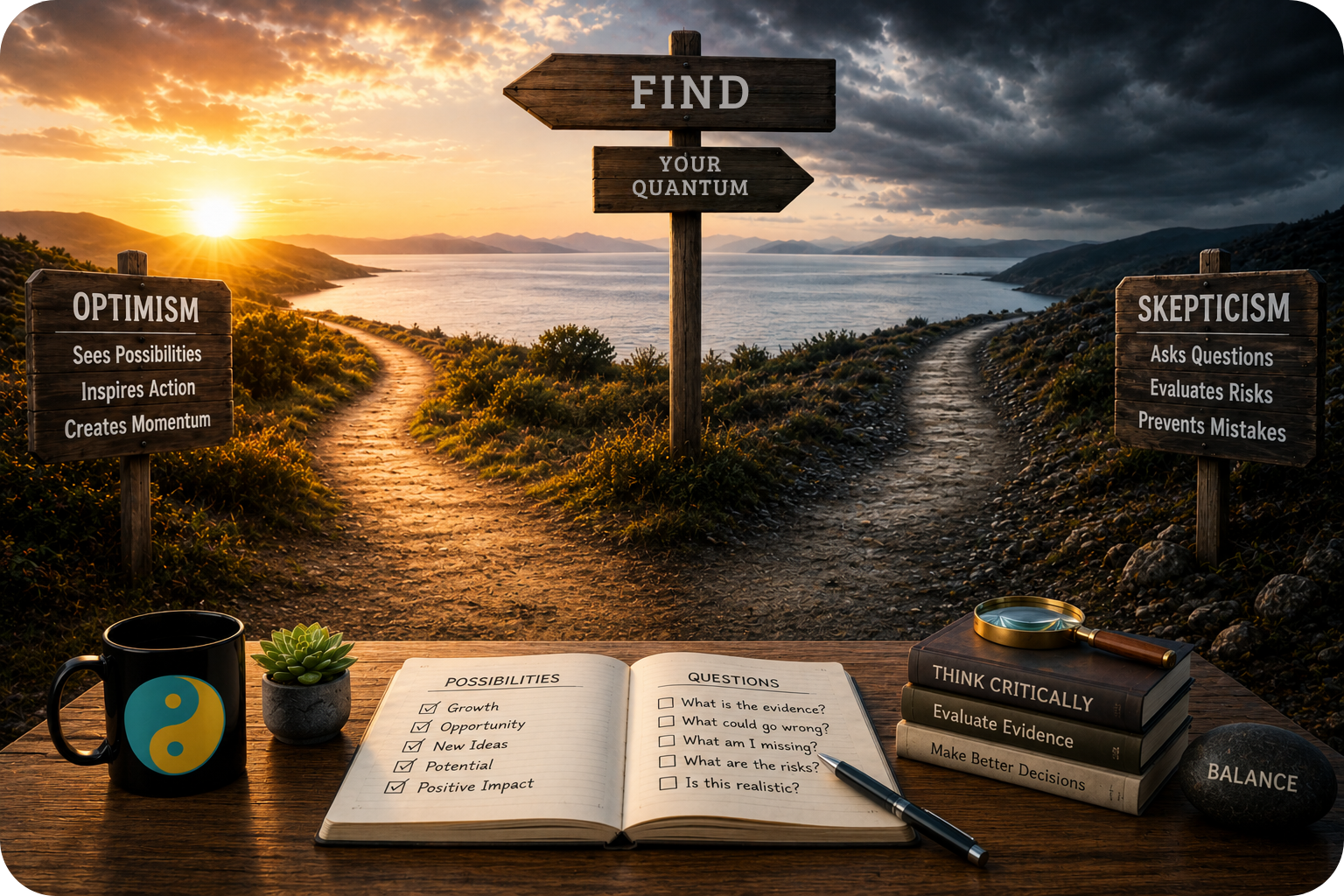
Optimism helps us recognize possibilities and pursue worthwhile goals. Skepticism helps us evaluate risks and avoid unnecessary mistakes. The challenge is not choosing one over the other. The challenge is learning when each perspective serves us best.
Two Valuable Perspectives
Optimism and skepticism are often portrayed as opposites. One appears hopeful while the other appears cautious. In reality, both developed for important reasons.
Optimism encourages exploration. It motivates people to pursue goals, build relationships, start businesses, learn new skills, and attempt things that have never been done before.
Skepticism serves a different role. It encourages careful thinking, asks important questions, and helps identify weaknesses before they become problems. One expands possibilities. The other improves judgment.
Why Optimism Matters
Psychologists have found that optimistic people are often more resilient during difficult circumstances. They are more likely to persist when facing setbacks because they believe improvement remains possible.
This does not mean optimists ignore reality. Healthy optimism recognizes challenges while maintaining confidence that solutions can be found. It provides the emotional energy needed to move forward when outcomes remain uncertain.
Many worthwhile accomplishments begin with a simple belief that success is possible. Without optimism, many opportunities would never be pursued.
Isaac Read The Fine Print

Several years ago I received information about what appeared to be an excellent investment opportunity. The presentation was polished, the testimonials were impressive, and the projected returns seemed attractive.
Like many people, I immediately began imagining positive outcomes.
The optimistic side of my mind focused on what might go right. It was easy to become excited about the possibilities.
Fortunately, another thought appeared before I made a decision.
Read the fine print.
As I reviewed the details more carefully, I discovered conditions, limitations, and risks that received very little attention during the presentation. The opportunity was not necessarily bad, but it was certainly more complicated than it first appeared.
That experience reinforced an important lesson. Optimism encouraged me to explore the opportunity. Skepticism encouraged me to understand it.
Both perspectives proved valuable.
“Duality emerges in the balance of optimism and skepticism. One reveals possibility. The other reveals truth. Wisdom listens to both.” – Isaac Yue
Why Skepticism Matters
Healthy skepticism is often misunderstood. It is not cynicism, negativity, or assuming the worst about everything.
Skepticism simply asks questions. It encourages us to examine evidence, test assumptions, and look beyond first impressions.
Science depends upon this process. Researchers constantly question ideas, test hypotheses, and seek evidence before accepting conclusions. Many important discoveries occurred because someone was willing to ask whether accepted beliefs were actually correct.
The same principle applies to everyday decisions. Healthy skepticism helps protect us from misinformation, unrealistic expectations, poor investments, and unnecessary mistakes.
The Brain Prefers Simplicity
Human beings naturally rely on mental shortcuts when making decisions. These shortcuts help us process information quickly, but they can sometimes create blind spots.
One common example is confirmation bias. We tend to notice information that supports what we already believe while overlooking information that challenges our assumptions.
An optimist may focus heavily on positive evidence. A skeptic may focus heavily on negative evidence. Both can unintentionally create an incomplete picture.
Balanced thinking requires the willingness to consider information from multiple perspectives.
What I Have Observed
Throughout my engineering career I worked with many talented teams. The most successful groups rarely consisted entirely of optimists or entirely of skeptics.
The optimists generated ideas, explored possibilities, and encouraged innovation. The skeptics identified weaknesses, evaluated risks, and improved reliability.
Together they produced stronger solutions than either group could have achieved alone.
Life often works the same way. Progress requires optimism. Protection requires skepticism.
Wisdom requires both.
The Quantum Alchemy Of Balanced Awareness
Quantum Alchemy encourages awareness before reaction. Rather than immediately accepting or rejecting an idea, awareness creates space for thoughtful evaluation.
Optimism asks what possibilities may exist. Skepticism asks what evidence supports those possibilities.
When both questions are considered together, decision making becomes more balanced. We remain open to opportunity without becoming gullible. We remain cautious without becoming fearful.
Balanced awareness helps us navigate uncertainty with greater clarity.
Practical Application
The next time you face an important decision, pause before acting. Give both perspectives an opportunity to participate.
Ask yourself what the best realistic outcome might be. Then consider the worst realistic outcome. Finally, examine the evidence supporting your expectations.
This simple exercise often reveals information that excitement or fear alone may overlook.
Closing Reflection
Most people naturally lean toward one side. Some need a little more optimism. Others need a little more skepticism.
The goal is not choosing between them. The goal is learning how to use both effectively.
What decision in your life might benefit from a little more optimism?
What opportunity might benefit from a little more skepticism?
This week, practice balancing possibility with evidence. You may discover that wisdom often lives somewhere between the two.
Research published in the Journal of Personality and Social Psychology found that realistic optimism is associated with greater resilience, improved coping skills, and higher long term goal achievement compared to both pessimism and unrealistic optimism.

References
- Seligman, M. E. P. (2011). Flourish. Free Press.
- Kahneman, D. (2011). Thinking, Fast and Slow. Farrar, Straus and Giroux.
- Tetlock, P. E., & Gardner, D. (2015). Superforecasting. Crown.
- Shermer, M. (2011). The Believing Brain. Times Books.
See more of QuantumAlchemist369™ selected self-empowerment knowledge selections on the Book Shelf
INKED RESONANCE
Every Mark Remembers

Science. Consciousness. Love. Loss. Quantum Mystery.
Read Book Sample Prologue Chapter Here
Read Sample Pages on Amazon
A Kind Request From the Author
Please give us your feedback.
Leave your comments below. We would love to hear your thoughts
More Optimism
Benefits of Joining Our Community
By joining QuantumAlchemist369™, you will love to stay informed and connected with us and the Quantum Alchemist community. Join us and receive free daily email updates of blogs, events, and useful insights.
Leave a Comment
We would love to hear your thoughts. Please leave a comment and share how this content resonates with your own mindful journey.
Forum Discussion
Join the Quantumarian Forum Community discussion.
Sustain the Alchemy
If the insights here have sparked something within you…We invite you to Sustain the Alchemy
You Will Want to Explore
All the items, books and graphic designs, available in our QuantumAlchemist369 Shop
Featured Offering on 369 Shop


Leave a Reply