

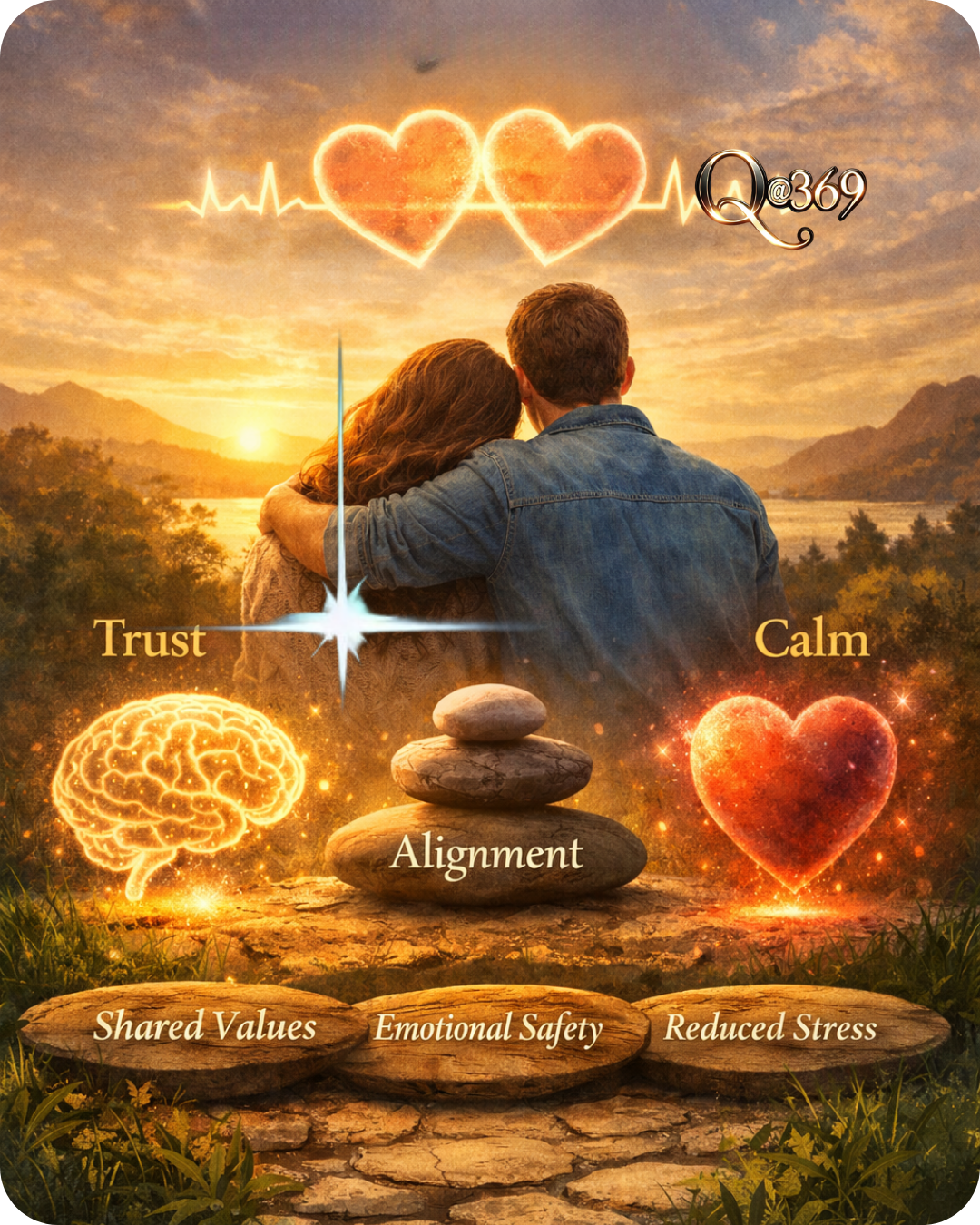
Why do shared values create a sense of calm and safety in relationships?
Biology responds to value alignment as strongly as it responds to physical safety.
This reflection explains how shared values stabilize neurochemistry and trust.
You will learn why alignment reduces stress and supports lasting connection.
☼ AUDIO: Listen to “Why do shared values create a sense of calm and safety in relationships?” by Isaac Yue
☼ Also Available on Spotify
Values and the Nervous System
The nervous system constantly scans for safety or threat.
Neuroscience shows predictability lowers baseline stress activation.
Shared values create emotional predictability through aligned meaning.
This stability supports calmer reactions and clearer communication.
Trust Hormones and Alignment
Oxytocin supports bonding trust and emotional openness.
Research shows oxytocin release increases with perceived similarity and shared intention.
Spiritual alignment deepens meaning beyond surface agreement.
Shared values encourage trust through repeated emotional safety.
Reducing Chronic Stress in Relationships
Misalignment increases uncertainty and vigilance.
Chronic relational stress elevates cortisol over time.
Aligned values reduce cognitive conflict and emotional friction.
This reduction supports long term health and relational ease.
Surprising Relationship Science Fact
Studies show couples with aligned core values experience lower resting heart rates together.
This occurs even during disagreement.
The body responds to shared meaning as stabilizing input.
Alignment influences physiology beyond conscious awareness.
Meaning as a Biological Signal
The brain treats shared meaning as a safety cue.
Neurochemistry responds to coherence between belief and behavior.
Spiritual awareness recognizes meaning as a unifying force.
Shared values anchor connection during challenge or change.

“Value alignment in relationships creates a quiet stability where trust grows naturally and the body relaxes into shared meaning.” – Isaac Yue
Practical Alignment Check
List three values that guide your daily decisions.
Notice whether they appear in shared conversations and choices.
Observe how your body feels during alignment or misalignment.
This awareness reveals relational stability clearly.
Conclusion
Shared values stabilize biology through trust and reduced stress.
Neurochemistry responds to alignment as a form of safety.
Which shared values bring calm to your closest relationships?
Reflect on one value you can honor more consistently.
This practice supports connection health and a harmonious life.
Value alignment predicts lower cortisol levels in long term couples
Smith and Randall Journal of Social and Personal Relationships 2012
References
- Smith, T. W., and Randall, A. K., Emotion Regulation and Relationship Processes, Journal of Social and Personal Relationships, 29(2), 173 to 193, 2012.
- Coan, J. A., Social Baseline Theory, Current Directions in Psychological Science, 22(6), 427 to 432, 2013.
- Gottman, J. M., The Science of Trust, W. W. Norton and Company, New York, 2011.
“The Quantumarian Way”

“The Quantumarian Way” offers a clear and grounded approach to understanding coherence and how it shapes a harmonious life. This book is for those seeking clarity without complexity and harmony without perfection.
- Read Sample Pages on Amazon
- Learn More
Please give us your feedback.
Leave your comments below. We would love to hear your thoughts
More Value Alignment
Benefits of Joining Our Community
By joining QuantumAlchemist369™, you will love to stay informed and connected with us and the Quantum Alchemist community. Join us and receive free daily email updates of blogs, events, and useful insights.
Leave a Comment
We would love to hear your thoughts. Please leave a comment and share how this content resonates with your own mindful journey.
Contact Us
For more information, and to contact Isaac Yue, visit our contact page.


Leave a Reply