
Discover the Scientists, Friendships, and Debates Behind the Quantum Revolution

Commerative Emblem Available Now
Can a single photograph help us understand how some of history’s greatest scientific discoveries began?
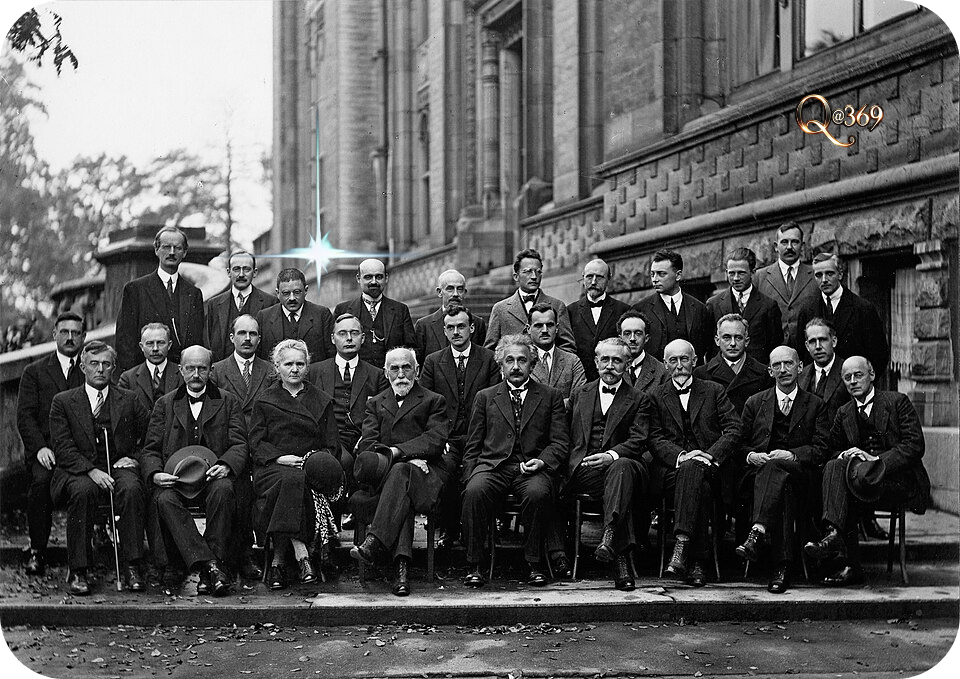
The prologue of Pioneers of Quantum Physics, titled The Photograph, begins with an extraordinary gathering of scientists in 1927. Their faces reveal a human story of curiosity, collaboration, disagreements, and discoveries that transformed our understanding of nature.
This Friday begins our new chapter review series, exploring the people and discoveries presented in the book. Each edition will introduce a chapter and explain what readers can discover through its story.
Five ideas make this opening chapter worth exploring:
- Historical Discovery: The 1927 Solvay Conference brought leading physicists together during a scientific revolution.
- Human Connections: Teachers, students, colleagues, and critics influenced one another’s discoveries.
- Scientific Curiosity: Unanswered questions encouraged new experiments and mathematical explanations.
- Competing Perspectives: Einstein, Bohr, and their contemporaries disagreed about what quantum physics revealed.
- Accessible Learning: Understanding the people provides a welcoming introduction to the science.
The practical benefit is a more approachable understanding of quantum physics. Readers can follow the development of important ideas without beginning with advanced mathematics.
✨Listen to: AUDIO PODCAST or on SPOTIFY
🙏 Join Our Community Today!
💞 Share with Friends and Colleagues
Why Does The Book Begin With A Photograph?
In October 1927, twenty nine scientists gathered for a photograph outside a building in Brussels. They were attending the Fifth Solvay Conference on Physics, where discussions focused on electrons and photons.
Albert Einstein and Marie Curie are among the most recognizable faces. Max Planck, Niels Bohr, Werner Heisenberg, Erwin Schrödinger, and several other influential physicists also appear.
At first, the photograph seems to capture an impressive gathering of accomplished scientists. However, understanding their relationships reveals something more interesting.
These individuals were helping develop a new understanding of nature. Their ideas challenged established explanations of matter, light, and the behavior of atoms.
The photograph captures a brief moment of calm. Behind those composed expressions were unresolved questions that would influence physics for generations.
A Short Excerpt From The Prologue
The following passage captures the central idea behind the opening chapter.
From Pioneers of Quantum Physics, Prologue: The Photograph
“The photograph no longer contains twenty nine separate people. It contains a network.”
This short passage changes how we interpret the famous photograph. Instead of seeing isolated scientific geniuses, we begin recognizing relationships that helped discoveries develop.
The scientists exchanged ideas through conversations, letters, calculations, experiments, and disagreements. Their work demonstrates that scientific progress often depends on intellectual communities rather than individuals working alone.
Young Scientists Who Were Changing Physics
One surprising detail concerns the ages of several participants. Werner Heisenberg and Paul Dirac were only twenty five years old when the photograph was taken.
Heisenberg had already contributed to a new mathematical approach to quantum mechanics. Earlier that year, he had introduced the relationship now known as the uncertainty principle.
Dirac was developing mathematical ideas that would become important to quantum theory. Some of his most celebrated discoveries were still ahead.
Wolfgang Pauli, at twenty seven, had already introduced the exclusion principle. His work helped explain how electrons arrange themselves within atoms.
These were not simply established scientists celebrating past achievements. Several were young investigators confronting problems that would shape their scientific careers.
Their ages remind us that important discoveries can emerge from fresh perspectives. Scientific progress does not always wait for decades of professional recognition.
Einstein, Bohr, And The Importance Of Disagreement
Einstein and Bohr are often presented as opponents in a famous debate about quantum mechanics. However, their historical relationship was more complicated than a simple contest between competing viewpoints.
Einstein helped establish the importance of quantum ideas through his work on light. He later questioned whether the emerging theory provided a complete description of physical reality.
Bohr contributed important ideas about atomic structure and quantum interpretation. His institute in Copenhagen also became an influential center for younger physicists.
Their disagreements reflected deeper questions about probability, measurement, and the nature of physical reality. These questions were not completely resolved during the 1927 conference.
The prologue shows that disagreement can contribute to scientific progress. Challenging an explanation may reveal assumptions that deserve further investigation.
Scientific understanding advances through evidence, criticism, and the willingness to reconsider established ideas.
Why Were These Scientific Relationships Important?
The photograph contains scientists whose work influenced one another across countries and institutions. Their discoveries developed through a connected community of researchers.
Louis de Broglie’s proposal that matter could possess wave properties influenced Erwin Schrödinger. Schrödinger subsequently developed a mathematical approach to quantum mechanics based on waves.
Max Born contributed an interpretation involving probability. His work helped reshape how physicists understood the mathematical descriptions of quantum systems.
Heisenberg worked with Born in Göttingen and spent time in Copenhagen with Bohr. These connections encouraged the exchange of ideas during a period of rapid scientific development.
Not every contributor appears in the photograph. Pascual Jordan, who helped develop matrix mechanics, is one important example.
The photograph therefore represents more than the people standing before the camera. It introduces a much larger community connected through discoveries, criticism, and shared scientific questions.
What Is The Purpose Of This Prologue?
The prologue introduces the people behind quantum physics before explaining their discoveries in historical sequence. Readers first encounter the scientists as individuals rather than names attached to equations.
This approach provides a foundation for understanding the book’s larger story. Familiar names gradually become connected to personalities, relationships, and scientific challenges.
The chapter also establishes an important historical perspective. The scientists in 1927 did not know how their discoveries would influence future generations.
They were investigating problems with incomplete information. Some explanations would survive, while others would require substantial revision.
The book invites readers to experience that uncertainty alongside the scientists. Understanding their questions helps explain why their discoveries mattered.
What Will Readers Gain From The Book?
Pioneers of Quantum Physics is written for curious readers who want to understand the story behind quantum theory. Advanced mathematics is not required to follow the historical narrative.
Readers encounter scientific discoveries through the people who investigated them. Their questions, experiments, disagreements, and relationships provide context for understanding unfamiliar concepts.
The book offers several benefits for readers interested in science and its history.
A More Accessible Introduction
Scientific concepts become easier to approach when readers understand the problems that inspired them. Historical storytelling provides context before introducing more demanding ideas.
A Better Understanding Of Discovery
Readers see that scientific theories develop through investigation and revision. Important discoveries rarely appear as complete explanations without earlier questions or competing proposals.
A Human Perspective On Famous Scientists
Einstein, Bohr, Heisenberg, and their contemporaries become individuals with different personalities and intellectual commitments. Their relationships help explain how scientific knowledge developed.
A Foundation For Further Learning
Understanding the historical development of quantum physics prepares readers to explore its concepts more deeply. The book provides a starting point for continued curiosity.
Isaac Yue Reflection: Seeing The People Behind The Discoveries
When I look at the 1927 Solvay photograph, I see more than an impressive collection of scientific minds. I see individuals who approached the same problems through different experiences and perspectives.
That human dimension influenced how I wanted to write Pioneers of Quantum Physics. I wanted readers to understand the curiosity that motivated discovery before confronting its mathematical explanations.
I find the relationships particularly fascinating. A conversation, disagreement, or unexpected question could influence the direction of someone’s investigation.
Writing about these scientists also reminds me of conversations with people who bring different perspectives to familiar subjects. Sometimes another person’s question reveals something I had overlooked.
The photograph captures that same human quality on a remarkable historical scale. These scientists did not agree about everything, but their shared questions connected them. For me, the story of quantum physics becomes more meaningful when we recognize those connections. The discoveries remain important, but the people make the history memorable.
Quantum Alchemy: Curiosity, Collaboration, And Understanding
Quantum Alchemy explores how scientific understanding can encourage personal reflection. The Solvay photograph provides an opportunity to consider the importance of curiosity and intellectual openness.
Quantum physics developed through experiments, mathematical reasoning, and competing scientific explanations. Its history does not establish that consciousness or personal intention controls physical reality.
However, the scientific community offers a meaningful example of collaborative learning. Researchers advanced understanding by questioning assumptions and examining unfamiliar ideas.
We can apply that lesson to everyday conversations and personal learning. Different perspectives may help us recognize limitations in our existing understanding.
The photograph reminds us that disagreement does not always prevent progress. Sometimes thoughtful criticism becomes an important part of discovery.
A Friday Reflection: Look Beyond The Familiar Faces
Consider a historical photograph, family picture, or image of a community gathering. Look beyond the people you recognize immediately.
Ask yourself what relationships, shared experiences, and unanswered questions might connect them. Consider how those connections influenced events beyond the moment captured by the camera.
The same approach can change how we understand scientific history. Discoveries become more meaningful when we recognize the people and relationships behind them.
Closing Reflection: The Story Begins Before The Photograph
The Fifth Solvay Conference captured a remarkable moment in scientific history. By October 1927, quantum physics had already developed through decades of experiments, discoveries, and disagreements.
However, the scientists in the photograph had traveled different paths to reach Brussels. Understanding those journeys requires returning to the beginning of the quantum revolution.
The prologue ends by taking readers backward toward the questions that first challenged classical physics. A problem involving heat and light would help begin that transformation.
Featured Quote From The Prologue
“What they shared was a problem.” — Pioneers of Quantum Physics, Isaac Yue
Those five words capture the central message of the opening chapter. Different personalities, generations, and interpretations became connected through questions about nature.
Continue The Story
Read Pioneers of Quantum Physics to discover how scientific curiosity transformed our understanding of matter and light. Follow the people, experiments, and debates that made the quantum revolution possible.
Next Friday, we will continue exploring the book’s historical journey through another chapter review. Each edition will offer an accessible introduction to the discoveries and the people behind them.
Which scientist in the 1927 Solvay photograph would you most want to meet, and what would you ask?
Join the Quantumarian Community and share your perspective. Understanding the people behind science can change how we appreciate their discoveries.
Find Your Quantum


Pioneers of Quantum Physics

Interactive Live Meetups
Thursday 7PM EDT Live Q&A with Isaac Yue
Join the Live Meetup Community discussion.
QA369 Forum – Empower Your Life
Join the Conversation? Start sharing your insights today! On our Quantumarian Forum Page


Leave a Reply