
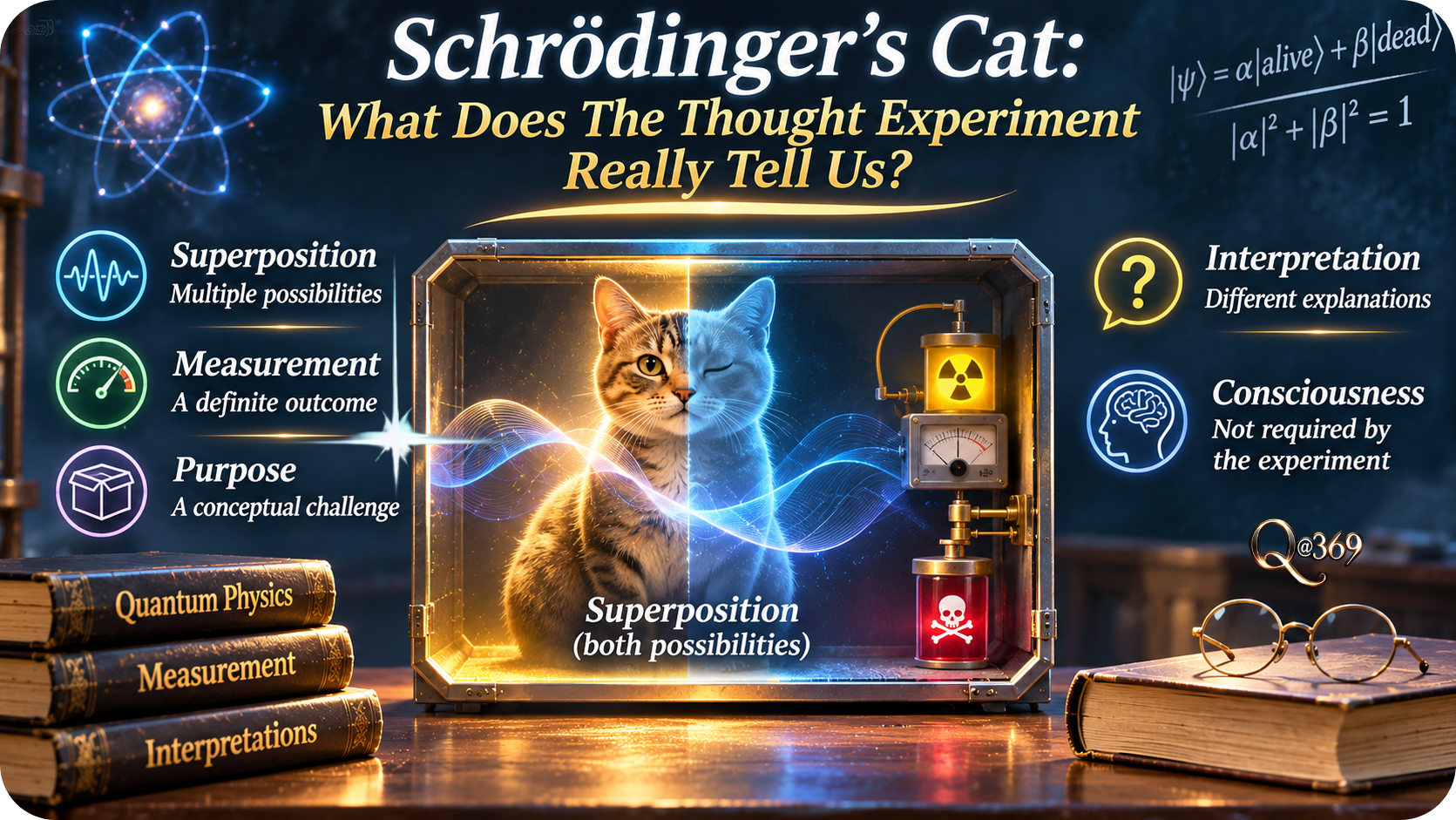
Understanding Quantum Superposition, Measurement, And The Questions That Physics Has Yet To Resolve
|Ψ⟩ = α|no decay⟩|cat alive⟩ + β|decay⟩|cat dead⟩
Can a cat really be alive and dead at the same time, or have we misunderstood one of quantum physics’ most famous thought experiments?
Schrödinger’s cat challenges how we understand quantum superposition, measurement, and physical reality. Its purpose was to expose a conceptual difficulty, not demonstrate that cats can occupy two ordinary physical conditions simultaneously.
- Superposition: How quantum mathematics describes combinations of possible measurement outcomes.
- Measurement: Why interactions with measuring systems produce definite recorded results.
- Schrödinger’s Question: Why quantum behavior becomes puzzling when extended to everyday objects.
- Interpretation: Why physicists disagree about what the mathematics tells us about reality.
- Consciousness: Why the experiment does not establish that human awareness creates physical outcomes.
✨Listen to: AUDIO PODCAST or on SPOTIFY
🙏 Join Our Community Today!
💞 Share with Friends and Colleagues
Why Schrödinger’s Cat Still Matters
Schrödinger’s cat has become one of the most recognizable images associated with quantum physics. Unfortunately, its popularity has also encouraged several misunderstandings.
The experiment does not demonstrate that an ordinary cat can be observed both alive and dead. It asks whether applying quantum theory to increasingly large systems creates a problem requiring further explanation.
This distinction matters when evaluating popular claims about quantum physics. A mathematical description of possible outcomes is not automatically a literal description of everyday experience.
To understand the experiment, we must first examine the concept of quantum superposition.
What Does Quantum Superposition Mean?
In classical physics, we ordinarily describe an object through properties that have definite values. A coin resting on a table displays either heads or tails.
Quantum physics introduces a different mathematical framework. Before measurement, a quantum system can be described through a superposition of states associated with different possible outcomes.
Consider an electron whose spin will be measured along a selected direction. Its quantum state may contain components corresponding to both possible measurement results.
The mathematics assigns probability amplitudes to those components. These amplitudes determine measurement probabilities and can produce interference effects.
Superposition is therefore more than ordinary uncertainty about an unknown result. Quantum interference distinguishes coherent superpositions from classical mixtures of possible outcomes.
However, the mathematics alone does not settle every philosophical question about what exists before measurement.
The Historical Purpose Of Schrödinger’s Cat

“Pioneers of Quantum Physics” Chapter 15 The Cat Was a Criticism
In 1935, Austrian physicist Erwin Schrödinger introduced his famous cat thought experiment. He was examining the implications of quantum theory and the difficulties surrounding measurement.
His imaginary experiment places a cat inside a sealed box. The box also contains radioactive material, a radiation detector, and a mechanism capable of releasing poison.
The arrangement connects a microscopic quantum event with a macroscopic consequence. A radioactive decay can trigger the detector, activate the mechanism, and kill the cat.
If no decay occurs, the mechanism remains inactive and the cat survives.
The radioactive system may initially be described through a quantum superposition involving decay and no decay. Schrödinger asked what happens when that description is extended to the entire apparatus.
Does the mathematical description now involve a superposition of a living cat and a dead cat?
Schrödinger intended this uncomfortable consequence to reveal a problem. He was challenging an overly straightforward extension of quantum descriptions into familiar everyday experience.
The cat was not proposed as a practical laboratory demonstration. It was a conceptual argument about the relationship between quantum mathematics and physical reality.
What Happens When We Open The Box?
Popular explanations often claim that opening the box forces the cat to choose between life and death. This wording can create a misleading impression about the role of observation.
In quantum physics, measurement involves physical interactions between systems. A detector can record an event without requiring a conscious person to watch it.
The radiation detector interacts with the radioactive system. The mechanism responds to that interaction, while the surrounding environment interacts with the apparatus and cat.
These interactions matter long before anyone opens the box.
When we eventually inspect the apparatus, we encounter a definite recorded outcome. The difficult question concerns how that definite experience relates to the complete quantum description.
Opening the box reveals the result to us. It does not establish that human awareness caused the result to exist.
Decoherence: Why Everyday Objects Behave Differently
Modern quantum theory includes an important concept called decoherence. It helps explain why quantum interference becomes extremely difficult to observe in large systems.
A microscopic quantum system can sometimes be isolated sufficiently to preserve interference between different state components. Everyday objects interact continuously with their surroundings.
Light, air molecules, thermal radiation, and countless environmental interactions become correlated with those objects. These interactions rapidly suppress observable interference between macroscopically different alternatives.
For a cat and its surroundings, decoherence would be extraordinarily rapid. This helps explain why we do not encounter ordinary cats displaying interference between living and dead states.
However, decoherence does not independently settle every question about measurement.
It explains why alternatives become effectively noninterfering in the relevant description. Whether this process produces one uniquely realized outcome depends on how quantum theory is interpreted.
That distinction remains important.
Quantum Mathematics Versus Quantum Interpretation
Quantum mechanics provides mathematical rules that predict experimental outcomes with remarkable accuracy. Its success does not mean every question about the underlying nature of reality has been resolved.
Physicists broadly agree on the effectiveness of the mathematical framework within its tested applications. They disagree about what certain mathematical features mean physically.
Several interpretations offer different ways to understand the measurement problem.
Copenhagen And Related Approaches
Traditional Copenhagen approaches emphasize the distinction between quantum descriptions and definite measurement outcomes. Some formulations introduce a collapse of the quantum state when measurement occurs.
However, Copenhagen is not one perfectly uniform interpretation. Different physicists have understood its concepts and boundaries differently.
Many Worlds Interpretation
The Many Worlds interpretation treats quantum evolution as universal, without introducing a separate physical collapse process. Measurement produces correlations among different branches of the overall quantum state.
Observers within those branches experience definite outcomes. The interpretation does not claim that someone can freely travel between branches or observe every alternative.
Objective Collapse Theories
Objective collapse theories propose that quantum state reduction is a genuine physical process. Some models introduce modifications to standard quantum dynamics.
These approaches may produce experimentally testable differences under suitable conditions. Their proposed mechanisms remain subjects of scientific investigation.
Bohmian Mechanics
Bohmian mechanics describes particles with definite positions guided by a quantum wavefunction. Its account of measurement differs from collapse centered interpretations.
These approaches demonstrate an important point. Agreement about experimental predictions does not necessarily imply agreement about the underlying explanation.
Does Consciousness Collapse The Wavefunction?
Schrödinger’s cat frequently appears in discussions connecting consciousness with quantum physics. Some popular accounts claim that a conscious observer creates reality by looking at it.
This conclusion does not follow from the thought experiment.
Quantum measurements can be registered through physical detectors and automated instruments. Human awareness is not required to operate those systems or establish their experimental records.
Some historical discussions explored whether consciousness might play a special role in measurement. Such proposals remain speculative and are not established consequences of quantum mechanics.
There is no accepted experimental demonstration that conscious intention causes wavefunction collapse.
This does not mean consciousness lacks scientific or philosophical importance. It means we must distinguish questions about awareness from experimentally supported claims about quantum measurement.
Quantum Alchemy: The Difference Between Reality And Our Understanding
Quantum Alchemy encourages curiosity about the relationship between scientific knowledge, personal experience, and philosophical reflection. Schrödinger’s cat provides an opportunity to practice that distinction.
Quantum physics describes microscopic systems through mathematical structures that differ from everyday intuition. Philosophy asks what those structures reveal about the nature of reality.
Spiritual reflection may explore how uncertainty influences our attitudes toward knowledge and experience. However, personal meaning does not establish a physical explanation.
We can appreciate uncertainty without treating every possibility as scientifically demonstrated.
The practical lesson involves intellectual humility. Understanding improves when we recognize what evidence establishes and what remains open to interpretation.
Isaac Yue Reflection: Curiosity Without Premature Conclusions

I have always appreciated scientific questions that challenge familiar assumptions. Schrödinger’s cat is particularly interesting since its apparent simplicity conceals a difficult problem.
When I encounter an unfamiliar idea, my first interpretation may seem reasonable. Further reading sometimes reveals distinctions that completely change my understanding.
I experience something similar during conversations with people whose perspectives differ from mine. Listening carefully often reveals that we were answering different questions.
Schrödinger’s thought experiment reminds me to distinguish a mathematical prediction from an explanation of reality. Those two questions are related, although they are not identical.
I also appreciate that science can be remarkably successful while important philosophical questions remain unresolved.
For me, curiosity becomes more meaningful when accompanied by patience and intellectual honesty. We do not need to claim certainty to appreciate the wonder of discovery.
A Practical Exercise: Separate Evidence From Interpretation
The next time you encounter a surprising scientific claim, take a moment to examine its foundation.
First: Identify the scientific observation.
What was actually measured or demonstrated? Look for the specific experimental result rather than relying on an attention grabbing headline.
Second: Identify the explanation.
What theory or model accounts for the observation? Consider whether the explanation introduces assumptions beyond the experimental evidence.
Third: Recognize alternative interpretations.
Can the same observation support more than one explanation? Determine whether scientists agree about the prediction while disagreeing about its meaning.
Fourth: Examine the personal conclusion.
Does the claim connect scientific evidence with a philosophical or spiritual belief? Recognize that such connections may be meaningful without becoming established scientific facts.
This exercise applies beyond quantum physics. It can improve how we evaluate information, participate in discussions, and make everyday decisions.
Closing Reflection: What Does The Cat Really Teach Us?
Schrödinger’s cat was designed to challenge our understanding of quantum measurement. It was never intended to establish that human consciousness creates reality.
Superposition is a mathematical and experimentally meaningful feature of quantum systems. Decoherence helps explain why everyday objects rarely display observable quantum interference.
The measurement problem remains a subject of scientific and philosophical discussion. Different interpretations offer different explanations for the definite outcomes we experience.
The enduring value of Schrödinger’s cat lies in the questions it forces us to examine.
Does a successful mathematical description necessarily tell us what physical reality is?
Perhaps the most useful lesson is recognizing the difference between predicting an outcome and explaining its underlying meaning.
This evening, consider a scientific claim you have encountered recently. Ask yourself which parts are supported by evidence and which involve interpretation.
Join the Quantumarian Community and share your perspective.
Can science accurately predict what happens while leaving open questions about what reality fundamentally is?
Keep questioning, keep learning, and remain open to discoveries supported by evidence.
Find Your Quantum

References
- Schrödinger, E. (1935). The Present Situation in Quantum Mechanics. Naturwissenschaften, 23, 807–812, 823–828, 844–849. https://doi.org/10.1007/BF01491891
- Zurek, W. H. (2003). Decoherence, Einselection, and the Quantum Origins of the Classical. Reviews of Modern Physics, 75, 715–775. https://doi.org/10.1103/RevModPhys.75.715
- Schlosshauer, M. (2005). Decoherence, the Measurement Problem, and Interpretations of Quantum Mechanics. Reviews of Modern Physics, 76, 1267–1305.https://doi.org/10.1103/RevModPhys.76.1267
See more of QuantumAlchemist369™ selected self-empowerment knowledge selections on the Book Shelf

Pioneers of Quantum Physics

Interactive Live Meetups
Thursday 7PM EDT Live Q&A with Isaac Yue
Join the Live Meetup Community discussion.
QA369 Forum – Empower Your Life
Join the Conversation? Start sharing your insights today! On our Quantumarian Forum Page


Leave a Reply