
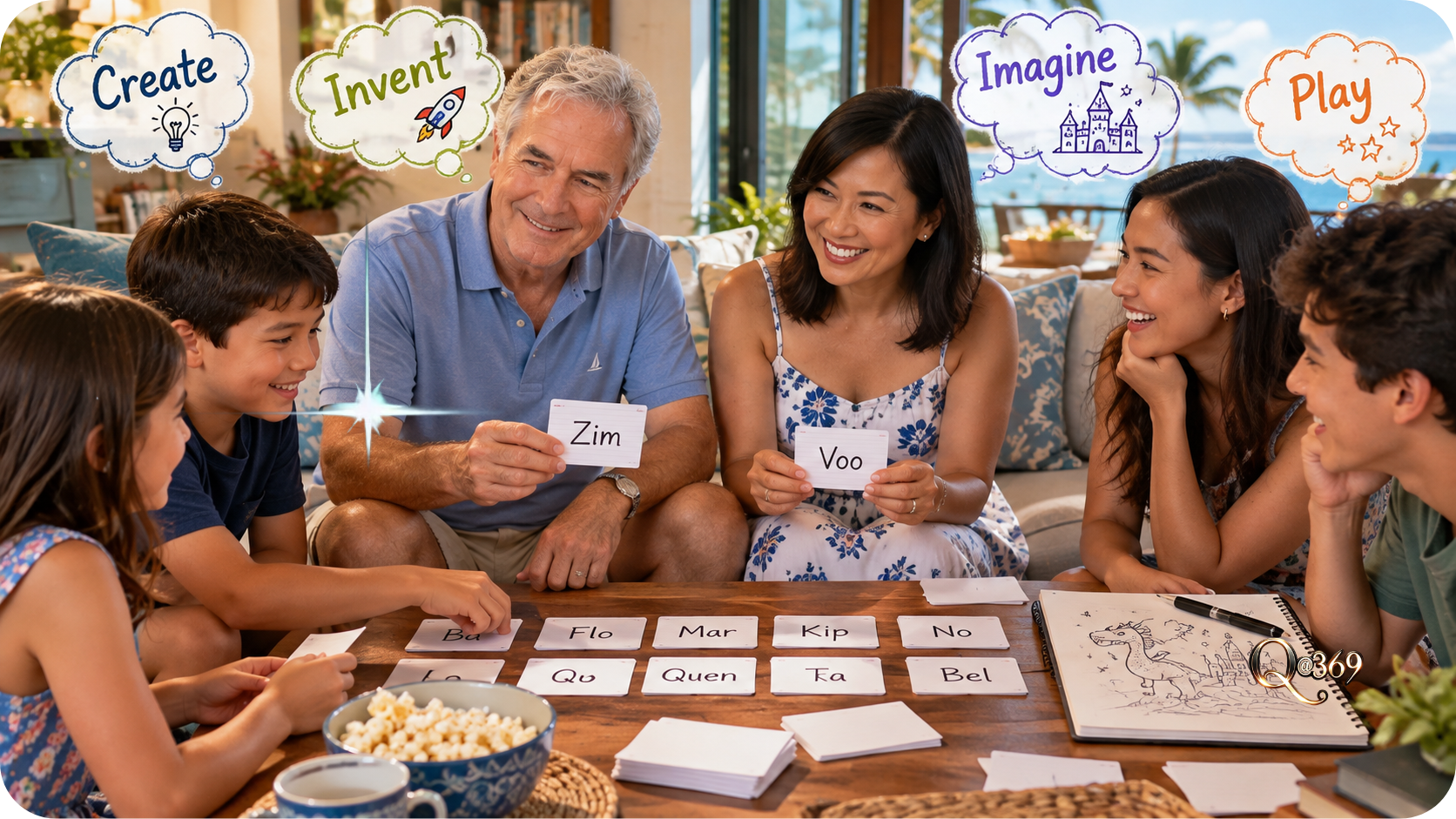
An Original Word Game That Turns Simple Sounds Into Creativity, Laughter, And Shared Experiences
How much imagination can twelve simple syllables unlock when family, friends, or colleagues begin creating together?
A few handwritten cards can become an entertaining experiment in spontaneous creativity. My original Twelve Syllables Game invites participants to invent words, imagine unusual events, and discover unexpected connections.
Creativity grows when we give ourselves permission to experiment without worrying about finding the correct answer.
- Twelve ordinary syllables can become the foundation for an imaginative group activity.
- Inventing fictional words encourages flexible thinking and unexpected associations.
- Shared storytelling can strengthen communication and social connections.
- Playful activities offer opportunities to experiment without performance pressure.
- Creating your own games can turn everyday gatherings into memorable experiences.
✨Listen to: AUDIO PODCAST or on SPOTIFY
🙏 Join Our Community Today!
💞 Share with Friends and Colleagues
The Syllable Game: A Simple Beginning
Imagine twelve ordinary index cards arranged on a table.
Each card measures three by five inches. Each contains one syllable written in large, readable letters.
There are no complicated instructions, expensive materials, or specialized skills required.
The challenge begins when participants combine these syllables into words that do not yet exist.
Then comes the entertaining part.
Everyone imagines what the new word means and invents an unusual event involving it.
A word might describe a mysterious creature, an impossible invention, or a surprising neighborhood celebration.
The possibilities depend entirely on the imagination of the participants.
This is the idea behind my original Syllable Game.
Twelve Cards And An Open Imagination
You can prepare the game in a few minutes.
Gather twelve index cards, a marker, and a table where everyone can participate.
Write one syllable on each card. Choose sounds that are easy to pronounce and interesting to combine.
Here is one possible collection:
| Card | Syllable | Card | Syllable |
| 1 | Zim | 7 | Lo |
| 2 | Ba | 8 | Quen |
| 3 | Flo | 9 | Ti |
| 4 | Mar | 10 | Voo |
| 5 | Kip | 11 | Ra |
| 6 | No | 12 | Bel |
These are examples rather than required syllables. You can invent an entirely different collection.
Arrange the cards face up so everyone can see them.
Each participant selects two or more syllables and combines them into an imaginary word.
There is no dictionary to consult. The purpose is to invent something new.
From A Fictional Word To A Whimsical Event
Suppose someone combines three syllables:
Zim + Ba + Lo = Zimbalo
What could Zimbalo mean?
One participant imagines a musical instrument that plays only when someone laughs.
Another imagines a creature that collects misplaced socks and returns them during thunderstorms.
A third decides Zimbalo is the name of an annual neighborhood festival.
Suddenly, the invented word becomes the beginning of a story.
Imagine the first Zimbalo Festival.
Every resident must bring an object that makes an unusual sound. The town orchestra includes kitchen utensils, bicycle bells, and squeaking shoes.
The mayor attempts to conduct the performance with a feather duster.
Nobody knows when the music will end. Everyone agrees that the festival should return next year.
A few random syllables have created a fictional community, an unusual tradition, and a shared moment of laughter.
The game becomes more entertaining as participants build upon one another’s ideas.
How To Play The Syllable Game
The basic activity has five simple stages.
Stage 1: Choose Your Syllables
Place twelve syllable cards on the table. Allow everyone to examine the available sounds.
Stage 2: Invent A Word
Combine two or more syllables into a fictional word. Say it aloud and enjoy its unusual sound.
Stage 3: Give It Meaning
Decide what the word represents. It could describe a place, creature, invention, celebration, or unexpected event.
Stage 4: Create An Event
Invent a short, whimsical situation involving the word. Include a surprising detail that makes the story memorable.
Stage 5: Build Together
Invite another participant to add something unexpected. Continue until the story reaches an entertaining conclusion.
There is no need to declare a winner.
The goal is to create something together rather than compete for the most impressive answer.
For additional variety, participants can exchange cards or introduce a new syllable during another round.
Why Invented Words Encourage Creativity
Our minds frequently rely on familiar patterns.
We recognize words, recall their meanings, and connect them with previous experiences.
Inventing a new word changes this process.
Without an established definition, participants must create their own associations.
They explore different possibilities and combine ideas that would not ordinarily appear together.
Psychologists describe this ability to generate multiple possible responses as divergent thinking.
Divergent thinking is one component of creativity. It helps people explore alternatives before selecting or refining an idea.
The Syllable Game provides a playful opportunity to practice this approach.
It does not require artistic talent or advanced vocabulary.
A willingness to experiment is enough to begin.
Creating Your Own Game
The Syllable Game is only one example of a larger possibility.
You can invent simple games using ordinary objects, familiar places, or unexpected questions.
Consider a family gathering.
Place several household objects inside a bag. Invite participants to select two objects and invent a new purpose for them.
A wooden spoon and a flashlight might become a device for communicating with imaginary underwater creatures.
At a gathering with friends, write fictional locations on cards.
Participants might create an unusual holiday celebrated in a floating village or a library beneath the ocean.
For colleagues, consider a creative problem solving activity.
Give each group three unrelated words. Ask them to invent a product, service, or workplace improvement connecting those ideas.
The objective is not immediate practicality.
It is to explore possibilities before evaluating which ideas deserve further development.
Each game can be adjusted to match the interests and abilities of its participants.
Creativity Without The Pressure To Perform
Many adults hesitate when asked to be creative.
They may worry that their ideas will appear foolish or that someone else will produce something better.
Play offers a different environment.
When everyone understands that the activity is imaginary, unusual ideas become part of the entertainment.
A fictional word does not need to be useful.
A whimsical event does not need to be realistic.
Participants can explore possibilities without expecting every idea to become a finished product.
This freedom can encourage experimentation.
However, a playful atmosphere requires mutual respect.
Everyone should have opportunities to contribute without ridicule or unwanted pressure.
A welcoming environment matters more than the complexity of the game.
Quantum Alchemy: The Value Of Unexpected Connections
Quantum Alchemy encourages us to examine relationships between knowledge, experience, and personal awareness.
Creative games offer a practical example of exploring unexpected connections.
We begin with familiar sounds and combine them into unfamiliar arrangements.
Our minds then connect these arrangements with memories, emotions, and imagined possibilities.
This is a psychological and creative process, not evidence of a special quantum effect in consciousness.
The value comes from observing how our thinking changes when familiar rules become more flexible.
We can carry that awareness into everyday problem solving.
Sometimes a new perspective begins with combining familiar ideas in an unfamiliar way.
Isaac’s Reflection: Rediscovering The Joy Of Play
I enjoy activities that bring people together through curiosity and imagination.
The Syllable Game grew from a simple idea. I wanted to see how twelve cards could encourage spontaneous creativity.
The most interesting part is not necessarily the fictional word someone invents.
It is watching how another person’s imagination changes the direction of the story.
One idea leads to another. Unexpected connections become opportunities for laughter and conversation.
I particularly enjoy the possibility of sharing this activity with family and friends.
Children may approach the challenge with fewer expectations about what a word should mean. Adults can rediscover the enjoyment of inventing something without a predetermined outcome.
The game also reminds me of an important distinction.
Knowledge helps us understand established meanings. Imagination allows us to explore meanings that do not yet exist.
Both contribute to a richer human experience.
Closing Reflection: Create Something Together
Twelve syllables may appear insignificant when written on separate cards.
Combined with imagination, they can become fictional words, unusual stories, and memorable shared experiences.
The deeper lesson extends beyond the Syllable Game.
Creativity does not always require elaborate equipment, specialized training, or a major project.
Sometimes it begins with ordinary materials and an invitation to experiment.
Your Saturday Creativity Challenge
Gather twelve index cards and invent your own collection of syllables.
Invite family members, friends, or colleagues to create fictional words and whimsical events.
Then take the idea further.
Design a new game using materials already available in your home or workplace.
Keep the rules simple, welcome unexpected ideas, and allow everyone to contribute.
You may discover that creating the game becomes as entertaining as playing it.
What fictional word would you invent, and what extraordinary event might it inspire?
Share your creation in the Quantumarian Community. Your imaginary word may become the beginning of someone else’s story.
Thank you for spending part of your Saturday exploring creativity with me.
Find Your Quantum

References
- Guilford, J. P. (1967). The Nature of Human Intelligence. McGraw Hill.
Explores divergent thinking, creative abilities, and the generation of multiple possible solutions. Google Books - Runco, M. A., & Acar, S. (2012). Divergent Thinking as an Indicator of Creative Potential. Creativity Research Journal, 24(1), 66–75.
Explains how divergent thinking relates to creative potential and why generating unusual ideas can support creativity. https://doi.org/10.1080/10400419.2012.652929 - Russ, S. W. (2004). Play in Child Development and Psychotherapy: Toward Empirically Supported Practice. Lawrence Erlbaum Associates.
Examines connections between imaginative play, emotional expression, and creative thinking. Google Books
See more of QuantumAlchemist369™ selected self-empowerment knowledge selections on the Book Shelf

Pioneers of Quantum Physics

Interactive Live Meetups
Thursday 7PM EDT Live Q&A with Isaac Yue
Join the Live Meetup Community discussion.
QA369 Forum – Empower Your Life
Join the Conversation? Start sharing your insights today! On our Quantumarian Forum Page


Leave a Reply