
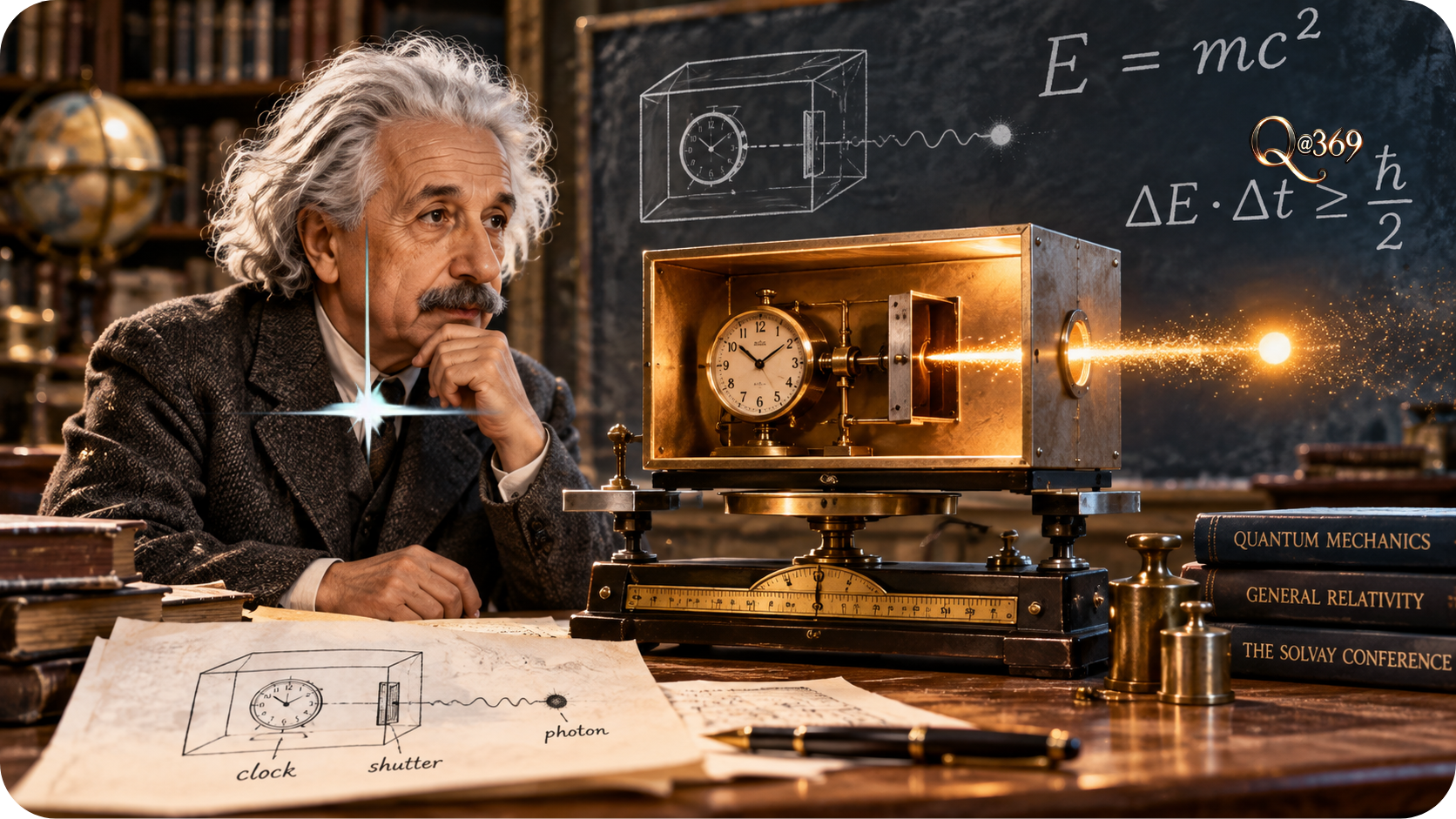
Einstein imagined a box, a clock, and a single photon. His challenge revealed how powerful a thought experiment can be.
Can an imaginary box containing a clock and a single photon expose a weakness in quantum mechanics?
Einstein believed his ingenious Photon Box thought experiment could challenge the limits of quantum uncertainty. His debate with Niels Bohr reveals how imagination, scientific reasoning, and thoughtful disagreement advance our understanding of nature.
A thought experiment allows scientists to examine physical principles through carefully constructed imaginary situations. Albert Einstein used this approach to challenge quantum uncertainty with an ingenious device called the photon box. His debate with Niels Bohr demonstrates how scientific disagreement can deepen our understanding of nature.
- Thought experiments: Imaginary situations can reveal important consequences of scientific theories.
- Einstein’s challenge: A photon box appeared capable of determining a photon’s energy and emission time with extraordinary precision.
- Quantum uncertainty: Quantum mechanics places limits on the simultaneous precision associated with certain physical quantities.
- Bohr’s response: Gravity and uncertainty in the box’s position affected the clock’s time measurement.
- Scientific progress: Challenging accepted explanations can reveal overlooked connections.
✨Listen to: AUDIO PODCAST or on SPOTIFY
🙏 Join Our Community Today!
💞 Share with Friends and Colleagues
Can An Imaginary Experiment Change Science?
Imagine a scientist sitting at a desk with nothing more than paper, a pencil, and a question. There is no laboratory equipment, no expensive machinery, and no physical experiment taking place. Yet the scientist may be examining a problem that could expose a weakness in an established theory.
This is the power of a thought experiment. Scientists construct imaginary situations governed by known physical principles, then reason through their consequences. The purpose is to examine whether an explanation remains logically consistent under challenging conditions.
Thought experiments have played important roles throughout the history of physics. They allow scientists to isolate essential principles and investigate situations that may be difficult to reproduce experimentally. Their conclusions must remain consistent with physical evidence and established scientific reasoning.
Albert Einstein was particularly skilled at using this approach. His imagined situations helped clarify questions about motion, light, gravity, and physical reality. In 1930, he introduced one of his most ingenious challenges to quantum mechanics.
The challenge became known as Einstein’s photon box. Its apparent simplicity concealed a profound question about the limits of scientific measurement.
Why Einstein Challenged Quantum Mechanics
By 1930, quantum mechanics had become remarkably successful at explaining atomic behavior. Its mathematical framework described experimental results that classical physics could not adequately explain. However, the theory also challenged traditional expectations about physical reality.
Werner Heisenberg had introduced his uncertainty principle in 1927. It established fundamental limits on the simultaneous precision of position and momentum. Related questions involving energy and time also became important subjects of debate.
Einstein recognized the predictive success of quantum mechanics. His concern was whether its mathematical description provided a complete account of physical reality. He continued searching for situations that might reveal something missing from the theory.
At the Sixth Solvay Conference in Brussels in 1930, Einstein presented a new thought experiment. His challenge required physicists to examine the relationship between energy, time, and measurement.
The Photon Box: Einstein’s Ingenious Device

“Pioneers of Quantum Physics” – Chapter 14
Imagine a perfectly enclosed box containing light. Inside the box is an extremely accurate clock connected to a shutter. The clock controls when the shutter briefly opens, allowing exactly one photon to escape.
Einstein proposed placing the box on a sensitive weighing apparatus. Before the photon escapes, the box has a certain mass. After emission, its mass is slightly smaller.
According to Einstein’s relationship between mass and energy, the difference corresponds to the energy carried away by the photon.
E = mc²
Here, E represents energy, m represents the corresponding mass, and c represents the speed of light. Measuring the change in mass would therefore provide information about the photon’s energy.
Meanwhile, the internal clock would record the precise time of emission. Einstein argued that the apparatus could determine the photon’s energy and emission time with arbitrarily high precision.
The proposed arrangement appeared to challenge the energy and time uncertainty relation. If both quantities could be determined without the expected limitation, Einstein believed quantum mechanics would face a serious problem.
The device existed only in imagination, although its scientific implications were substantial. Einstein had constructed a challenge using principles that physicists already accepted.
Why The Challenge Was So Difficult
Einstein’s argument was powerful because its individual components appeared reasonable. The relationship between mass and energy was established, while clocks and weighing devices were familiar measuring instruments.
The difficulty arose when these components were considered together. Einstein proposed determining the photon’s energy indirectly through the box’s change in mass. The internal clock would independently identify the emission time.
Quantum mechanics placed limits on the precision associated with certain physical quantities. Einstein believed his apparatus might provide a way around those limitations.
His challenge forced defenders of quantum mechanics to examine the complete measuring process. If the theory remained correct, some overlooked physical effect would need to explain why unlimited precision was impossible.
Bohr’s Response: Gravity Enters The Discussion
Niels Bohr initially found Einstein’s challenge deeply troubling. According to Bohr’s later account, the problem occupied him intensely before he developed a response.
His explanation involved an unexpected connection between quantum mechanics and Einstein’s own theory of gravity. Bohr considered what would happen when the box was weighed with extreme precision.
The weighing procedure required accounting for the box’s position and momentum. Quantum uncertainty limits the simultaneous precision of these quantities, introducing uncertainty into the physical arrangement.
The box’s vertical position also mattered for the clock. According to general relativity, the rate of a clock depends on gravitational potential. A clock at one height runs at a slightly different rate from a clock at another height.
Uncertainty in the box’s vertical position therefore affected the precision of its time measurement. Bohr connected this effect with the uncertainty introduced during weighing.
His argument showed that the proposed procedure could not provide unlimited precision for both energy and emission time. The physical consequences of the complete apparatus preserved the relevant uncertainty limitation.
Einstein had used a carefully imagined device to challenge quantum mechanics. Bohr responded by identifying physical effects that Einstein’s original argument had not fully accounted for.
A Surprising Connection Between Two Theories
One fascinating feature of this debate is the role played by general relativity. Einstein had developed this theory to explain gravity through the geometry of spacetime.
Bohr used gravitational time effects from Einstein’s own theory to defend quantum uncertainty. The response connected ideas that might initially appear unrelated.
This did not establish that general relativity proved every aspect of quantum mechanics. Instead, it demonstrated that Einstein’s proposed measurement required a more complete physical analysis.
The episode illustrates an important scientific principle. We cannot always understand a measurement by examining only the quantity we want to determine.
The measuring apparatus also belongs to the physical situation. Its behavior, limitations, and interactions can influence what the experiment reveals.
What Does Energy And Time Uncertainty Mean?
The energy and time uncertainty relation is often written as:
ΔE · Δt ≥ ħ/2
Here, ΔE represents an uncertainty in energy, while Δt represents an appropriate time interval or characteristic timescale. The symbol ħ represents the reduced Planck constant.
However, energy and time require special consideration in quantum mechanics. Time is generally treated as a parameter rather than an observable represented in the same manner as position.
Consequently, the meaning of Δt depends on the physical situation being examined. The relationship should not be interpreted as a universal restriction applying identically to every clock measurement.
Einstein’s photon box concerned the precision of an energy determination and the time assigned to photon emission. Bohr’s historical response addressed the specific weighing and timing procedure proposed by Einstein.
Understanding this distinction helps us appreciate the scientific reasoning. It also prevents a subtle principle from becoming an oversimplified statement about measurement.
Did Einstein Lose The Debate?
The photon box episode is sometimes presented as a contest with one winner. Einstein proposed a challenge, Bohr found a response, and quantum mechanics survived.
That description captures part of the history, although it overlooks the larger scientific contribution. Einstein’s objections forced physicists to examine the assumptions behind quantum measurement more carefully.
Bohr’s response required connecting several physical principles within one imagined experiment. Their disagreement helped clarify the relationship between measurement and uncertainty.
Einstein did not abandon his concerns about the completeness of quantum mechanics. He continued examining whether quantum theory provided a complete description of physical reality.
In 1935, Einstein, Boris Podolsky, and Nathan Rosen presented another influential challenge. Their paper raised questions about the completeness of quantum mechanics and the relationships between separated physical systems.
Those questions eventually became central to research on quantum entanglement. The photon box was therefore one chapter in a continuing scientific conversation.
Scientific disagreement does not always produce an immediate final answer. Sometimes its greatest contribution is revealing which questions deserve further investigation.
Quantum Alchemy: The Value Of A Thought Experiment
The photon box offers a lesson that extends beyond physics. Einstein began with an imagined situation rather than a physical machine, then examined its consequences through scientific reasoning.
His challenge required imagination, knowledge, and a willingness to question established assumptions. Bohr’s response required equally careful thinking about consequences that were not immediately obvious.
This approach connects with the philosophy of Quantum Alchemy. Curiosity opens a question, reasoning examines its possibilities, and evidence determines which explanations deserve confidence.
A thought experiment can reveal an overlooked assumption without requiring immediate physical construction. However, imagining a possible outcome does not establish that the outcome occurs in nature.
Scientific reasoning must remain consistent with evidence. This distinction helps separate productive imagination from unsupported conclusions.
We can apply similar reasoning when examining everyday problems. Before accepting an assumption, we can imagine circumstances in which it might fail.
We can then consider what information would help us evaluate the assumption. The purpose is not to defend an existing belief, but to improve our understanding.
Isaac’s Reflection: The Courage To Question
While researching Pioneers of Quantum Physics, I became increasingly interested in the conversations between scientists. Their discoveries were remarkable, and their disagreements often revealed even more about scientific progress.
Einstein’s photon box became a particularly memorable example. He did not accept a theory’s predictive success as a reason to stop asking questions.
Bohr also demonstrated the importance of serious intellectual engagement. Rather than dismissing Einstein’s challenge, he examined the problem and developed a response grounded in physical principles.
I find this approach valuable beyond science. During conversations with readers and friends, I sometimes encounter perspectives that differ from my own.
A thoughtful question can reveal an assumption I had not recognized. Listening carefully may lead me to reconsider an explanation I previously accepted.
These experiences remind me that curiosity requires more than asking questions. It also requires a willingness to reconsider our answers when new information becomes available.
The photon box demonstrates how disagreement can become productive when participants remain committed to understanding. Neither imagination nor confidence can replace careful reasoning.
Closing Reflection And Action
Einstein’s photon box began as an imaginary device containing light, a clock, and a shutter. Its purpose was to challenge the limits associated with quantum uncertainty.
Bohr’s response demonstrated how gravity and the physical process of measurement affected the proposed experiment. The exchange revealed connections that were not obvious from the original description.
Their debate reminds us that scientific progress does not always begin with a new observation. Sometimes it begins with a carefully constructed question that challenges an accepted explanation.
Today, choose one assumption you encounter in everyday life. Imagine a situation in which that assumption might not hold, then consider what evidence would help you evaluate it.
Ask yourself whether you are trying to defend what you already believe or understand what is actually true. This distinction can change how we approach disagreements, decisions, and unfamiliar ideas. Einstein’s photon box reminds us that even our strongest explanations deserve thoughtful examination. Curiosity becomes especially valuable when we remain willing to question our own conclusions.

References
- Bohr, N. (1949). Discussion with Einstein on Epistemological Problems in Atomic Physics. In Albert Einstein: Philosopher Scientist, edited by P. A. Schilpp. https://openlibrary.org/search?q=Albert+Einstein+Philosopher+Scientist+Bohr
- Heisenberg, W. (1927). Über den anschaulichen Inhalt der quantentheoretischen Kinematik und Mechanik. Zeitschrift für Physik, 43, 172–198. https://doi.org/10.1007/BF01397280
- Einstein, A., Podolsky, B., & Rosen, N. (1935). Can Quantum Mechanical Description of Physical Reality Be Considered Complete? Physical Review, 47, 777–780. https://doi.org/10.1103/PhysRev.47.777
See more of QuantumAlchemist369™ selected self-empowerment knowledge selections on the Book Shelf

Pioneers of Quantum Physics

Interactive Live Meetups
Thursday 7PM EDT Live Q&A with Isaac Yue
Join the Live Meetup Community discussion.
QA369 Forum – Empower Your Life
Join the Conversation? Start sharing your insights today! On our Quantumarian Forum Page

Leave a Reply