
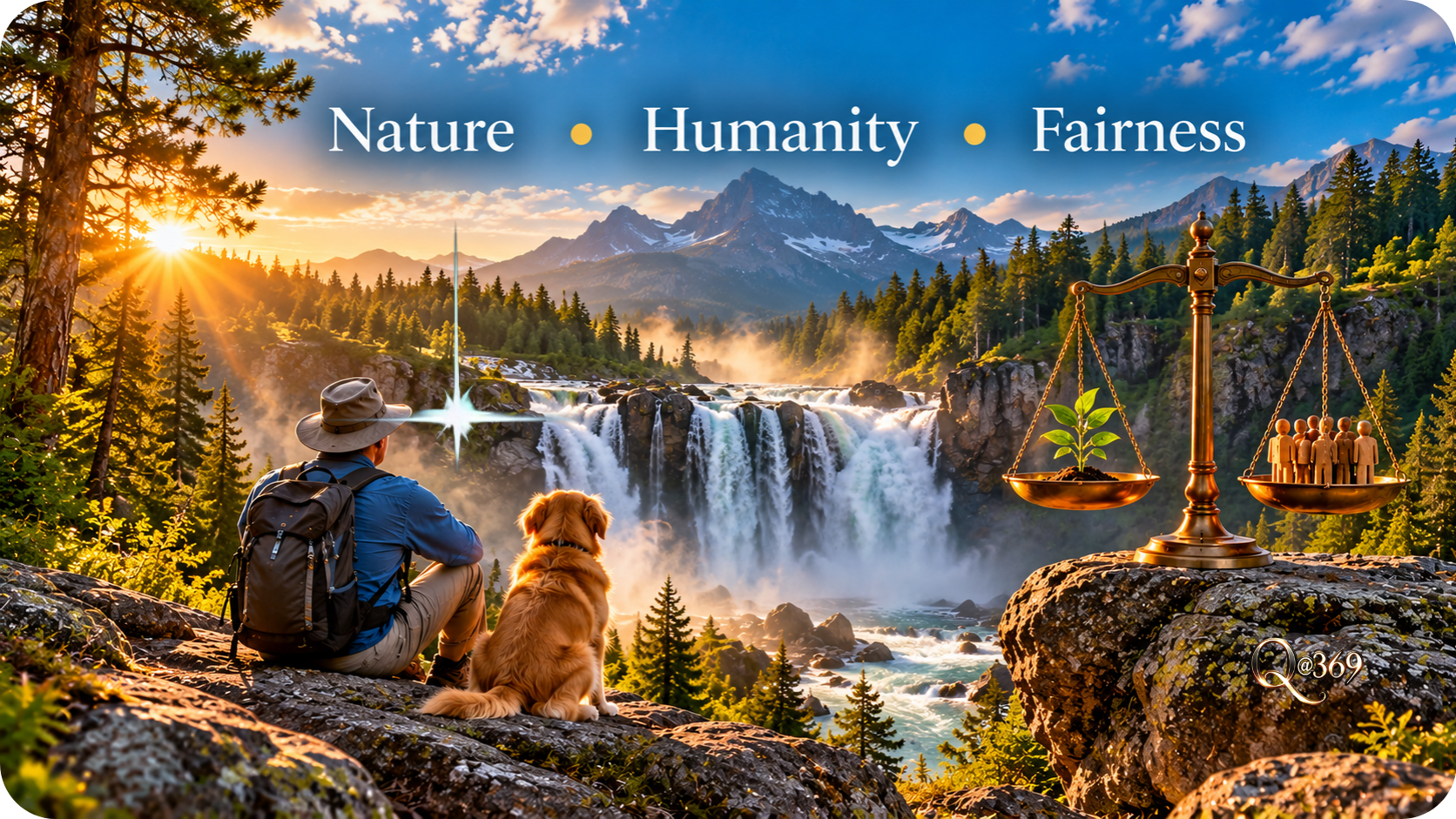
Exploring How Natural Laws, Personal Bias, And Human Values Shape Our Understanding Of Fairness

If nature follows the same physical laws for everyone, why do humans experience such different outcomes and call some unfair?
Natural laws describe how the physical world behaves, while fairness reflect human judgment are shaped by values, circumstances, and personal perspectives.
- Understand why impartial natural laws do not guarantee fair outcomes.
- Explore how personal experiences and biases influence judgments about fairness.
- Recognize the differences between equality, impartiality, and fairness.
- Distinguish physical laws from philosophical natural law.
- Learn how listening and examining assumptions can improve everyday decisions.
✨Listen to: AUDIO PODCAST or on SPOTIFY
🙏 Join Our Community Today!
💞 Share with Friends and Colleagues
Nature Does Not Decide What Is Fair
Imagine two trees growing beside the same lake. Both experience sunlight, gravity, changing temperatures, and seasonal rainfall. Yet one grows tall and healthy while the other struggles to survive.
The difference may come from soil conditions, access to water, or the development of their roots. Nature applies its physical laws consistently, although the circumstances surrounding each tree are different. We generally do not accuse sunlight or gravity of treating one tree unfairly.
Now consider two people growing up in the same community. One receives encouragement, educational opportunities, and dependable support. The other faces limited resources, unexpected responsibilities, and fewer opportunities.
We immediately recognize that their circumstances may influence their futures. We begin asking whether both people received reasonable opportunities to develop their abilities. We also consider whether someone could have reduced unnecessary disadvantages.
The physical world has not changed its laws. Human judgment has introduced questions about values, responsibility, and fairness. Understanding this distinction helps us recognize where our responsibility begins.
What Do Natural Laws Actually Describe?
Physics examines the relationships governing matter, energy, motion, and physical interactions. Gravity influences falling objects, while electromagnetic forces contribute to countless familiar processes. Thermodynamics describes energy transfer and the behavior of physical systems.
These principles do not change according to personal preference or social status. Their effects depend on physical conditions, including the environment and the starting circumstances. Identical laws can therefore produce very different outcomes.
Consider two sailboats traveling across the same lake. One enjoys favorable winds, while the other struggles against a strong headwind. Both experience the same underlying physical principles under different conditions.
Neither boat receives special consideration from nature. The differences arise from their circumstances rather than a moral decision. Physics explains the motion without declaring which experience is fair.
This distinction also requires us to clarify the meaning of natural law. In philosophy, natural law theories examine moral principles grounded in human nature, reason, or an objective moral order. These theories are different from the experimentally tested laws of physics.
Philosophers have debated natural law and moral obligations for centuries. Some defend objective moral principles, while others question their foundations or interpretation. Physical laws alone cannot settle those philosophical disagreements.
Does Impartiality Guarantee Fairness?
Impartiality generally means making decisions without inappropriate favoritism. Fairness asks whether the treatment, circumstances, and decision criteria are reasonable. The two concepts are closely connected, although they are not identical.
Imagine a community event where every participant receives exactly the same equipment. The organizers believe identical resources demonstrate equal treatment. Yet some participants may require accommodations to participate meaningfully.
Providing everyone with identical resources does not always create comparable opportunities. Sometimes fairness requires recognizing relevant differences in ability, access, or circumstances. At other times, fairness depends on applying the same standards consistently.
Consider a classroom where every student receives the same examination time. One student may require an approved accommodation to demonstrate knowledge under comparable conditions. The accommodation changes the procedure without necessarily changing the academic standard.
Different people may disagree about which adjustments are reasonable. Their judgments often reflect competing concerns about consistency, opportunity, and responsibility. Fairness requires examining those concerns rather than assuming one simple rule answers every situation.
How Personal Bias Influences Our Judgments
Our brains continuously interpret information through memory, experience, expectations, and emotional responses. These processes help us recognize patterns and make decisions efficiently. They can also influence how we evaluate unfamiliar situations.
Bias occurs when a preference, expectation, or predisposition affects judgment. Some biases are deliberate, while others operate without our immediate awareness. Recognizing this possibility helps us examine whether our conclusions are adequately supported.
Imagine hearing that a friend failed to attend an important family gathering. You may conclude that the friend behaved selfishly or showed insufficient concern. Your interpretation may feel reasonable based on the information available.
Later, you discover that the friend was caring for someone experiencing an unexpected emergency. The additional information changes how you understand the decision. Your original judgment reflected an incomplete account rather than the full circumstances.
This familiar experience reveals an important limitation of human judgment. We frequently evaluate actions before understanding every relevant influence. Our confidence in an interpretation does not guarantee its accuracy.
Psychological research examines how expectations and cognitive biases influence human decisions. These influences do not mean every personal judgment is unreliable. They remind us to distinguish observations from assumptions when evaluating fairness.
A Community Garden And The Meaning Of Equal Responsibility
Imagine a neighborhood committee organizing a shared community garden. Several residents volunteer to maintain the planting areas, manage supplies, and care for the vegetables. The committee decides that every participant must contribute four hours each month.
Initially, the arrangement appears reasonable and easy to administer. Everyone receives the same responsibility, and the garden benefits from predictable participation. The committee believes it has established a fair system.
Then several residents explain their circumstances. One works irregular hours, another cares for an elderly family member, and a third has limited physical mobility. Each person wants to contribute, although their available time and abilities differ.
Some committee members believe identical hours demonstrate accountability. Others believe fairness requires recognizing different circumstances and possible contributions. Both positions raise legitimate questions about shared responsibility.
The committee decides to examine the purpose behind its original rule. The garden needs dependable care, while residents need meaningful opportunities to participate. Equal hours were one possible method rather than the ultimate objective.
After discussion, the committee considers several forms of contribution. Residents can maintain planting beds, coordinate schedules, organize supplies, or assist with community events. Each activity supports the garden through a different form of participation.
The revised arrangement may not satisfy everyone equally. However, the committee has considered additional information and clarified its shared purpose. Its decision now reflects a more informed understanding of fairness.
This example illustrates why identical treatment and fair treatment are not always interchangeable. Fairness depends partly on which differences are relevant to the decision. Recognizing those differences requires listening and thoughtful evaluation.
Continuing Our Conversation About Fairness And Bias
Last Sunday, we explored the question, Can Fairness Exist Without Recognizing Our Biases? We considered how personal experiences influence judgments that may initially appear impartial. Recognizing our assumptions became an important starting point for more thoughtful decisions.
Today’s discussion extends that question into our understanding of natural law. Physical processes operate according to consistent principles, while human circumstances vary considerably. Fairness becomes relevant when we evaluate how people respond to those differences.
Consider a severe storm affecting several neighborhoods. The weather does not assign consequences according to personal character, income, or moral worth. Its physical effects depend on atmospheric conditions, geography, buildings, and other environmental factors.
Yet households may experience the consequences very differently. Some residents have strong homes, transportation, savings, and dependable support networks. Others face greater difficulties preparing for the same event.
The storm follows physical processes without making moral judgments. Questions about assistance, preparation, and community responsibility belong to human decision making. Our understanding of fairness influences how we respond to those needs.
Recognizing this distinction does not eliminate disagreements about responsibility. People may hold different views about how assistance should be distributed. A more productive discussion begins by identifying the facts, relevant circumstances, and values guiding each proposal.
Isaac Yue Reflection: Fairness Begins With Listening
I enjoy meeting people whose experiences and perspectives differ from my own. These conversations often reveal details that I had not considered. They remind me how easily personal experience can become the starting point for judging others.
During community conversations, I sometimes hear two people describe the same situation differently. Each person may sincerely believe their interpretation is reasonable. Listening carefully often reveals circumstances that were missing from the original account.
Conversations with Z also remind me that two people can observe the same event from different perspectives. One person may notice the practical consequences, while another recognizes an emotional concern. Both observations can contribute to a fuller understanding.
I have learned to value the opportunity to ask another question before reaching a conclusion. This does not require abandoning my values or agreeing with every perspective. It means recognizing that understanding can improve when additional information becomes available.
For me, fairness begins with awareness of my own assumptions. It develops through listening, examining evidence, and considering the circumstances of others. These ordinary practices connect the principles of Quantum Alchemy with meaningful daily choices.
Can Fairness Be More Than Personal Opinion?
Recognizing the influence of bias raises another important question. If human perspectives differ, does fairness become nothing more than personal preference? The answer depends partly on how we understand moral reasoning.
People can disagree about fairness while still examining the quality of their arguments. We can compare evidence, identify contradictions, and consider the consequences of proposed decisions. We can also ask whether a principle remains consistent when applied to different people.
Consider someone who believes every community member deserves an opportunity to participate. That principle can be examined through actual decisions and their consequences. We can ask whether the rules unnecessarily exclude certain participants.
Philosophers offer different explanations for the foundations of fairness and justice. Some emphasize rights, others emphasize consequences, and still others emphasize duties or social relationships. These approaches may reach different conclusions in difficult situations.
Recognizing these disagreements does not make careful reasoning meaningless. It makes transparency about our values and assumptions more important. We improve discussions when we explain why a particular decision appears fair.
Three Questions For More Thoughtful Judgments
Fairness becomes more practical when we examine how we reach conclusions. Before deciding that someone received unfair treatment, consider three questions. Each encourages a different form of awareness.
1. What Facts Do I Actually Know?
Separate direct observations from assumptions and secondhand information. Consider whether important circumstances remain unknown. Additional facts may strengthen your original conclusion or reveal a different interpretation.
2. Whose Perspective Have I Not Considered?
Identify the people affected by the decision. Consider their responsibilities, limitations, and opportunities without automatically accepting every explanation. Listening provides information that may improve the quality of your judgment.
3. Would I Accept This Reasoning If Our Positions Were Reversed?
Imagine experiencing the decision from another person’s position. Examine whether your preferred standard would remain consistent. This question can reveal when personal advantage has influenced your interpretation.
These questions cannot guarantee agreement or eliminate every bias. They can make our reasoning more transparent and better informed. Their greatest value appears when we apply them before an important decision.
Finding Your Quantum In Everyday Fairness
Quantum Alchemy encourages curiosity, awareness, and thoughtful application of scientific understanding. Physics teaches us to distinguish observations from explanations and test whether our interpretations fit the evidence. Everyday relationships can benefit from a similar commitment to careful reasoning.
We observe someone’s behavior and begin interpreting its meaning. Our interpretation may be accurate, incomplete, or influenced by personal expectations. Recognizing that distinction gives us an opportunity to respond more thoughtfully.
Scientific reasoning does not establish a complete moral theory of fairness. Nor does quantum physics determine how people should treat one another. These questions require ethical reflection, social understanding, and consideration of human consequences.
We can still apply useful habits from scientific inquiry. We can examine assumptions, consider alternative explanations, and revise conclusions when better information becomes available. These practices help us approach disagreements with greater clarity.
Finding Your Quantum in fairness means recognizing the choices within our control. We cannot change the impartial operation of gravity or the weather. We can influence how carefully we listen and how responsibly we treat others.
Conclusion: Nature Follows Laws. Humans Make Judgments.
Nature operates through physical principles without assigning moral worth to the outcomes. Human beings experience those outcomes through different circumstances, opportunities, and responsibilities. Our understanding of fairness develops as we evaluate those differences.
Personal bias can influence our judgments, even when we intend to remain impartial. Recognizing that influence does not require abandoning our principles. It encourages us to examine the evidence and apply our values more consistently.
Fairness is not guaranteed by the consistency of physical laws. It requires human attention to circumstances, consequences, and responsibilities. Our decisions become more thoughtful when we recognize the limits of our individual perspectives.
A fairer community begins with people willing to listen before judging. It grows when individuals examine their assumptions and consider how decisions affect others. These everyday choices give practical meaning to our understanding of fairness.
Reflection Question
When you believe a situation is unfair, how often do you examine the assumptions influencing your judgment? Consider whether another person’s circumstances might reveal information you have overlooked.
Your Quantumarian Practice
During your next disagreement, identify one fact you know and one assumption you may be making. Ask a thoughtful question before deciding whether the situation is fair.
Notice whether the additional information changes your understanding. The goal is not immediate agreement, but a more informed and considerate judgment.
Nature does not promise fairness. Our awareness and choices determine how thoughtfully we pursue it.
Find Your Quantum

References
- Miller, David. (2026). “Justice.” Stanford Encyclopedia of Philosophy. Explores justice, equality, impartiality, and fair distribution. Read Reference.
- Finnis, John. “Natural Law Theories.” Stanford Encyclopedia of Philosophy. Explains philosophical natural law and its relationship to moral reasoning. Read Reference.
- Nickerson, Raymond S. (1998). “Confirmation Bias: A Ubiquitous Phenomenon in Many Guises.” Review of General Psychology, 2(2), 175–220. Examines how existing beliefs influence our interpretation of evidence. Read Reference.
See more of QuantumAlchemist369™ selected self-empowerment knowledge selections on the Book Shelf


Interactive Live Meetups
Thursday 7PM EDT Live Q&A with Isaac Yue
Join the Live Meetup Community discussion.
QA369 Forum – Empower Your Life
Join the Conversation? Start sharing your insights today! On our Quantumarian Forum Page


Leave a Reply