
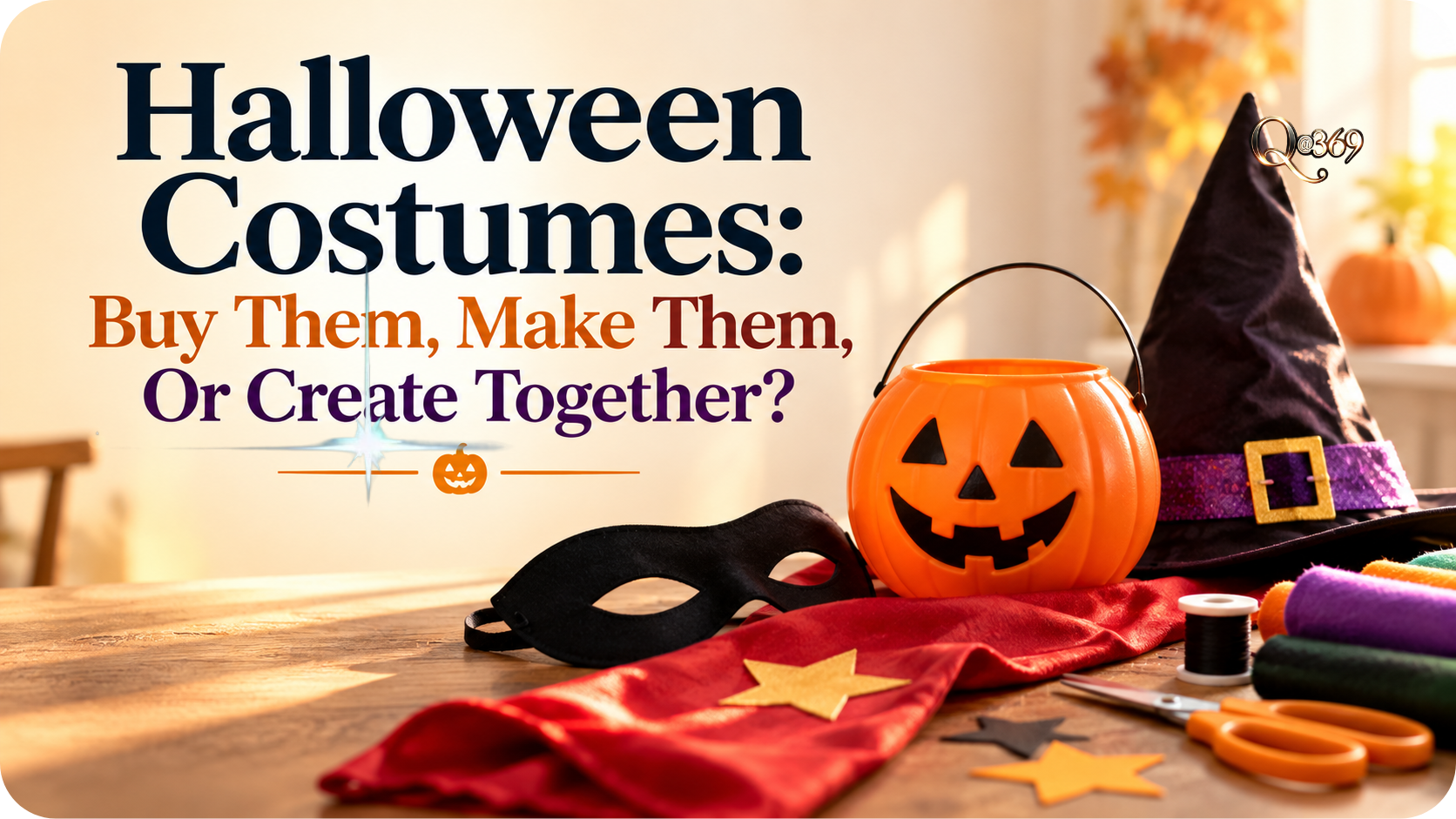
How Creativity, Family Traditions, Time, And Budget Shape Halloween Fun

Could the most memorable part of a Halloween costume is not what you wear, rather what happens while preparing it?
Every October, families face a familiar decision. Should they purchase a Halloween costume, make one at home, or create something together?
The answer involves more than clothing. It includes creativity, family traditions, available time, cost, and the experiences we hope to remember.
Halloween costumes offer opportunities for creativity, practical decisions, family connections, and shared experiences that extend beyond one evening.
- Creativity: Costume planning encourages imagination, experimentation, and personal expression.
- Family Traditions: Preparing costumes together can create meaningful shared memories.
- Time And Budget: Buying, making, and combining costume elements offer different practical advantages.
- Learning Through Participation: Children can practice planning, problem solving, and decision making.
- Safety And Comfort: Visibility, mobility, weather, and appropriate materials deserve attention.
✨Listen to: AUDIO PODCAST or on SPOTIFY
🙏 Join Our Community Today!
💞 Share with Friends and Colleagues
The Halloween Costume Decision
Walk through almost any store during October, and Halloween costumes are everywhere.
Superheroes, movie characters, animals, historical figures, and imaginative creatures fill the displays. Some costumes arrive complete with accessories, while others require a little creativity.
For busy families, purchasing a ready made costume offers convenience. A child can choose a favorite character, try on the outfit, and prepare for Halloween without extensive planning.
There is genuine value in that convenience. Families already manage school schedules, work responsibilities, household activities, and other commitments.
The best costume decision does not have to be the most elaborate one.
It should fit the people, circumstances, and enjoyment involved.
Buying A Costume | Convenience Has Value
A purchased costume can save considerable preparation time. It also offers a practical solution when specialized clothing or accessories are difficult to reproduce.
Children may enjoy selecting an outfit that represents a favorite story or character. That decision can provide an opportunity to express personal interests and preferences.
However, convenience deserves consideration alongside cost and quality. Some costumes are expensive, uncomfortable, or unlikely to be worn again.
Before purchasing, consider whether the costume fits properly and allows comfortable movement. Examine the materials, accessories, and expected weather conditions.
A less expensive costume that fits well may provide a better experience than an elaborate outfit that restricts movement.
Buying a costume is not a failure of creativity. It is one reasonable choice among several.
Making A Costume | Imagination Meets Practical Skills
A homemade costume begins with a different question.
What can we create using materials already available?
An old shirt might become part of a pirate costume. Cardboard can become a robot, while fabric scraps can help create an imaginative animal.
The possibilities depend on available materials, time, and willingness to experiment.
Making a costume introduces practical learning opportunities. Measuring, cutting, assembling, decorating, and adjusting materials all involve planning and problem solving.
Children can participate according to their ages and abilities. Younger children might select colors or attach decorations, while older children can help develop the design.
A homemade costume does not need professional craftsmanship.
Its value may come from the imagination and effort invested in creating something personal.
Creating Together | The Experience Becomes Part Of The Costume
There is another possibility between buying everything and making everything.
Families can create costumes together by combining purchased items, clothing from home, and handmade accessories.
Perhaps a child wants to become an astronaut. A simple outfit, homemade mission patches, and a carefully decorated cardboard control panel might complete the idea.
Another family might create a group costume around a favorite story. Each person contributes something different to the overall design.
These activities provide opportunities for conversation, cooperation, and shared decisions.
Children may discover that adults do not always have immediate answers. Everyone can experiment, make adjustments, and solve unexpected problems together.
The completed costume becomes a reminder of the preparation experience.
And sometimes those preparations become the stories families remember years later.
What Psychology Tells Us About Creating Together
Psychological research helps explain why participating in creative activities can be meaningful.
Self-determination theory identifies autonomy, competence, and relatedness as important psychological needs. Costume preparation can offer opportunities to support all three.
A child experiences autonomy when choosing a character or contributing design ideas. Competence develops through manageable challenges, while relatedness grows through positive shared activities.
Research on parent and child interactions also emphasizes the importance of responsive support during learning.
Adults can provide guidance without taking control of every decision. Children benefit from opportunities to contribute ideas and complete tasks within their abilities.
The goal is not simply producing a finished costume.
It is creating an enjoyable experience where participation matters.
When The Budget Becomes Part Of The Conversation
Halloween expenses can accumulate quickly.
Costumes, decorations, candy, parties, and neighborhood activities all compete for household resources. An expensive costume may offer little additional enjoyment compared with a simpler alternative.
A useful approach begins with establishing a comfortable spending limit.
Families can then explore available options together. Purchasing one accessory, borrowing clothing, or reusing materials may provide enough flexibility to create something distinctive.
Secondhand shops and costume exchanges can offer additional possibilities. Reusing existing items may also reduce unnecessary purchases and waste.
Budget decisions can become opportunities to discuss priorities without diminishing the celebration.
Creativity often becomes more interesting when resources are limited.
Safety And Comfort Matter More Than Appearance
Halloween costumes should allow people to enjoy the activities they have planned.
For trick or treating, visibility and comfortable movement are particularly important. Masks should not obstruct vision, and footwear should be appropriate for walking.
Reflective materials or lights can improve visibility after dark. Loose fabric and accessories should be checked for tripping hazards.
Families should also consider weather conditions, material safety, and age appropriate accessories. Young children require particular attention to choking hazards and potentially dangerous costume components.
Adults can help children understand these considerations while allowing them to participate in suitable decisions.
A costume that looks wonderful in a photograph is less valuable when the person wearing it cannot enjoy the evening.
Isaac Yue Reflection | The Value Of Creating Something Together
I have always appreciated the creativity people bring to ordinary experiences.
A handmade object, a carefully prepared meal, or a family project often carries a story beyond its appearance. The conversations and decisions involved become part of its meaning.
Halloween costumes offer another opportunity to experience that connection.
I enjoy seeing how people interpret familiar characters through their own imagination. Some choose elaborate costumes, while others create memorable outfits using simple materials.
What interests me most is the personal expression behind those choices.
A costume does not need to be expensive or perfect to become meaningful. Sometimes a shared laugh during preparation becomes more memorable than the finished outfit.
These experiences remind me that creativity is not limited to artists or designers.
It is something we can practice through everyday choices and shared activities.
The Quantumarian Connection | Creativity Begins With Possibilities
Quantum Alchemy encourages curiosity, awareness, and thoughtful choices in everyday living.
Costume preparation provides a simple opportunity to practice those principles. Instead of immediately selecting the most convenient option, we can consider several possibilities.
What materials do we already have? What would the child enjoy creating? How much time can we reasonably spend together?
There is no universal answer.
A purchased costume may be the most practical choice for one family. A homemade creation may offer greater enjoyment for another.
The important question is whether our decision supports the experience we want to create.
Awareness helps us recognize that the process can be just as valuable as the result.
Five Questions Before Choosing A Costume
Before making this year’s Halloween costume decision, consider five practical questions.
1. What Does The Person Wearing It Want?
Begin with their interests, comfort, and preferences. Allow them to participate in age appropriate decisions.
2. How Much Time Do We Have?
Be realistic about preparation time. A simple costume completed comfortably may be more enjoyable than an ambitious project finished under pressure.
3. What Is Our Comfortable Budget?
Establish spending expectations early. Consider purchased, borrowed, reused, and handmade options.
4. Could Creating Together Add To The Experience?
Look for opportunities to involve family members. Even a small handmade accessory can become a shared activity.
5. Will The Costume Be Safe And Comfortable?
Check movement, visibility, fit, materials, and weather suitability before Halloween evening.
These questions can make costume preparation easier while keeping the celebration enjoyable.
Conclusion | The Best Costume Is Not Always The Most Expensive
Halloween costumes can be purchased, handmade, borrowed, or created through a combination of approaches.
Each option offers different advantages. Convenience, creativity, affordability, and family participation all deserve consideration.
The most meaningful costume is not necessarily the one that attracts the most attention.
It may be the one that allows someone to express themselves, enjoy the occasion, and remember the experience positively.
For families, the preparation can become part of the celebration rather than another task to complete.
Reflection Question
What Halloween costume do you remember most clearly, and was the memory connected to the costume itself or the experience surrounding it?
Today’s Practical Action
Before purchasing or preparing a Halloween costume, invite everyone involved to share one creative idea.
Consider how time, budget, and available materials might influence the possibilities. Choose an approach that supports enjoyment and meaningful participation.
Sometimes the best Halloween memory begins long before Halloween night.
Find Your Quantum.

References
- Ginsburg, K. R. (2007). The Importance Of Play In Promoting Healthy Child Development And Maintaining Strong Parent-Child Bonds. Pediatrics, 119(1), 182–191. https://doi.org/10.1542/peds.2006-2697
- Deci, E. L., & Ryan, R. M. (2000). The “What” And “Why” Of Goal Pursuits: Human Needs And The Self-Determination Of Behavior. Psychological Inquiry, 11(4), 227–268. https://doi.org/10.1207/S15327965PLI1104_01
- Wood, D., Bruner, J. S., & Ross, G. (1976). The Role Of Tutoring In Problem Solving. Journal of Child Psychology and Psychiatry, 17(2), 89–100. https://doi.org/10.1111/j.1469-7610.1976.tb00381.x
See more of QuantumAlchemist369™ selected self-empowerment knowledge selections on the Book Shelf


Interactive Live Meetups
Thursday 7PM EDT Live Q&A with Isaac Yue
Join the Live Meetup Community discussion.
QA369 Forum – Empower Your Life
Join the Conversation? Start sharing your insights today! On our Quantumarian Forum Page


Leave a Reply