
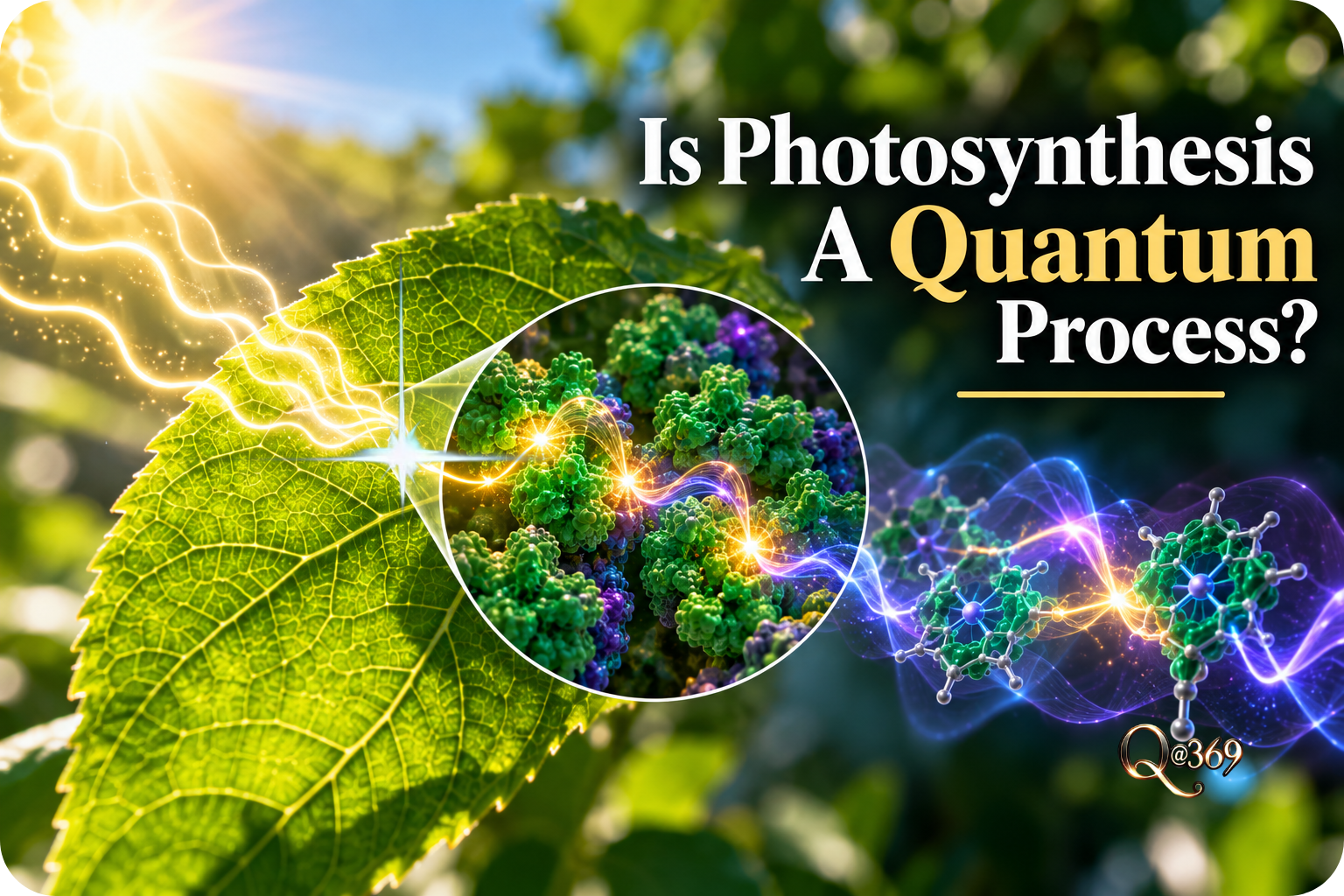
Where Quantum Physics Helps Plants Turn Sunlight Into Usable Energy

When sunlight reaches a leaf, where does quantum physics enter the process that eventually helps a plant grow?
The answer, photosynthesis, begins surprisingly early. A pigment molecule absorbs light, creating an electronic excitation that can move through a light harvesting system.
Quantum mechanics is fundamental to describing those molecular events. Yet photosynthesis contains many later biochemical processes that do not require exotic quantum explanations. ACS Publications
Quantum mechanics helps explain how photosynthetic systems absorb light and transfer electronic excitation toward reaction centers.
- Light arrives in discrete packets of energy called photons.
- Photosynthetic pigments absorb particular photon energies.
- Absorption can move electrons into higher energy states.
- Excitation energy can travel among coupled pigment molecules.
- Quantum coherence has been observed in some photosynthetic complexes.
- Its functional importance under natural conditions remains an active scientific question.
✨Listen to: AUDIO PODCAST or on SPOTIFY
🙏 Join Our Community Today!
💞 Share with Friends and Colleagues
A Leaf Is Doing Something Remarkable
Walk outside and look at a green leaf.
It may appear quiet. At the molecular level, an extraordinary energy conversion system is operating.
Plants capture energy arriving from the Sun and eventually store part of it in chemical forms. Photosynthesis supports most ecosystems directly or indirectly.
The familiar story begins with sunlight, water, and carbon dioxide. Yet that description hides an important question.
How does a molecule capture light in the first place?
That question takes us into quantum physics.
Start With A Photon
Light can exchange energy with matter in discrete amounts associated with photons.
A photon carries energy related to its frequency. Different wavelengths therefore correspond to different photon energies.
Photosynthetic organisms contain pigments that interact with particular portions of the electromagnetic spectrum. Chlorophylls are among the most familiar examples.
When an appropriate photon interacts with a pigment molecule, its energy can produce an electronic excitation.
That first step is inherently quantum mechanical.
Electrons Cannot Take Just Any Energy
Quantum mechanics tells us that molecules possess allowed electronic energy states.
An electron does not simply absorb an arbitrary amount of energy and slide continuously upward. The energy supplied must correspond appropriately to available molecular transitions.
This helps explain why pigments absorb some wavelengths more strongly than others.
A leaf therefore does not treat every photon identically. Molecular structure helps determine which portions of incoming light can be captured.
From One Pigment To A Network
Capturing light is only the beginning.
Photosynthetic organisms arrange pigments within protein structures called light harvesting complexes. These molecular systems help collect excitation energy and direct it toward reaction centers. ACS Publications
That organization matters.
An excitation created on one pigment can interact with neighboring pigments. In some arrangements, the electronic excitation becomes distributed across more than one pigment.
Physicists describe these collective electronic excitations using the concept of excitons.
An exciton is not a tiny object traveling through the leaf along a miniature road.
It is a quantum mechanical description of an electronic excitation within the coupled molecular system.
The Reaction Center Changes The Story
Eventually, excitation energy reaches a reaction center.
Here, photochemical reactions create charge separation. That begins the conversion from short lived electronic excitation into more stable chemical forms.
Later stages involve electron transfer, proton gradients, enzyme activity, carbon fixation, and many other biochemical processes.
This distinction is important.
Quantum mechanics underlies molecular behavior throughout nature. Yet saying that quantum mechanics underlies molecules is different from claiming that every biological process displays unusual macroscopic quantum behavior.
Photosynthesis contains both quantum scale molecular events and larger biochemical processes. PubMed Central (PMC)
Then Scientists Found Something More Interesting
The quantum story became especially fascinating when researchers investigated how excitation energy moves through light harvesting complexes.
In 2007, researchers reported spectroscopic evidence of electronic quantum coherence in the Fenna Matthews Olson complex of green sulfur bacteria.
Their measurements revealed oscillatory behavior associated with coherent interactions among excitonic states. Nature
Later experiments reported coherent behavior at physiological temperatures and in other photosynthetic organisms. These findings helped create enormous interest in what became known as quantum biology. Nature
The possibility was captivating.
Could photosynthetic organisms exploit quantum coherence to move energy exceptionally efficiently?
What Does Quantum Coherence Mean Here?
Imagine several possible electronic states within a molecular complex.
Classical intuition encourages us to picture excitation occupying one definite location and then hopping to another.
Quantum mechanics permits a more complex description.
Coupled pigments can support excitonic states in which electronic excitation is delocalized across multiple molecules. Coherence concerns maintained phase relationships among quantum states.
This can create wave shaped behavior in how excitation evolves through the molecular system.
Experiments using ultrafast spectroscopy can probe these dynamics on extraordinarily short timescales.
We are talking about femtoseconds.
One femtosecond is one quadrillionth of a second.
Did Plants Discover Quantum Computing?
No.
This is where an interesting scientific finding can quickly become exaggerated.
Photosynthetic organisms are not known to perform quantum computation in the popular technological sense. A leaf is not consciously evaluating possible energy routes.
There is also no evidence here for quantum consciousness.
The relevant physics concerns interactions among light, pigments, proteins, electronic excitations, molecular vibrations, and the surrounding environment.
That science is fascinating without adding claims that the evidence does not support.
The Coherence Debate Became More Complicated
Early experiments generated excitement around the possibility that long lived electronic coherence might explain extraordinary photosynthetic efficiency.
Later research made that interpretation more cautious.
A major 2020 review reexamined spectroscopic evidence and concluded that some long lived signals previously associated with electronic coherence arise primarily from molecular vibrations. The authors found that interexciton electronic coherences were too short lived to provide the originally proposed functional role in energy transfer. PubMed Central (PMC)
Other researchers have reached similarly cautious conclusions.
A 2021 analysis found photosynthetic complexes operating in a mixed quantum and classical regime. It concluded that quantum coherence probably provides little direct enhancement to overall energy transfer efficiency under natural conditions. PubMed Central (PMC)
This does not mean quantum mechanics disappeared from photosynthesis.
It means scientists refined the question.
Quantum Or Classical Is The Wrong Choice
Nature does not need to choose between being quantum and classical.
At molecular scales, quantum mechanics provides the underlying physical description.
Yet biological systems interact strongly with warm, complicated environments.
Proteins move.
Molecules vibrate.
Water surrounds biological structures.
Thermal motion creates constant environmental interaction.
These interactions can rapidly disrupt delicate quantum coherence.
Photosynthetic energy transport therefore appears to involve a mixture of coherent, incoherent, vibrational, environmental, and molecular effects. Reviews increasingly describe a more nuanced picture than a simple quantum shortcut through a leaf. PubMed Central (PMC)
The Environment May Be Part Of The Solution
We often imagine environmental noise as something that destroys useful organization.
Photosynthetic systems reveal a more interesting possibility.
Interactions between electronic excitations, molecular vibrations, proteins, and their surroundings can help shape energy flow. Researchers have studied how this balance may allow efficient transport without requiring long lived quantum coherence.
A 2020 review described nature as using interactions between excitons and their surrounding molecular environment rather than simply protecting fragile coherence from disturbance.
That changes the picture.
The system may work effectively not despite its complicated environment, yet partly through interactions with it.
The Science Is Still Moving
This field remains active.
A 2026 article in The Journal of Physical Chemistry B reports recent research into several possible quantum effects across different photosynthetic systems. The authors describe evidence for coherent energy transfer in particular pigment systems while also identifying systems where transfer follows an incoherent mechanism. ACS Publications
That variation is scientifically valuable.
It warns us against turning photosynthesis uses quantum mechanics into a claim that every photosynthetic organism uses the same quantum mechanism.
Different molecular structures can produce different transport behavior.
Science becomes more interesting when the details matter.
Isaac Yue Reflection
Photosynthesis is one reason I remain fascinated by the boundary between familiar life and unfamiliar physics.
I can walk outside and see leaves everywhere. Nothing about that ordinary scene announces femtosecond spectroscopy, excitons, electronic states, or molecular energy transfer.
Yet those processes are part of understanding how sunlight enters living systems.
I also appreciate the caution this subject teaches.
An exciting discovery can generate a compelling explanation. Additional experiments can later reveal that the original explanation needs refinement.
That is not science failing.
That is science working.
The goal is not to protect the most exciting interpretation. The goal is to keep improving the explanation as better evidence arrives.
A Quantum Alchemy Perspective
Photosynthesis gives Quantum Alchemy an excellent example of where scientific curiosity needs boundaries.
There is real quantum physics here.
Photon absorption, electronic excitation, excitonic states, and some aspects of energy transfer require quantum mechanical descriptions.
There are also open scientific questions concerning the functional importance of particular coherent effects.
We do not need to turn those findings into claims about intention, consciousness, or mystical communication.
The measured physics is already remarkable.
Photon → Pigment Excitation → Energy Transfer → Reaction Center → Charge Separation → Chemical Processes
At the beginning of that sequence, quantum physics is impossible to ignore.
As the process develops, chemistry, molecular biology, thermodynamics, and cellular organization become increasingly important.
The complete story needs all of them.
Why This Matters Beyond Plants
Understanding photosynthetic light harvesting is not merely an exercise in explaining leaves.
Researchers study these systems partly because nature provides remarkable examples of capturing and moving solar energy.
Learning how molecular organization controls absorption, excitation transfer, and energy dissipation can inform research into artificial light harvesting and energy technologies. Reviews of photosynthetic systems have explicitly examined these principles for their relevance to designed molecular systems. ACS Publications
Nature does not hand engineers a finished blueprint.
It gives science something valuable to investigate.
Practical Challenge | Look At A Leaf Differently
Find a healthy leaf in sunlight today.
Look at it for thirty seconds.
Then imagine what sunlight begins at the molecular level.
Photons arrive.
Pigments absorb particular energies.
Electronic states change.
Excitation energy moves through molecular structures.
Reaction centers begin converting that captured energy into forms biology can use.
The leaf does not need to know quantum mechanics.
We do.
Conclusion | Yes, With An Important Qualification
So, is photosynthesis a quantum process?
Parts of photosynthesis are fundamentally quantum mechanical. Light absorption, electronic excitation, excitonic interactions, and aspects of excitation energy transfer require quantum physics for a complete molecular description. ACS Publications
That does not mean every stage of photosynthesis depends upon exotic quantum coherence.
It does not mean plants consciously select quantum pathways.
It does not provide evidence for quantum consciousness.
And it does not turn every popular use of the word quantum into science.
What it does reveal is more interesting.
Some of the most ordinary things around us depend upon physics that is anything except ordinary to human intuition.
Reflection Question
The next time you see sunlight falling across a plant, consider this:
How does knowing something about the hidden physics change the way you experience an ordinary leaf?
Practical Action
Spend one minute outside examining a sunlit plant.
Connect what you see with one invisible step: photon absorption → electronic excitation → energy transfer.
A leaf may look still.
At the molecular scale, its relationship with sunlight has already begun.
Find Your Quantum.

References
- Scholes et al. | Light Absorption And Energy Transfer In Photosynthesis Chemical Reviews A comprehensive review of light absorption, excitations, and energy transfer in photosynthetic systems. https://pubs.acs.org/doi/10.1021/acs.chemrev.5b00700
- Engel et al. | Evidence For Wavelike Energy Transfer Through Quantum Coherence In Photosynthetic Systems Nature, 2007 The influential experiment reporting evidence of electronic quantum coherence in a photosynthetic complex. https://www.nature.com/articles/nature05678
- Cao et al. | Quantum Biology Revisited Science Advances, 2020 A modern review examining quantum effects in biological systems, including photosynthetic energy transfer and the limits of earlier interpretations. https://www.science.org/doi/10.1126/sciadv.aaz4888
See more of QuantumAlchemist369™ selected self-empowerment knowledge selections on the Book Shelf


Interactive Live Meetups
Thursday 7PM EDT Live Q&A with Isaac Yue
Join the Live Meetup Community discussion.
2026 Community Feedback Now Open
You are invited to help build QuantumAlchemist369. Take a few minutes to complete the Quantumarian Community Review 2026.


Leave a Reply