
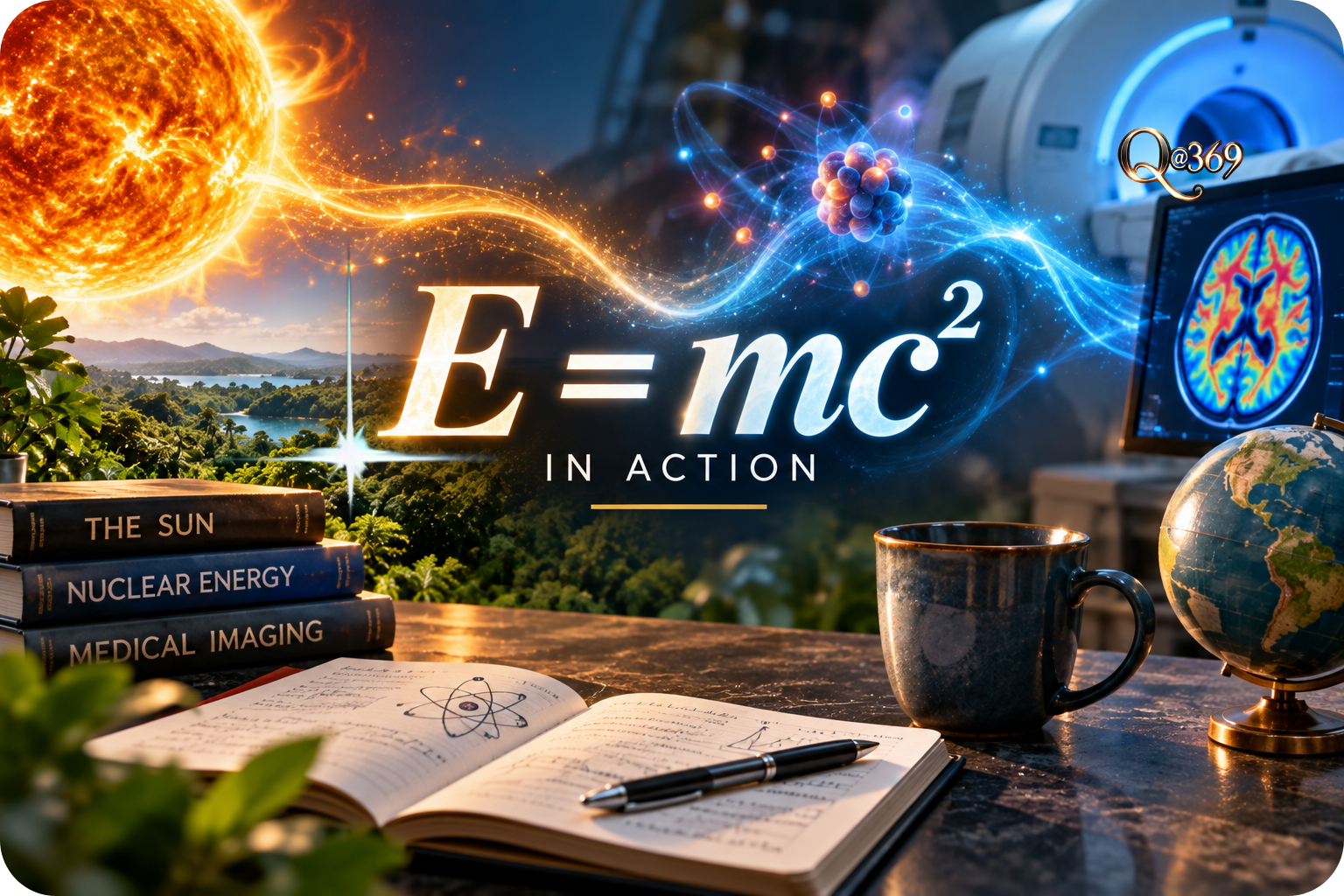
How Mass And Energy Shape Sunlight, Medicine, And The Technology Around Us

How can an equation describing the relationship between mass and energy help explain sunlight, medical treatments, and everyday technology?
Mass and energy are connected, and that relationship helps explain several important processes, sunlight to medicine, in our everyday world.
- Understand what Einstein’s famous equation actually tells us about mass and energy.
- Discover how nuclear fusion in the Sun helps produce the energy reaching Earth.
- Learn why nuclear power releases far more energy per kilogram of fuel than chemical combustion.
- Explore how mass and energy relationships matter in medical imaging and cancer treatment.
- Recognize why ordinary household objects do not routinely convert significant amounts of mass into energy.
- Develop a more accurate understanding of one of physics’ most recognizable equations.
✨Listen to: AUDIO PODCAST or on SPOTIFY
🙏 Join Our Community Today!
💞 Share with Friends and Colleagues
An Equation You Have Seen Everywhere
You have probably seen Einstein’s famous equation on posters, coffee mugs, T-shirts, and classroom walls. Its symbols are recognizable even to people who have never studied physics.
Yet the equation describes something far more important than a memorable scientific formula. It expresses a fundamental relationship between mass and energy.
That relationship helps explain processes occurring in stars, nuclear reactors, and medical technology. It also changes how physicists understand the energy associated with matter.
The equation does not mean that every object around us is constantly turning substantial amounts of its mass into usable energy. Understanding that distinction makes its practical consequences much more interesting.
What Does E = mc² Actually Mean?
Einstein’s equation connects an object’s rest energy with its mass. The letter E represents energy, m represents mass, and c represents the speed of light in a vacuum.
The speed of light is approximately 300 million meters per second. Squaring that enormous number creates a very large conversion factor between mass and energy.
This means even a small difference in mass can correspond to a substantial amount of energy. The equation does not, however, describe a practical method for extracting all that energy from an ordinary object.
Mass is associated with energy. Accessing that energy is a separate physical question.
That distinction helps us understand where the equation becomes useful in everyday life.
Sunlight Begins With Nuclear Fusion
One of the most familiar consequences of mass and energy equivalence reaches us every morning. Sunlight warms our surroundings, supports photosynthesis, and helps regulate Earth’s climate.
The energy begins deep inside the Sun, where extreme temperatures and pressures allow nuclear fusion to occur. Through a sequence of reactions, hydrogen nuclei ultimately form helium.
The resulting helium nucleus has slightly less mass than the particles that contributed to its formation. The difference is associated with energy released during the reactions.
Einstein’s equation connects that mass difference with the energy produced. Some of the released energy eventually escapes the Sun as radiation and reaches Earth.
The sunlight entering your window is therefore connected to mass and energy equivalence.
Your Morning Sunlight Has A Remarkable History
Imagine sitting outside with your morning coffee. The sunlight reaching your face feels ordinary, even though its journey began with nuclear reactions inside a star.
Energy produced in the Sun’s interior takes a complicated path through its dense material. After escaping the Sun’s surface, sunlight travels approximately eight minutes before reaching Earth.
That energy can warm your skin, power a solar panel, or support the growth of a plant. Each application involves additional physical processes after the energy arrives.
The practical connection is direct. Nuclear fusion in the Sun helps provide the energy supporting much of life on Earth.
Nuclear Power Uses A Different Process
Nuclear power plants provide another practical example of mass and energy equivalence. Unlike the Sun, conventional nuclear reactors produce energy primarily through nuclear fission.
During fission, a heavy atomic nucleus splits into smaller nuclei and other particles. The products have slightly less total rest mass than the original nucleus and the particles involved in the reaction.
The corresponding energy appears in the motion of reaction products and radiation. That energy becomes heat within the reactor.
The heat can produce steam, which drives turbines connected to electrical generators. The electricity then enters the power grid and can reach homes, hospitals, and businesses.
The process illustrates how a small change in mass can correspond to a substantial energy release.
Why Nuclear Fuel Contains So Much Energy
Consider the difference between burning fuel and producing energy through nuclear reactions. Burning wood, gasoline, or natural gas involves chemical changes in the arrangement of electrons and atoms.
Nuclear reactions involve changes within atomic nuclei. Their characteristic energy releases per reaction are generally much greater than those of ordinary chemical reactions.
This explains why a relatively small quantity of nuclear fuel can produce substantial amounts of energy. The distinction comes from the physical processes involved, not from nuclear fuel containing some mysterious form of energy.
Chemical reactions also obey mass and energy equivalence. Their associated changes in rest mass are simply too small to notice with ordinary measurements.
Einstein’s equation applies to both processes, even when the practical consequences differ enormously.
Medical Imaging Makes The Connection Personal
Mass and energy equivalence also plays a role in modern medicine. One example is positron emission tomography, commonly called PET imaging.
PET scans use radioactive tracers that emit positrons. A positron is the antimatter counterpart of an electron, with the same mass and opposite electric charge.
When a positron encounters an electron, they can annihilate and produce gamma-ray photons. The energy of those photons is connected to the mass and energy of the original particles.
PET scanners detect pairs of photons produced by these events. Computers use the detected signals to help reconstruct information about the tracer’s distribution inside the body.
This allows medical professionals to study certain biological processes and investigate conditions such as cancer.
A Small Amount Of Matter Can Produce Detectable Energy
The electron and positron provide a particularly clear example of mass and energy equivalence. Their annihilation converts their rest energy, along with any kinetic energy, into other forms of energy.
In the usual PET imaging process, the resulting photons each have an energy of approximately 511 kiloelectronvolts when the particles have negligible kinetic energy.
That energy corresponds to the rest energy of an electron or positron. The detectors use these photons to identify where annihilation events occurred.
This is a genuine example of particle mass being converted into radiation. It is very different from claiming that an ordinary household object can conveniently release its entire rest energy.
The physical process determines what happens.
Radiation Therapy And Nuclear Physics
Some cancer treatments use radiation to damage the DNA of cancer cells. Radiation therapy may use high-energy photons, electrons, protons, or other particles, depending on the treatment.
Mass and energy relationships help physicists understand particle interactions and the energies involved. These principles contribute to the scientific foundation of radiation technology.
Not every radiation treatment involves directly converting matter into energy. The equipment, radiation source, and treatment method determine the relevant physical processes.
This distinction matters when connecting Einstein’s equation to medical applications. The equation provides a fundamental relationship rather than a complete explanation of every technology.
Does Your Coffee Mug Contain Enormous Energy?
Einstein’s equation can produce a remarkable calculation for ordinary objects. A coffee mug with a mass of 300 grams has a rest energy of approximately 27 quadrillion joules.
That number is enormous. It can create the impression that the mug contains an accessible energy supply waiting to be released.
Yet the calculation does not provide a method for extracting that energy. The mug remains a stable collection of atoms held together through ordinary physical interactions.
Making its entire rest energy available would require physical processes far beyond ordinary household conditions. Your coffee mug does not routinely lose significant mass while sitting on the table.
The calculation is scientifically meaningful. Treating it as an available energy source would be misleading.
What Happens When You Charge A Battery?
There is a subtler everyday consequence of mass and energy equivalence. A charged battery has slightly more total energy than the same battery after it has discharged.
That energy difference corresponds to an extraordinarily small difference in the battery’s mass. The relationship follows directly from Einstein’s equation.
The difference is far too small for an ordinary household scale to measure. Charging a battery does not create a noticeable increase in its weight.
This example reveals something important about the equation. Adding energy to a system can increase its mass, even when the change is practically undetectable.
Mass and energy equivalence is not limited to dramatic nuclear reactions.
Energy Has Many Forms
A common misunderstanding is that E = mc² describes only the destruction of matter. The equation actually expresses the relationship between mass and rest energy.
Energy can also exist as motion, radiation, thermal energy, and other forms. A complete description of a moving object requires additional relationships involving momentum and total energy.
For an object at rest, Einstein’s familiar equation gives its rest energy. For a moving object, the total energy includes contributions associated with its motion.
This broader understanding prevents us from applying the familiar equation incorrectly. It also helps explain why physicists carefully distinguish rest energy from total energy.
Isaac Yue Reflection
I have always appreciated scientific ideas that change how we understand familiar experiences. Sunlight is a wonderful example of something ordinary with an extraordinary physical history.
During a morning walk, I may notice the warmth of the Sun without thinking about nuclear fusion. The experience remains enjoyable whether I consider the physics or simply appreciate the morning.
Yet understanding the science adds another dimension to that experience. The sunlight connects an everyday moment with processes occurring inside a star.
I find the same satisfaction in understanding how medical technology and electricity depend on discoveries that once appeared purely theoretical. Scientific knowledge becomes especially meaningful when we recognize its practical consequences.
A Quantum Alchemy View Of Scientific Understanding
Quantum Alchemy encourages curiosity, awareness, and practical learning. Einstein’s equation provides an opportunity to apply those principles without turning physics into a metaphor that claims more than the science supports.
Mass and energy equivalence is an established physical relationship. It does not demonstrate that human thoughts can transform ordinary matter into usable energy.
Its practical value comes from understanding real physical processes. Sunlight, nuclear energy, and medical technology provide meaningful examples.
Awareness begins with recognizing what the science actually says. Curiosity then helps us discover where that knowledge becomes useful.
Notice The Physics Around You
Choose one familiar experience today and consider the physical processes supporting it. You might begin with sunlight, electricity, or a medical technology you have encountered.
If you choose sunlight, remember that nuclear fusion in the Sun helps produce the energy reaching Earth. If you choose electricity, consider how different energy sources can supply the same electrical grid.
You can also think about a rechargeable battery. Its stored energy contributes an extremely small amount to its total mass, even though the difference is not measurable with an ordinary scale.
The purpose is not to perform a complicated calculation. It is to connect a fundamental scientific principle with something you already experience.
An Equation With Real Consequences
Einstein’s equation changed our understanding of the relationship between mass and energy. Its consequences extend from the interiors of stars to technologies used in hospitals and power plants.
The equation also applies to ordinary objects, although their everyday energy changes correspond to extraordinarily small mass differences. This is why we should distinguish a fundamental physical relationship from a practical energy conversion process.
Reflection: Which everyday experience becomes more interesting when you understand the science supporting it?
Practical Action: Identify one technology or natural process connected to mass and energy equivalence. Spend a few minutes learning how its energy is actually produced or transferred.
The next time sunlight reaches your face, remember that its energy began with nuclear reactions inside a star. A familiar moment can become an opportunity to appreciate the remarkable physics supporting everyday life.

References
- Einstein, A. (1905). Does the Inertia of a Body Depend Upon Its Energy Content?
Einstein’s original paper establishes the relationship between changes in energy and mass. It provides the scientific foundation for mass and energy equivalence.
https://doi.org/10.1002/andp.19053231314 - NASA. The Sun.
NASA explains the Sun’s structure and nuclear fusion processes. This reference supports the article’s discussion of how solar energy reaches Earth and influences everyday life.
https://science.nasa.gov/sun/ - National Institute of Biomedical Imaging and Bioengineering. Nuclear Medicine.
This resource explains nuclear medicine and how radioactive tracers support medical imaging, including positron emission tomography.
https://www.nibib.nih.gov/science-education/science-topics/nuclear-medicine
See more of QuantumAlchemist369™ selected self-empowerment knowledge selections on the Book Shelf


Interactive Live Meetups
Thursday 7PM EDT Live Q&A with Isaac Yue
Join the Live Meetup Community discussion.
2026 Community Feedback Now Open
You are invited to help build QuantumAlchemist369. Take a few minutes to complete the Quantumarian Community Review 2026.


Leave a Reply