
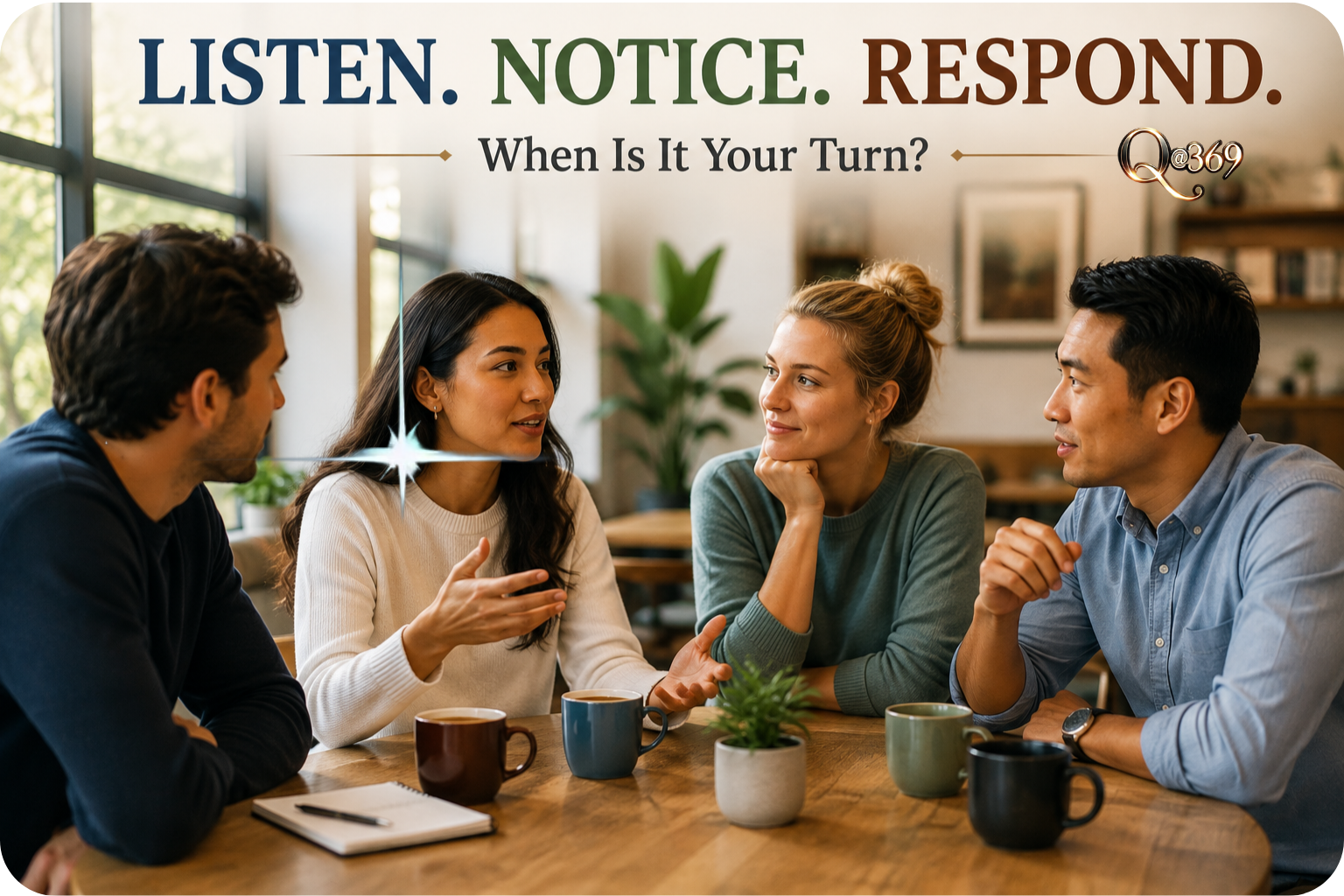
The Subtle Art Of Entering A Conversation Without Interrupting
Have you ever known exactly what you wanted to say, yet struggled to find the right moment to say it?

Good conversation depends on recognizing when another person has finished enough of a thought for someone else to respond.
- Why conversation depends upon rapid and largely unconscious turn taking.
- How pauses, voice patterns, eye contact, and body movement can signal a possible opening.
- Why preparing your answer too early can weaken listening.
- How conversational timing changes among people, cultures, and situations.
- What to do when two people begin speaking simultaneously.
- How better listening can make finding your turn easier.
✨ AUDIO: Listen to “Have you ever known exactly what you wanted to say, yet struggled to find the right moment to say it?” by Isaac Yue
🎯 Also Available on SPOTIFY
🙏 Join Our Enlightened Community Today!
💞 Share with Friends and Colleagues
Conversation Has An Invisible Rhythm
A good conversation can seem effortless. One person speaks. Another responds. Ideas move between people without anyone formally announcing whose turn comes next.
Underneath that apparent simplicity is remarkable coordination.
Researchers studying conversation call this turn taking. People continuously interpret speech, timing, facial expressions, and other signals while deciding when to speak.
The process happens quickly. Most of us learned much of it through years of social interaction rather than formal instruction.
Problems arise when we misread the rhythm.
A Pause Is Not Always An Invitation
Silence seems to provide the most obvious conversational cue.
Someone stops talking. You begin.
That works surprisingly often. It is not completely reliable.
People pause while searching for a word. They pause for emphasis. A speaker may take a breath before continuing the same thought.
Jumping into every silence can therefore create accidental interruptions.
Instead, listen for several cues working together.
Listen For Completion
Speech itself often tells us whether a thought is approaching completion.
A speaker may finish a sentence and lower their voice slightly. Their pace may slow. The grammatical structure of the sentence may also sound complete.
Compare these two moments:
“I went to the store this morning, and then…”
The thought clearly seems unfinished.
“I went to the store this morning and finally found what I needed.”
That statement provides a much more natural opportunity for a response.
We rarely analyze grammar consciously during conversation. Our brains still use linguistic structure to anticipate where a speaking turn may end.
Watch What The Speaker Does
Conversation is not carried by words alone.
Eye contact can provide useful information. Someone who has been looking away while recalling a story may look toward you after completing it.
Body movement can also change. A speaker may relax their posture, stop gesturing, or slightly turn toward another participant.
None of these behaviors forms a universal rule.
Think of them as clues.
A pause plus sentence completion plus renewed eye contact provides stronger evidence than any single signal.
Listening Helps You Find Your Turn
There is an interesting problem hiding inside our desire to respond.
Once we decide what we want to say, we may begin rehearsing it mentally.
At that moment, part of our attention moves away from the speaker.
We are no longer only listening.
We are waiting.
That difference can matter. The speaker may add something that changes the meaning of the conversation. We can miss it while protecting our prepared response.
Listening until the thought develops more fully can improve both timing and the quality of our reply.
Your response may even change.
That is evidence that you were listening.
Not Every Conversation Moves At The Same Speed
Some people leave generous pauses between turns. Others communicate through rapid exchanges with very little silence.
Families can develop their own conversational rhythms. Friends who know each other well may overlap frequently without interpreting it as rude.
Cultural expectations also influence conversational timing.
A pause considered respectful in one setting may seem uncomfortable somewhere else. Frequent conversational overlap may signal enthusiasm among some groups while appearing intrusive among others.
This is why rigid rules are less useful than social awareness.
Observe the people in front of you.
Group Conversations Add Another Challenge
Two person conversations are relatively simple.
Groups create competition for the same opening.
You may notice three people preparing to respond as one speaker finishes. Eye contact becomes especially useful here.
A small forward movement can communicate interest. Raising a hand slightly may work in a structured discussion.
You can also allow someone else to enter first.
Giving away a conversational turn does not diminish your contribution. Sometimes it demonstrates confidence and awareness.
Your idea can usually wait a few seconds.
What Happens When You Interrupt Accidentally?
Sooner or later, two people will begin speaking at the same time.
That is normal.
You do not need a lengthy apology.
A simple, “Go ahead,” often solves the problem immediately.
If the other person offers the turn back, continue. If they continue speaking, listen and return to your thought later when it remains relevant.
Conversation does not require flawless timing.
It requires cooperation.
Interrupting Can Sometimes Be Appropriate
Not every interruption is discourteous.
Someone may need clarification before the discussion moves forward. Important information may need immediate attention. A meeting facilitator may need to redirect a conversation that has moved far from its purpose.
The difference often involves intention and context.
Are you interrupting to improve understanding?
Or are you interrupting primarily to make sure your thought gets heard?
That distinction is worth noticing.
A Simple Three Cue Practice
During your next conversation, resist searching for one perfect signal.
Instead, look for three categories of information.
Listen to the words.
Does the thought sound complete?
Notice the pause.
Does the silence feel intentional rather than temporary?
Watch the person.
Do their eyes, expression, or posture appear to return the conversation to you?
When several cues agree, your opportunity to speak becomes easier to recognize.
You do not need to consciously perform this checklist forever. Practice can make these observations increasingly natural.
The Best Response May Arrive Later
There is another advantage to waiting.
Your first response is not always your best response.
A few additional seconds can reveal what the other person actually wants from the conversation. They may want information, reassurance, another perspective, or simply someone willing to listen.
Knowing when to speak therefore begins with understanding why you are speaking.
Sometimes the most useful contribution is a thoughtful response.
Sometimes it is another question.
Sometimes your turn arrives and you discover that nothing needs to be added.
Isaac Yue Reflection
I enjoy conversation, especially when people bring different experiences and ideas to the same discussion.
I have also learned that listening creates better conversations than competing for speaking time. When I concentrate too much on my response, I can miss something important that is still developing.
I try to watch the rhythm instead.
A pause, completed thought, or change in eye contact can tell me that the conversation has opened. Sometimes another person gets there first. That is fine.
The goal is not winning the next turn.
The goal is participating in a conversation worth having.
Your Turn Begins With Their Turn
Knowing when to speak is not mainly about finding an opening.
It begins with giving another person enough attention to recognize when their thought has reached a natural resting point.
Listen for completion. Notice the pause. Watch the person.
Then respond to what was actually said.
Good conversational timing does more than prevent interruptions. It communicates something valuable without requiring any words:
I was listening.
Reflection Question
Do you listen until another person’s thought is complete, or begin preparing your response while they are still speaking?
Practical Action
During one conversation today, pay attention to three cues before responding:
Words. Pause. Person.
Notice whether the thought sounds complete. Observe the silence. Watch for a visual cue.
Then take your turn.
Does Your Voice Affect When Others Take Their Turn?
Your words are not the only signals another person hears. Changes in pitch, volume, rhythm, and timing can communicate whether you intend to continue speaking or have reached the end of your thought.
A naturally higher pitched voice does not automatically invite interruption. What matters more is how your voice changes near a possible turn ending, combined with pauses, sentence completion, eye contact, and other conversational cues.
Gender can add another social influence. Research has found that women are interrupted more frequently in some conversational settings. However, results vary with context, conversational roles, and the type of interruption being measured.
The important distinction is simple: voice helps signal when a turn may be ending, while social context can influence what other people do with that signal.

References
- Stivers, T., Enfield, N. J., Brown, P., et al. (2009). “Universals and Cultural Variation in Turn Taking in Conversation.” Proceedings of the National Academy of Sciences, 106(26), 10587–10592.
Researchers examined ten languages and found broadly similar systems of conversational turn taking alongside measurable cultural variation in timing. This supports the article sections explaining conversational rhythm and differences among cultures.
https://doi.org/10.1073/pnas.0903616106 - Levinson, S. C., & Torreira, F. (2015). “Timing in Turn Taking and Its Implications for Processing Models of Language.” Frontiers in Psychology, 6, 731.
This review examines how people predict the completion of another person’s speaking turn and prepare responses within remarkably short conversational gaps. It strongly supports the article’s discussion of sentence completion, timing, and anticipating opportunities to respond.
https://doi.org/10.3389/fpsyg.2015.00731 - Bögels, S., & Torreira, F. (2015). “Listeners Use Intonational Phrase Boundaries to Project Turn Ends in Spoken Interaction.” Journal of Phonetics, 52, 46–57.
The research demonstrates that listeners use vocal and linguistic information to anticipate when another person’s conversational turn may end. This supports the practical advice to listen for completion rather than treating every pause as an invitation to speak.
https://doi.org/10.1016/j.wocn.2015.04.004
See more of QuantumAlchemist369™ selected self-empowerment knowledge selections on the Book Shelf
Interactive Live Meetups
Thursday 7PM EDT Live Q&A with Isaac Yue
Join the Live Meetup Community discussion.
2026 Community Feedback Now Open
You are invited to help build QuantumAlchemist369. Take a few minutes to complete the Quantumarian Community Review 2026.
“Quantum Alchemy: The Convergence of Science, Spirit, and Enlightenment”
Second Edition – Refined & Expanded


Leave a Reply