
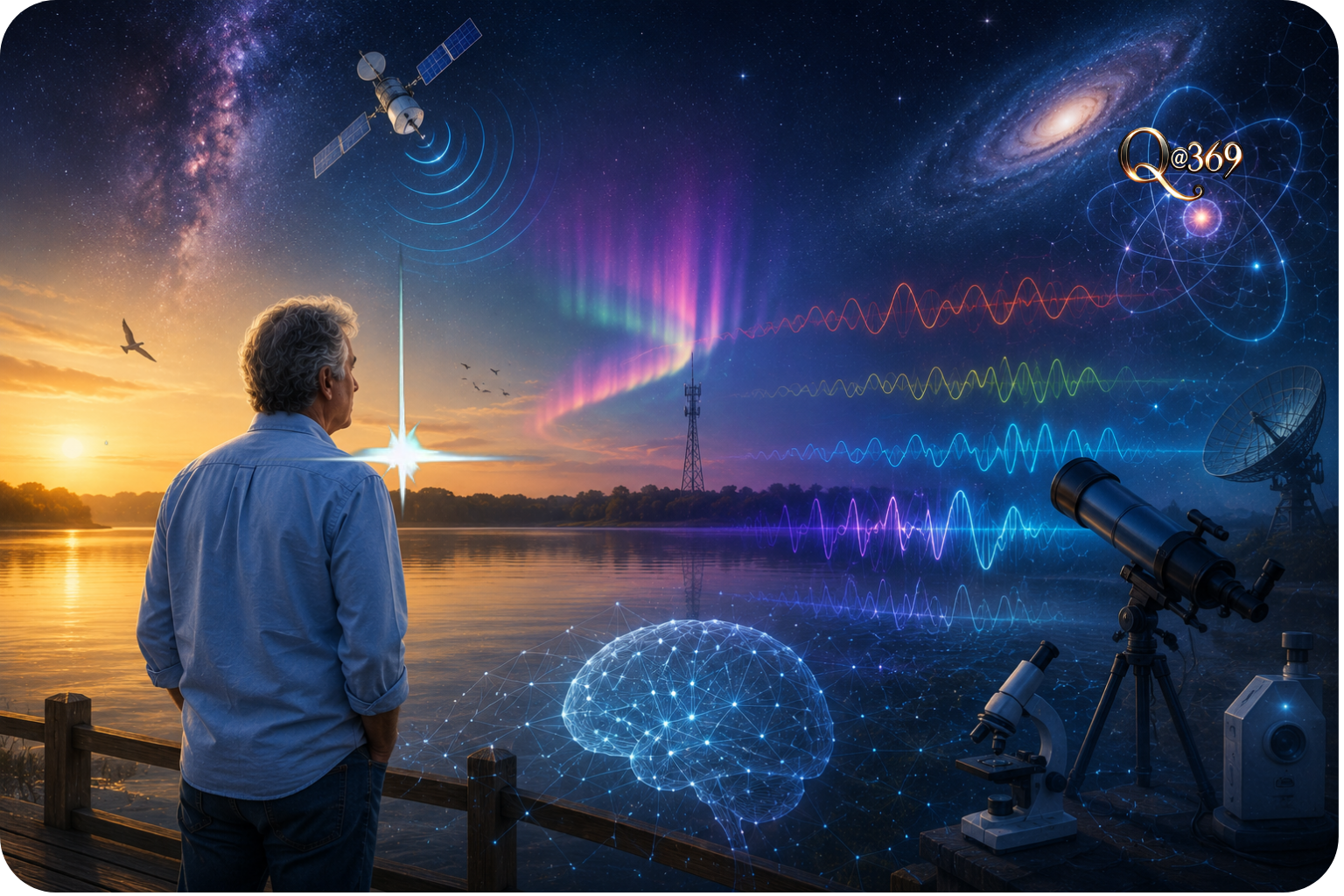
What exists around you right now that are beyond your senses to detect?
Human perception can feel remarkably complete. We see the room around us, hear nearby sounds, feel the ground beneath us, and assume we are experiencing the world as it exists. Yet our senses capture only portions of the physical information surrounding us.
Science already shows that instruments can detect forms of light, sound, radiation, magnetic activity, and other physical phenomena outside direct human perception. That fact does not prove hidden dimensions, spiritual worlds, or unknown forms of consciousness. It offers something more useful: a reason to remain curious and intellectually humble.
This Article Will Help You:
- Understand why human perception represents only part of our physical environment.
- Explore how the brain transforms sensory signals into conscious experience.
- Discover examples of phenomena that exist beyond unaided human detection.
- Separate scientifically detectable phenomena from speculation.
- Recognize why uncertainty does not require belief or rejection.
- Practice greater intellectual humility when confronting the unknown.
The World Feels Complete
Look around you for a moment. Perhaps you see a window, furniture, trees, a computer screen, or another person. You may hear traffic, birds, air conditioning, conversation, or almost nothing at all.
Your experience seems continuous and convincing. What you see appears to be the world, rather than one biological interpretation of information reaching your nervous system. That distinction can change how we think about perception.
Our sensory systems receive particular forms of physical information and convert them into electrical signals used by the nervous system. Different receptors respond to different kinds of stimulation, and the brain integrates these signals into our perceptual experience.
This process is extraordinarily effective for living an everyday human life.
It is not a complete measurement system for everything that exists.
Isaac Watches A World His Senses Cannot Fully Detect

Sometimes I sit quietly outside and watch the world around me. Palm fronds move slightly in the breeze. Birds cross the sky, insects move through vegetation, and sunlight reflects from the water.
Everything appears peaceful and complete.
Then I consider what is also present.
Radio transmissions may be crossing the area. Infrared radiation surrounds objects according to their temperatures. Ultraviolet radiation arrives from the Sun. Sounds may exist above or below frequencies my ears can detect.
None of these phenomena suddenly appeared when scientists invented instruments capable of measuring them. Instruments gave us new ways to observe physical information our unaided senses could not directly register.
That observation creates a humbling thought.
The limits of my perception are not necessarily the limits of reality.
Your Eyes See A Narrow Window
Vision provides one of the clearest examples.
What we call visible light represents only one portion of the electromagnetic spectrum. NASA describes typical human visual sensitivity as wavelengths from roughly 380 to 700 nanometers. Radiation outside that range includes infrared, ultraviolet, radio waves, microwaves, X rays, and gamma rays.
Consider what that means during an ordinary afternoon.
You may look across a landscape and feel that you are seeing everything available to see. In reality, your eyes are responding only to electromagnetic radiation within a limited biological range.
A television remote can transmit infrared radiation that your eyes cannot see. Radio communications can travel through the surrounding environment without producing visible patterns in front of you. Instruments translate some of this hidden physical information into forms our senses can understand.
The world did not become larger when we discovered these wavelengths.
Our ability to observe it became larger.
Your Ears Also Have Boundaries
Hearing creates another useful example.
A commonly cited range for young human hearing extends from about 20 hertz to 20,000 hertz. Sensitivity varies among individuals, and the upper boundary commonly decreases with age.
Many animals respond to frequencies outside the range we normally hear. Their sensory worlds therefore differ from ours even while occupying the same physical environment.
Imagine standing quietly beside another animal.
You may believe the surroundings are silent. The animal may be responding to acoustic information that never becomes part of your conscious experience.
Neither organism needs to possess a complete representation of everything occurring nearby.
Each sensory system evolved to collect information useful for that organism’s life.
Perception Begins With Selection
We sometimes speak about the five senses as though they were open windows providing direct access to reality. Biology gives us a more interesting picture.
Sensory receptors respond only within particular ranges and conditions. Physical stimuli below sensory thresholds may exist even when they fail to produce conscious perception. Researchers describe sensory thresholds as transitions in the probability that a stimulus will be detected, rather than perfectly sharp boundaries.
This means human perception begins with selection.
Some information reaches receptors. Some information does not. Some signals are strong enough to influence perception, while others remain below detection.
Then the nervous system has another task.
It must interpret what arrived.
The Brain Does Not Simply Record
Our experience is not comparable to a video camera recording everything entering the senses.
Sensory signals move through complex neural systems. The nervous system processes patterns, combines information, compares signals, and contributes to the coherent experience we call perception.
Even visual processing is not completely isolated from other sensory and cognitive systems. Research continues examining how sound, movement, attention, and other information can interact with activity in brain regions traditionally associated with vision.
That helps explain an important distinction.
Sensation provides information. Perception provides experience.
What reaches consciousness is therefore not a perfect inventory of everything physically present. It is the result of biological sensing and neural processing.
Our experience can be reliable enough to navigate life while remaining incomplete.
Technology Extends The Human Sensorium
One of science’s greatest achievements has been learning how to observe beyond natural sensory limits.
Telescopes collect information our eyes cannot gather unaided. Microscopes reveal structures too small for direct human vision. Radio telescopes detect electromagnetic radiation outside visible wavelengths.
Infrared cameras translate infrared radiation into visible displays. Geiger counters allow humans to detect ionizing radiation indirectly. Scientific instruments repeatedly transform otherwise inaccessible signals into information our brains can interpret.
This pattern appears throughout the history of science.
First, something is beyond direct perception.
Then an instrument makes measurement possible.
Eventually, something once invisible becomes scientifically observable.
That history should encourage curiosity.
It should also encourage discipline.
Undetected Does Not Mean Undetectable
This distinction is essential.
Something may be undetected simply because nobody has measured it yet. Something may be detectable through instruments even though human senses cannot perceive it directly.
A third category is very different.
Something may be speculative, meaning evidence has not yet established that it exists.
These categories should not be blended together.
The existence of ultraviolet radiation does not demonstrate that every invisible idea is physically real. The discovery of radio waves does not establish unknown dimensions, invisible beings, or spiritual forces.
Science requires evidence appropriate to the claim.
Curiosity can remain wide.
Conclusions should remain narrower.
Where Extra Dimensions Enter The Conversation
Physics offers concepts that can easily become confused with philosophical speculation.
Some theoretical approaches in physics investigate mathematical models containing additional spatial dimensions. These ideas arise from attempts to understand fundamental physics, not from evidence that humans occasionally sense hidden worlds.
The important word is theoretical.
Human sensory limitations cannot establish that additional dimensions exist. Our inability to perceive something directly is not evidence for a particular explanation.
Consider the logic carefully.
Your eyes cannot see radio waves.
Radio waves exist because instruments can repeatedly detect, measure, predict, and use them.
Your eyes also cannot see a hypothetical extra dimension.
That similarity tells us nothing about whether the second claim is true.
Absence from direct perception creates a question.
Evidence determines what we can responsibly say next.
Curiosity Without Automatic Belief
The unknown often produces two opposite reactions.
One person hears an extraordinary possibility and immediately accepts it. Another person immediately rejects anything that cannot currently be observed.
Both responses can close investigation too early.
A more productive position is curiosity supported by evidence.
We can say, “I do not know.”
Those words are not an intellectual failure. They may represent the most scientifically responsible answer available.
Researchers regularly work near the boundary between what is understood and what remains uncertain. Good science does not require pretending that unanswered questions have already been resolved.
Neither does thoughtful living.
Curiosity Without Automatic Rejection
Skepticism has tremendous value when it means examining evidence carefully.
It becomes less useful when skepticism turns into certainty that anything currently unknown must be impossible.
History contains many examples of physical phenomena becoming observable only after humans developed appropriate instruments and theories. Our current instruments may also have limitations.
That does not mean every proposed phenomenon will eventually prove real.
It means uncertainty should remain uncertainty until evidence changes it.
This position allows wonder without surrendering critical thinking.
We can remain fascinated by possibilities while refusing to convert possibilities into facts.
Isaac Looks Beyond What He Can See
When I look across the water during a quiet Florida afternoon, I know my senses are giving me an incomplete experience.
I cannot see infrared radiation. I cannot hear every acoustic frequency. I cannot directly observe the electromagnetic signals moving through the environment.
Yet I know some of those phenomena can be measured.
That realization changes the experience for me.
The view does not become less beautiful when I recognize its incompleteness. It becomes more interesting.
I become aware that nature contains more information than my biology can directly provide.
Then another question naturally appears.
What else have we not learned how to detect?
I do not need to answer that question.
The question itself has value.
The Difference Between Mystery And Explanation
Mystery is not evidence.
When something remains unknown, the honest conclusion is that it remains unknown. Filling the gap with an attractive explanation may reduce discomfort, yet it does not increase knowledge.
This principle applies equally to scientific and spiritual claims.
We should not use quantum physics to declare that consciousness creates physical reality. We should not use sensory limitations to prove unseen spiritual structures.
We can still explore philosophical meaning.
The distinction is in how we describe the exploration.
“This possibility makes me wonder” is different from “science has demonstrated this.”
Those sentences carry different levels of certainty.
Keeping them separate protects curiosity from becoming misinformation.
What Other Creatures Remind Us
Other animals provide an everyday reminder that perception is species dependent.
Animals can occupy the same environment while receiving different sensory information. Their nervous systems respond according to their biological capacities and ecological needs.
This creates a fascinating thought experiment.
Imagine several species standing in the same location.
They share one physical environment.
Their experienced worlds may still differ considerably.
Humans are part of that same biological story.
Our perception is impressive, yet there is no scientific reason to assume human sensory systems provide direct access to every measurable feature of nature.
Practical Daily Living
You do not need laboratory instruments to apply this lesson.
The practical benefit is intellectual humility.
When you encounter something unfamiliar, consider three possibilities before reaching a conclusion.
First, perhaps you simply have not noticed enough information.
Second, perhaps useful evidence exists beyond your immediate experience.
Third, perhaps nobody currently knows the answer.
That third possibility can be surprisingly liberating.
You do not have to believe something simply because it sounds fascinating.
You also do not have to reject it simply because it sounds unfamiliar.
You can remain curious.
A Better Response To The Unknown
The next time you encounter an extraordinary claim, pause before choosing belief or rejection.
Ask what exactly is being claimed.
Then ask what evidence would allow the claim to be tested.
Consider whether the phenomenon has been measured independently. Look for alternative explanations. Notice whether the conclusion reaches farther than the evidence permits.
This approach works beyond science.
It can improve conversations, decision making, relationships, and even our understanding of ourselves.
Many disagreements grow from certainty arriving before investigation.
Curiosity creates another route.
Reflection Question
Consider everything happening around you at this moment.
You can see only part of the electromagnetic spectrum and hear only part of the acoustic environment. Your brain is also selecting and interpreting information before it becomes conscious experience.
How might recognizing the limits of your own perception change the way you respond to something you do not yet understand?
Perhaps intellectual humility begins there.
Not with assuming the extraordinary is true.
Not with assuming it is impossible.
With becoming comfortable enough to say, “I do not know yet.”
Five Minute Quantumarian Challenge
Take five minutes somewhere familiar today.
Look slowly around you and identify what your senses provide. Notice colors, sounds, temperature, movement, texture, and physical sensations.
Then consider three things you know are present even though you cannot directly sense them.
Perhaps WiFi radio signals are carrying information nearby. Infrared radiation is moving through your environment. Sounds outside your hearing range may be present.
Finish with one question.
What might I be overlooking simply because my natural perception is limited?
Do not invent an answer.
Practice staying with the question.
Science Fact
Human eyes normally detect only a small region of the electromagnetic spectrum, approximately 380 to 700 nanometers. The electromagnetic spectrum extends far beyond visible light into radio, microwave, infrared, ultraviolet, X ray, and gamma ray regions.
Human hearing also operates within biological limits. A commonly described range is approximately 20 hertz through 20 kilohertz, with sensitivity varying across individuals and age.
These examples demonstrate something important.
Our inability to sense a physical phenomenon directly does not determine whether it exists.
Evidence does.
Isaac Yue Reflection
I have spent much of my life around engineering and technology.
Engineers frequently work with things they cannot directly see.
We trust instruments when those instruments are properly designed, calibrated, tested, and supported by repeatable measurements. We do not need to see an electrical signal with our eyes to understand that it is present.
That experience has given me respect for both measurement and uncertainty.
It reminds me not to confuse the limits of my senses with the limits of nature.
It also reminds me not to confuse curiosity with proof.
There may be aspects of reality humanity has not yet discovered.
That possibility excites me.
What matters is how we approach it.
With curiosity.
With evidence.
With humility.
And with enough patience to allow “we do not know yet” to remain a perfectly respectable answer.
Isaac Yue Reflection
I have spent much of my life around engineering and technology.
Engineers frequently work with things they cannot directly see.
We trust instruments when those instruments are properly designed, calibrated, tested, and supported by repeatable measurements. We do not need to see an electrical signal with our eyes to understand that it is present.
That experience has given me respect for both measurement and uncertainty.
It reminds me not to confuse the limits of my senses with the limits of nature.
It also reminds me not to confuse curiosity with proof.
There may be aspects of reality humanity has not yet discovered.
That possibility excites me.
What matters is how we approach it.
With curiosity.
With evidence.
With humility.
And with enough patience to allow “we do not know yet” to remain a perfectly respectable answer.
Scientific Insight
Human eyes normally detect wavelengths from roughly 380 to 700 nanometers, which represents only the visible portion of the electromagnetic spectrum. Radio waves, microwaves, infrared, ultraviolet, X rays, and gamma rays exist outside direct human vision.
Human hearing also operates within biological limits. A commonly described range extends from approximately 20 hertz to 20 kilohertz, with sensitivity varying among people and generally changing with age.
These facts reinforce the article’s central lesson. Human senses provide useful access to our surroundings without providing a complete inventory of physical reality. Scientific instruments can extend observation beyond those natural limits.
The important distinction remains clear. Something outside direct human perception may be measurable, currently undetected, or still speculative. Sensory limitations alone do not establish that an unknown phenomenon exists.

References
- NASA Science. (2023). Visible Light. NASA Electromagnetic Spectrum. Human vision commonly responds to wavelengths from about 380 through 700 nanometers.
https://science.nasa.gov/ems/09_visiblelight/ - Purves, D., Augustine, G. J., Fitzpatrick, D., et al. (2001). The Audible Spectrum. Neuroscience, 2nd Edition. National Center for Biotechnology Information. Human hearing commonly extends from approximately 20 hertz through 20 kilohertz.
https://www.ncbi.nlm.nih.gov/books/NBK10924/ - Le Prell, C. G., Spankovich, C., Lobarinas, E., & Griffiths, S. K. (2013). Extended high frequency thresholds in college students: Effects of music player use and other recreational noise. Journal of the American Academy of Audiology. The research examines variation in human sensitivity at higher acoustic frequencies.
https://pmc.ncbi.nlm.nih.gov/articles/PMC4111237/ - Merfeld, D. M. (2011). Signal detection theory and vestibular thresholds: I. Basic theory and practical considerations. Experimental Brain Research, 210, 389 to 405.
DOI: 10.1007/s00221-011-2557-7
https://pubmed.ncbi.nlm.nih.gov/21359662/
See more of QuantumAlchemist369™ selected self-empowerment knowledge selections on the Book Shelf
Quantum Alchemy: The Convergence of Science, Spirit, and Enlightenment
Second Edition – Refined & Expanded

- Discover the practical link of modern science to ancient wisdom
- Read Sample Pages on Amazon
- Follow the Link to Learn More
- Available in Print, Kindle and Audio.
A Kind Request From the Author
Please give us your feedback.
Leave your comments below. We would love to hear your thoughts
More Human Perception
Benefits of Joining Our Community
By joining QuantumAlchemist369™, you will love to stay informed and connected with us and the Quantum Alchemist community. Join us and receive free daily email updates of blogs, events, and useful insights.
Leave a Comment
We would love to hear your thoughts. Please leave a comment and share how this content resonates with your own mindful journey.
Forum Discussion
Join the Quantumarian Forum Community discussion.
Sustain the Alchemy
If the insights here have sparked something within you…We invite you to Sustain the Alchemy
You Will Want to Explore
All the items, books and graphic designs, available in our QuantumAlchemist369 Shop
2026 Community Feedback Now Open
You are invited to help build QuantumAlchemist369. Take a few minutes to complete the Quantumarian Community Review 2026.


Leave a Reply