
How can technology unearth ancient cities hidden beneath our feet?
Archaeologists have always searched for clues left behind by earlier civilizations, but artificial intelligence is now helping researchers discover patterns that human eyes can easily overlook. The result of AI archaeology is expanding our understanding of history while demonstrating how innovation continues changing the way we explore the past.
This Article Will Help You:
- Understand how artificial intelligence is transforming archaeological research.
- Learn how advanced imaging reveals features hidden beneath forests and deserts.
- Discover why human expertise remains essential alongside AI.
- Appreciate how new discoveries continue reshaping our understanding of history.
- Apply the value of looking beyond first impressions in everyday life.
Reader Takeaway
Artificial intelligence is allowing archaeologists to examine enormous amounts of information more efficiently than ever before. Rather than replacing human expertise, AI helps researchers identify promising clues that deserve closer investigation. The same principle applies to everyday life. Better observation often begins by learning to recognize patterns we previously overlooked.
Every Discovery Begins With A Better Question
History is filled with mysteries that generations of explorers hoped to answer. Some discoveries required courage to travel farther than anyone before them. Others required patience to uncover what had remained buried for centuries.
Today, many discoveries begin with a different kind of expedition. Researchers increasingly combine archaeology with artificial intelligence, satellite imaging, and advanced computer analysis to investigate places that once appeared ordinary. Technology is giving archaeologists another way to ask better questions before a single shovel touches the ground.
The Invisible City Beneath The Sand

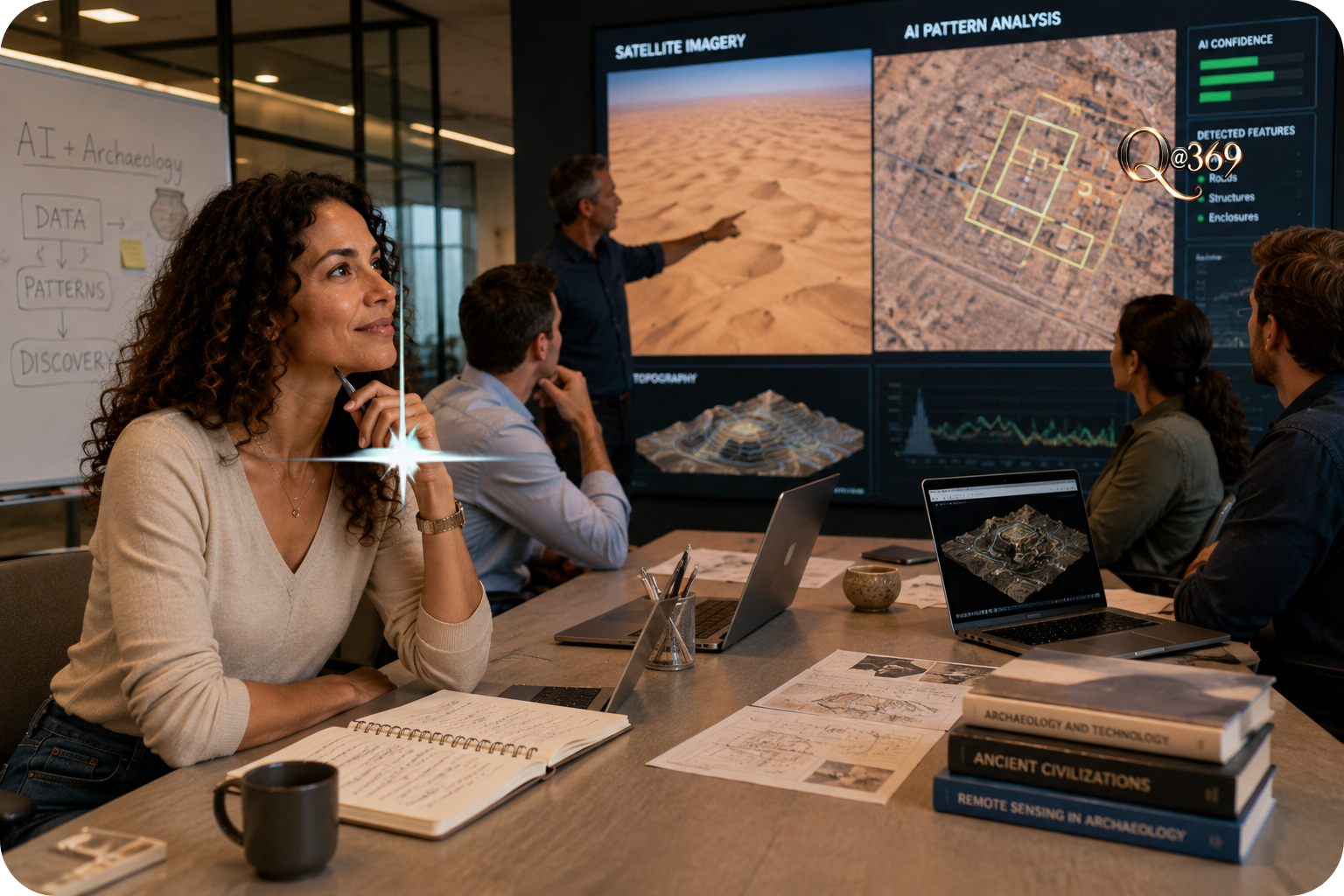
Alma enjoys working with data because she knows important answers are often hidden within ordinary information. One afternoon she attended a presentation by an archaeological research team demonstrating how artificial intelligence was helping identify ancient settlements from satellite imagery. At first, the photographs appeared to show nothing more than an endless desert.
The researchers activated their analysis software, and faint geometric patterns slowly appeared across the landscape. Straight lines intersected at right angles, while subtle shapes suggested walls, streets, and building foundations buried beneath centuries of drifting sand. What had looked empty only moments earlier now revealed the outline of a forgotten city.
The discovery fascinated Alma because nothing beneath the sand had changed. The city had always been there. The difference was that new technology helped people recognize patterns they previously could not see.
Driving home, Alma thought about how often people overlook opportunities in everyday life for the same reason. Sometimes the greatest obstacle is not the absence of information. It is the absence of perspective needed to recognize what has been present all along.
Looking Beyond What We First See
Modern archaeological projects produce extraordinary amounts of information. Satellites photograph landscapes from space, drones capture detailed aerial images, and LiDAR instruments map the ground beneath dense forests by measuring reflected laser light. Ground penetrating radar also helps identify buried structures without disturbing the soil.
Reviewing millions of images and measurements would require enormous amounts of time if completed manually. Artificial intelligence assists by recognizing subtle geometric shapes, unusual soil patterns, and repeated features that may indicate roads, foundations, walls, or ancient settlements. Human archaeologists then examine these findings and determine which locations deserve careful investigation.
Artificial intelligence accelerates discovery. Human expertise determines meaning.
What Is LiDAR?
LiDAR, which stands for Light Detection and Ranging, uses pulses of laser light to measure distances with remarkable precision. When these measurements are combined, computers create detailed three dimensional maps of the landscape.
Because some laser pulses reach the ground between leaves and branches, researchers can digitally remove vegetation and reveal ancient roads, buildings, terraces, and ceremonial sites that may have remained hidden beneath forests for centuries.
Artificial Intelligence Is A Research Partner
Artificial intelligence excels at processing enormous collections of information quickly. It compares images, identifies repeating patterns, detects small differences, and highlights locations that deserve additional study. These capabilities save researchers valuable time and often reveal possibilities that might otherwise remain unnoticed.
Artificial intelligence cannot determine historical significance on its own. Archaeologists still conduct excavations, analyze artifacts, compare historical records, and apply scientific methods to verify every important discovery. Technology supports the investigation, while experienced researchers provide interpretation and judgment.
The strongest discoveries occur when human curiosity and intelligent technology work together.
A Quantum Alchemy Reflection
Quantum Alchemy encourages us to approach life with curiosity, humility, and thoughtful observation. Artificial intelligence reminds us that better tools often reveal opportunities that have existed all along without changing reality itself.
The same lesson applies beyond archaeology. We sometimes overlook possibilities because our attention is focused elsewhere or because we assume we already understand the situation. By slowing down and examining circumstances more carefully, we often discover new perspectives that were present from the beginning.
Learning to observe more carefully is one of the simplest ways to improve both knowledge and wisdom.
Practical Application
Alma left the presentation thinking about more than archaeology. Artificial intelligence had not created the hidden city. It had simply revealed what had always been there by recognizing patterns that people could not easily see.
She wondered how often the same principle applies in everyday life. Opportunities, solutions, and new ideas may already exist around us, yet we overlook them because we are distracted, make assumptions, or stop looking too soon.
This week, practice becoming a more careful observer.
Before making an important decision, pause and ask yourself:
- What evidence have I not considered?
- Am I relying on assumptions instead of facts?
- Could another perspective reveal something I have overlooked?
- What patterns might become clearer if I slow down and observe more carefully?
Like Alma, you may discover that better understanding does not always require more information. Sometimes it begins by looking at familiar situations with fresh eyes, greater curiosity, and an open mind.
Closing Reflection
Artificial intelligence is helping archaeologists uncover forgotten cities, hidden roads, and remarkable chapters of human history that once seemed permanently lost. Every discovery reminds us that the past still holds many secrets waiting to be revealed.
Perhaps the greatest lesson extends beyond archaeology itself. The world frequently contains more than we first perceive, and our understanding grows whenever we become willing to observe with greater patience, curiosity, and care.
Scientific Insight
Artificial intelligence is becoming one of the most valuable tools in modern archaeology because it can rapidly analyze enormous collections of information that would take researchers years to examine manually. By combining machine learning with satellite imagery, LiDAR, drone photography, and ground penetrating radar, archaeologists can identify subtle patterns that may indicate buried structures, ancient roads, irrigation systems, or forgotten settlements.
Artificial intelligence does not replace archaeological expertise. Instead, it helps researchers prioritize where to investigate, while archaeologists continue verifying discoveries through excavation, artifact analysis, dating techniques, and historical research. This partnership between technology and human judgment is accelerating discoveries across the world while preserving scientific rigor.
Why this matters:
Better technology allows us to ask better questions. Whether exploring ancient civilizations or solving everyday problems, combining careful observation with thoughtful analysis often reveals possibilities that were previously overlooked.

References
- Chase, A. F., & Chase, D. Z. (2017). Remote Sensing In Archaeology.
- Renfrew, C., & Bahn, P. (2020). Archaeology: Theories, Methods, and Practice. Eighth Edition.
- Caspari, G., & Crespo, P. (2019). Artificial Intelligence In Archaeology. Nature Machine Intelligence.
- Lambers, K., & Remondino, F. (Eds.). (2009). Optical 3D Measurement Techniques In Archaeology.
- UNESCO World Heritage Centre https://whc.unesco.org
- Smithsonian Institution Human Origins Program https://humanorigins.si.edu
- National Geographic Archaeology https://www.nationalgeographic.com/history
- Archaeological Institute of America https://www.archaeological.org
See more of QuantumAlchemist369™ selected self-empowerment knowledge selections on the Book Shelf
Quantum Alchemy: The Convergence of Science, Spirit, and Enlightenment
Second Edition – Refined & Expanded

- Discover the practical link of modern science to ancient wisdom
- Read Sample Pages on Amazon
- Follow the Link to Learn More
- Available in Print, Kindle and Audio.
A Kind Request From the Author
Please give us your feedback.
Leave your comments below. We would love to hear your thoughts
More AI Archaeology
Benefits of Joining Our Community
By joining QuantumAlchemist369™, you will love to stay informed and connected with us and the Quantum Alchemist community. Join us and receive free daily email updates of blogs, events, and useful insights.
Leave a Comment
We would love to hear your thoughts. Please leave a comment and share how this content resonates with your own mindful journey.
Forum Discussion
Join the Quantumarian Forum Community discussion.
Sustain the Alchemy
If the insights here have sparked something within you…We invite you to Sustain the Alchemy
You Will Want to Explore
All the items, books and graphic designs, available in our QuantumAlchemist369 Shop
2026 Community Feedback Now Open
You are invited to help build QuantumAlchemist369. Take a few minutes to complete the Quantumarian Community Review 2026.


Leave a Reply