
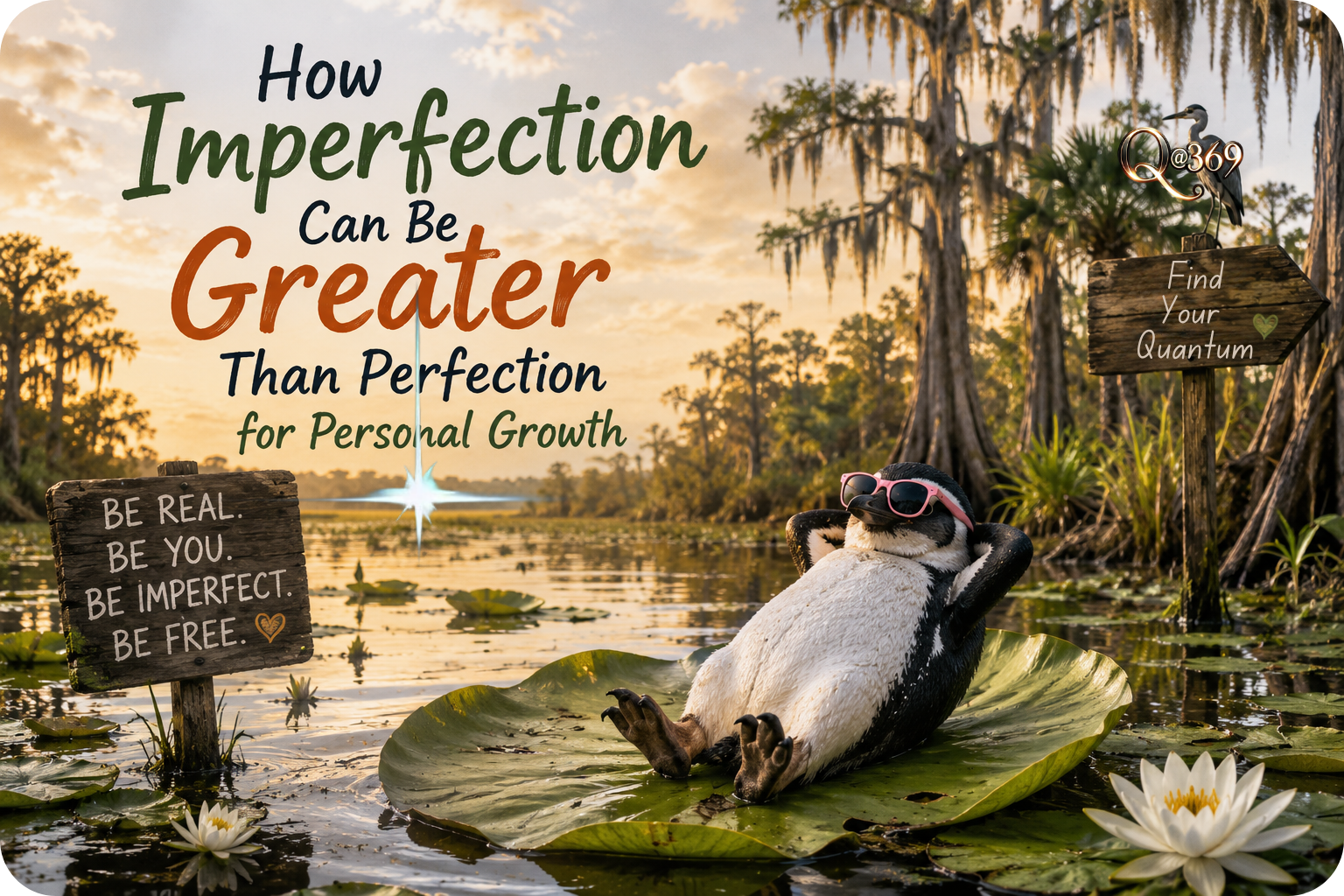
What defines perfection?
Perfection sounds like the ideal goal, yet it is remarkably uncommon throughout the natural world. Living systems succeed because they adapt, recover, and continually improve rather than remaining perfectly unchanged.
This article explores how biology, mathematics, and engineering reveal that small imperfections often create strength instead of weakness. By applying these scientific principles to everyday life, we can replace the pressure of perfection with the confidence to make steady progress.
Why We Chase Perfection
Have you ever postponed beginning something because it did not feel quite ready?
Perhaps you continued editing a presentation that was already excellent. Maybe you delayed writing a book, planting a garden, or starting a new hobby because you believed everything needed to be perfect first. Most of us have experienced moments like these.
As an engineer, I appreciate precision. Measurements matter, specifications matter, and attention to detail matters because accuracy often determines whether a system succeeds. Yet my career also taught me that perfection and reliability are not the same thing.
The most successful designs are rarely perfect in every possible way. Instead, they are designed to perform consistently under real world conditions where change, uncertainty, and small variations are inevitable.
Isaac And The Slightly Crooked Table

Several years ago, I decided to build a small wooden side table for our back patio. It was a straightforward weekend project with four legs, a square top, and a simple design that would hold our morning coffee while we enjoyed the Florida sunshine.
After carefully measuring each piece, I assembled the table and proudly carried it outside. As soon as I placed it on the patio, I noticed something disappointing. One leg was just slightly different from the others, causing the table to rock ever so gently.
The engineer in me immediately wanted to take the entire table apart and start over. Every measurement had been checked twice, yet one small imperfection seemed impossible to ignore.
Before reaching for my tools, I moved the table to another spot on the patio. The natural variation in the stone surface balanced the tiny difference in the table, making it completely stable. That little table has remained there for years, supporting books, flowerpots, coffee mugs, and conversations with family and friends.
Not one visitor has ever noticed what I once considered a serious flaw. Only I knew the table was slightly crooked, and over time it became one of my favorite reminders that usefulness often matters far more than perfection.
Biology Rewards Variation
One of the greatest strengths of life is that it is never perfectly identical.
No two oak trees produce exactly the same leaves. No two snowflakes share identical patterns. Even identical twins gradually develop biological differences as they grow and experience the world.
At first glance, variation may appear to be a flaw. Biology shows exactly the opposite. Small differences within a population give living organisms the flexibility to adapt when environments change, diseases emerge, or food sources become scarce.
Without variation, evolution would have no material upon which natural selection could act. The remarkable diversity we see throughout nature exists because life continually produces small differences rather than perfect copies.
Nature’s Design Principle
If every living organism were genetically perfect and identical:
- A single disease could eliminate an entire species.
- Environmental changes could leave no individuals capable of adapting.
- Evolution would effectively stop because there would be no beneficial variation.
Imperfection is not nature’s mistake.
It is one of nature’s greatest survival strategies.
Why Nature Would Not Succeed If Everything Were Perfect
Imagine a forest where every oak tree was genetically identical.
If a new disease appeared that could infect one tree, it would likely infect every tree. The same principle applies to animals, insects, and even humans. Genetic diversity increases the likelihood that some individuals possess traits allowing them to survive changing conditions, helping entire populations continue into future generations.
Engineers apply a remarkably similar philosophy. Aircraft, spacecraft, and medical devices include backup systems, design tolerances, and safety margins because no component is expected to perform flawlessly forever. Reliability comes from thoughtful adaptation, not impossible perfection.
Nature reached that conclusion billions of years before humans ever built their first machine. Life succeeds because it continually adapts, not because it is perfectly uniform.
Mathematics Finds Beauty In Irregularity
Mathematics also reveals that perfection is not nature’s preferred design.
Coastlines twist and turn in endlessly complex ways. Tree branches divide into patterns that never repeat exactly, while clouds constantly reshape themselves into forms that cannot be described by simple geometry. These natural structures often follow fractal patterns, where irregularity contributes to both beauty and efficiency.
Rather than producing perfectly straight lines and flawless symmetry, nature creates patterns that are flexible, resilient, and endlessly varied. Those imperfections are not mistakes. They are part of the design.
Engineering Designs For Reality, Not Perfection
My engineering career reinforced a lesson that nature had already mastered. The objective of good engineering is rarely absolute perfection. Instead, the goal is dependable performance under real world conditions where change, wear, and uncertainty are unavoidable.
Every manufactured component is built within carefully calculated tolerances. Engineers understand that no two parts can be identical down to the atomic level, nor do they need to be. What matters is that every part performs its intended function safely and reliably throughout its service life.
Spacecraft provide an excellent example of this philosophy. They experience dramatic temperature swings, intense vibration during launch, and years of exposure to radiation. Rather than assuming every component will remain flawless forever, engineers incorporate redundancy, safety margins, and fault tolerant designs so the mission can continue even when individual components begin to age.
Nature follows the very same principle. Living systems are remarkably reliable because they are adaptable rather than perfect.
Resilience Is Built Through Adaptation
A healthy forest does not remain unchanged from season to season. Trees lose branches during storms, plants compete for sunlight, and new seedlings emerge where older trees once stood. Although individual organisms change, the forest itself becomes stronger because it continually adapts to its environment.
Human beings grow in much the same way. We develop wisdom through experience, improve our skills through practice, and strengthen our character by overcoming challenges. Every obstacle provides information that helps us make better decisions in the future.
If our lives unfolded without setbacks, we would have far fewer opportunities to develop patience, creativity, and resilience. What often feels like an imperfection today may become one of tomorrow’s greatest strengths.
The Mathematics Of Natural Beauty
Many people associate mathematics with perfectly straight lines and flawless geometric shapes. While those concepts are important, mathematics also explains why nature appears beautifully irregular.
Fractal geometry describes patterns that repeat across different scales without becoming exact copies. Coastlines, mountain ranges, rivers, clouds, and tree branches all display this remarkable characteristic. Although these structures appear random, they follow underlying mathematical principles that allow them to grow efficiently while adapting to their surroundings.
The result is both practical and beautiful. A tree with perfectly symmetrical branches would actually collect sunlight less efficiently than one with natural variation. Likewise, rivers that meander across a landscape distribute water and nutrients more effectively than perfectly straight channels.
Nature demonstrates that mathematical order and natural variation can exist together. One does not eliminate the other.
Quantum Alchemy And Continual Refinement
Quantum Alchemy encourages continual improvement rather than impossible perfection. It recognizes that transformation is usually the result of many small choices repeated consistently over time instead of one dramatic moment.
Science advances through this same process. Every experiment answers some questions while raising new ones. Researchers refine theories as additional evidence becomes available, allowing our understanding of the universe to become progressively more accurate.
Personal growth follows a similar path. Each experience teaches something valuable, whether it brings success or disappointment. Every thoughtful adjustment becomes another step toward becoming a wiser, more capable person.
Instead of asking, “How can I become perfect?”, perhaps we should ask, “What small improvement can I make today?” That question encourages progress while removing the unnecessary burden of perfection.
Practical Daily Application
Think about one project you have delayed because it still feels incomplete. Perhaps you wanted more experience, more confidence, or simply more time before taking the first step.
Now consider whether perfection has quietly become an excuse for postponing progress. In many cases, completing a good first draft, planting the first seed, or making the first phone call creates far more momentum than continuing to wait for ideal circumstances.
Today, choose one meaningful task and devote just fifteen focused minutes to it. Do not measure success by whether it is perfect. Measure success by whether you moved forward.
Small actions repeated consistently produce remarkable results over months and years.
Final Thoughts From Isaac Yue
That slightly crooked patio table still sits outside our home today. It continues to hold coffee cups, books, flowerpots, and countless conversations without anyone noticing what I once considered its greatest flaw.
Over the years, I have realized the table represents something much larger than a simple woodworking project. It reminds me that usefulness, reliability, and purpose often matter far more than flawless appearance.
Nature never promised perfection. Instead, it demonstrates remarkable adaptability through endless variation, continual refinement, and extraordinary resilience. Forests survive because every tree is slightly different, ecosystems thrive because species continually adapt, and human beings grow because every experience offers another opportunity to learn.
Perhaps the greatest freedom we can give ourselves is to stop pursuing perfection and begin pursuing continual improvement. Progress may be slower than we would like, but it is infinitely more valuable than standing still while waiting to become flawless.
From one of my favorite Sc-Fi movies:
A Science Fiction Thought Experiment
In The Matrix (1999), Agent Smith claims that the first simulated world created by the Machines was designed to be perfect. According to the story, humanity rejected that flawless world because it lacked struggle, uncertainty, and challenge. The Machines eventually created an imperfect world that people would accept as real.
Agent Smith tells Morpheus that the first Matrix was designed as a perfect human world, but it failed because humans rejected it.
“Did you know that the first Matrix was designed to be a perfect human world? Where none suffered. Where everyone would be happy. It was a disaster. No one would accept the program. Entire crops were lost.”
“Some believed we lacked the programming language to describe your perfect world. But I believe that, as a species, human beings define their reality through misery and suffering. The perfect world was a dream that your primitive cerebrum kept trying to wake up from.”
Reflection Question
Where has the pursuit of perfection prevented you from taking the first step toward a goal that could already be improving your life?
Five Minute Quantumarian Challenge
Choose one project you have postponed because it did not seem ready.
Spend the next five minutes taking one meaningful step forward, regardless of whether the result feels perfect.
When you finish, notice how progress creates confidence, while waiting for perfection often creates only hesitation.
One of the most important discoveries in modern biology is that variation is not a defect. It is one of the primary reasons life survives. Every generation introduces small genetic differences that allow populations to adapt to changing climates, emerging diseases, new predators, and shifting food supplies. Without variation, evolution would eventually stop, leaving species vulnerable to extinction.
Mathematics reaches a similar conclusion through fractal geometry. Natural systems such as coastlines, mountain ranges, lightning, blood vessels, and tree branches rarely display perfect symmetry. Instead, they grow through organized irregularity that maximizes efficiency, strength, and adaptability.
Engineering follows these same principles. Aircraft, spacecraft, bridges, and medical devices are designed with tolerances, redundancy, and safety margins because engineers understand that perfect manufacturing does not exist. Reliability comes from anticipating change and designing systems that continue performing safely despite small imperfections.
Nature, mathematics, and engineering all point toward the same remarkable conclusion. Lasting success is built upon resilience and continual adaptation rather than flawless perfection.

References
- Darwin, C. (1859). On the Origin of Species. John Murray.
- Mayr, E. (2001). What Evolution Is. Basic Books.
- National Human Genome Research Institute. Genetic Variation. https://www.genome.gov
- National Institutes of Health. Genetics and Human Variation. https://www.nih.gov
- Mandelbrot, B. B. (1982). The Fractal Geometry of Nature. W. H. Freeman and Company.
See more of QuantumAlchemist369™ selected self-empowerment knowledge selections on the Book Shelf
Quantum Alchemy: The Convergence of Science, Spirit, and Enlightenment
Second Edition – Refined & Expanded

- Discover the practical link of modern science to ancient wisdom
- Read Sample Pages on Amazon
- Follow the Link to Learn More
- Available in Print, Kindle and Audio.
A Kind Request From the Author
Please give us your feedback.
Leave your comments below. We would love to hear your thoughts
More Perfection
Benefits of Joining Our Community
By joining QuantumAlchemist369™, you will love to stay informed and connected with us and the Quantum Alchemist community. Join us and receive free daily email updates of blogs, events, and useful insights.
Leave a Comment
We would love to hear your thoughts. Please leave a comment and share how this content resonates with your own mindful journey.
Forum Discussion
Join the Quantumarian Forum Community discussion.
Sustain the Alchemy
If the insights here have sparked something within you…We invite you to Sustain the Alchemy
You Will Want to Explore
All the items, books and graphic designs, available in our QuantumAlchemist369 Shop
2026 Community Feedback Now Open
You are invited to help build QuantumAlchemist369. Take a few minutes to complete the Quantumarian Community Review 2026.


Leave a Reply