
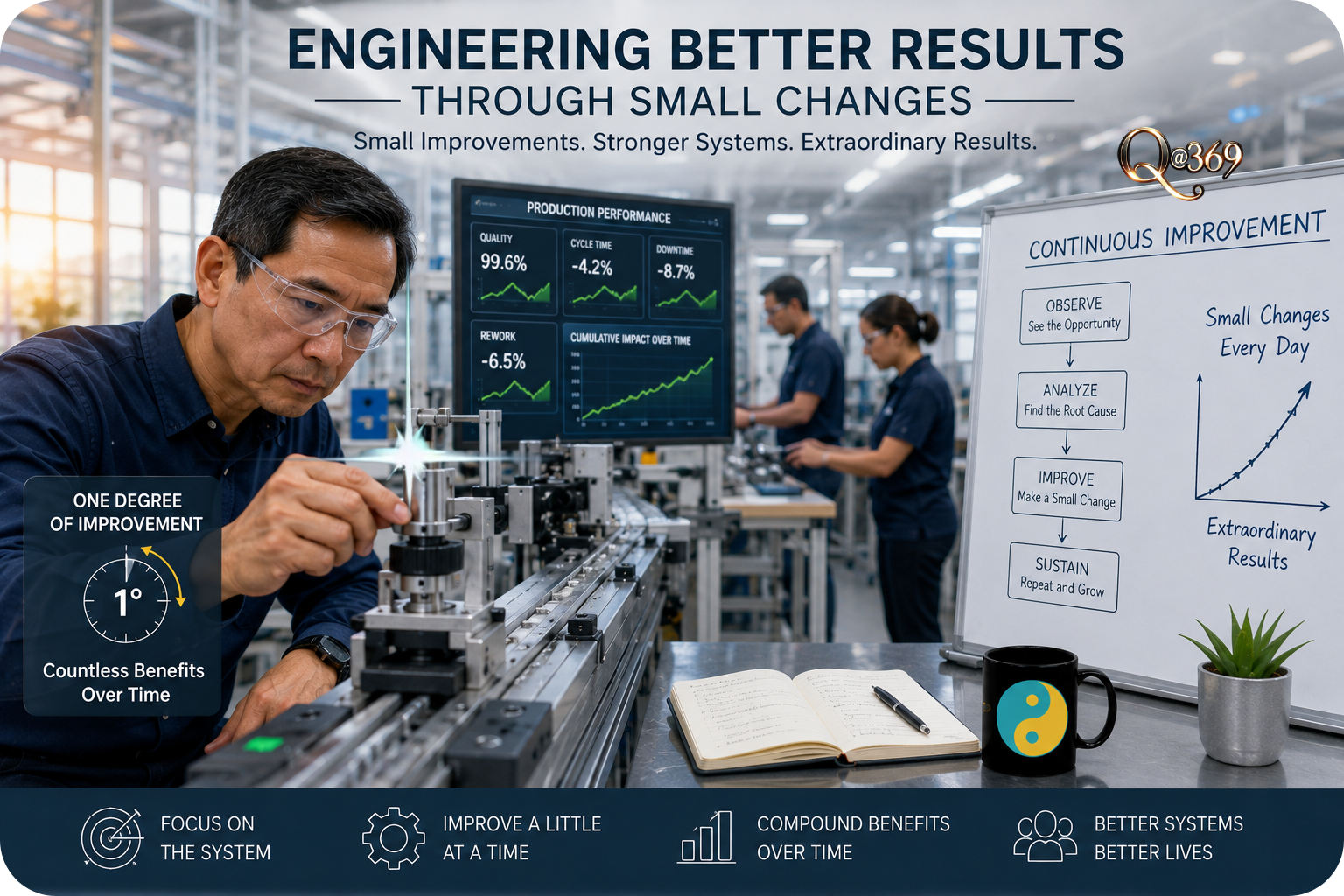
How do you make sustained progress easily with an optimized system?
Many of us naturally believe that better results require greater effort. We work longer hours, stay busier, and push ourselves harder, hoping that determination alone will produce the outcomes we want. No appreciating small changes can have the greatest affect.
Engineers often approach the same challenge differently.
Instead of asking, “How can we work harder?” they first ask, “How can we improve the system?”
Today we explore how systems thinking, continuous improvement, and engineering demonstrate that extraordinary results are often created through many small refinements rather than one dramatic breakthrough. You may discover that the next improvement in your own life begins, not by working harder, but by improving the system that guides your daily actions.
Working Hard Versus Working Better
Hard work has always been an admirable quality.
Whether raising a family, building a business, preparing for an examination, or serving our communities, determination and perseverance remain essential ingredients of success. Yet hard work alone cannot overcome an inefficient process.
Imagine carrying buckets of water across a field every day. Working harder may allow you to carry more buckets, but building a simple pipeline changes the entire system. The effort invested in improving the process continues producing benefits long after the construction is complete.
Engineers understand this principle well.
Rather than asking people to work faster forever, they search for ways to improve the process so that every future task becomes easier, safer, and more reliable.
The Engineer Adjusted One Degree

During one manufacturing project, I was helping introduce a new production process into an assembly line. The equipment was operating within specifications, quality reports looked good, and production had successfully begun. Most people considered the project complete.
I continued observing.
One station consistently required operators to make a small correction before each component entered the next assembly step. The adjustment was minor and occurred so naturally that most people hardly noticed it anymore. Because production continued without major problems, there seemed little reason to investigate further.
Instead of accepting the process as “good enough,” I began asking questions.
Why was the correction necessary?
Could the equipment perform that adjustment automatically?
Was there a better way to align the component before it reached the operator?
Careful testing revealed that a very small change in the alignment angle, barely noticeable to the eye, allowed the component to enter the station much more consistently. The adjustment measured approximately one degree, yet the results extended far beyond that tiny movement.
Operators spent less time making corrections. Cycle times became more consistent. Rework decreased. Small time savings accumulated across every shift, every day, and every week. Months later, the improvement had quietly saved countless hours while improving both quality and consistency.
The remarkable outcome was not created through one revolutionary invention.
It was created through one thoughtful improvement repeated thousands of times.
“The greatest improvements are often measured, not by one remarkable day, but by thousands of ordinary days made slightly better.” – Isaac Yue
Systems Multiply Every Improvement
One of the most valuable lessons engineering has taught me is that systems multiply the value of every improvement. A single refinement may appear almost insignificant when viewed in isolation, yet a process repeated hundreds or thousands of times transforms that same refinement into something remarkably valuable.
That principle extends well beyond manufacturing.
A family that prepares healthy meals together creates a system that supports better nutrition every day. A business that improves communication reduces misunderstandings with every future project. A person who establishes a consistent bedtime creates a system that supports clearer thinking every morning.
Well designed systems quietly produce better outcomes because they make good decisions easier to repeat.
Why Systems Think Differently
One of the greatest differences between engineering and everyday problem solving is the way engineers approach recurring challenges. Rather than asking how people can work harder, engineers ask why the problem continues happening in the first place. Their goal is not simply to solve today’s issue, but to prevent tomorrow’s.
This shift in thinking changes everything.
Instead of repeatedly correcting the same mistake, engineers improve the process that created it. Once the system improves, everyone who uses it benefits without requiring additional effort.
Continuous Improvement Creates Lasting Value
Manufacturing has long embraced a philosophy known as continuous improvement. Rather than waiting for one revolutionary breakthrough, organizations encourage hundreds of small refinements that gradually improve quality, safety, efficiency, and reliability.
Each individual improvement may appear insignificant.
Together, they transform the entire operation.
Imagine reducing the time required to complete a task by only five seconds. Five seconds seems almost meaningless until that task is repeated thousands of times each week. Those small savings become hours of additional productivity, reduced fatigue, lower costs, and greater consistency.
The same principle applies throughout everyday life.
Preparing tomorrow’s lunch the evening before may save only a few minutes each morning. Organizing frequently used tools in one convenient location may eliminate dozens of unnecessary trips every day. Creating a weekly family calendar may prevent countless scheduling conflicts throughout the year.
Small improvements become powerful because systems repeat them automatically.
Designing Better Systems
People often depend upon willpower to achieve their goals.
Willpower certainly has value, but it is also limited. Busy schedules, unexpected interruptions, and mental fatigue eventually challenge even the strongest determination.
Good systems reduce that dependence.
A bowl of fresh fruit placed on the kitchen counter encourages healthier choices without requiring constant self discipline. Automatic savings transferred each payday gradually build financial security without relying on memory. Preparing tomorrow’s priorities before leaving work makes the following morning more focused and productive.
Notice that none of these examples depends upon extraordinary motivation.
They depend upon thoughtful design.
When a system supports the behavior we want, success becomes easier to repeat.
Quantum Alchemy And Systems
One principle that continues to shape Quantum Alchemy is that awareness extends beyond observing ourselves. It also includes observing the systems that quietly influence our daily lives. Sometimes the greatest opportunity for improvement is not changing ourselves, but changing the environment in which our decisions are made.
Better systems encourage better habits.
Better habits support better decisions.
Better decisions gradually shape better lives.
Instead of asking, “How can I work harder?”, we might ask a more productive question.
“What small improvement can I make to the system that supports this part of my life?”
That single question often produces solutions that continue creating value long after the original effort has been forgotten.
Extraordinary Results Are Usually Engineered
People often admire outstanding results while overlooking the systems that quietly produced them. Successful organizations, healthy families, effective teams, and meaningful personal growth rarely happen by accident. They are usually built through thoughtful observation, careful refinement, and a willingness to improve one small part at a time.
Extraordinary results are seldom created by extraordinary effort alone.
More often, they are engineered through hundreds of ordinary improvements that continue working long after they have been implemented.
Bringing Systems Thinking Home
The encouraging news about systems thinking is that you do not need to be an engineer to apply it. Every one of us lives within systems every day. Our morning routines, work habits, financial decisions, family schedules, and even our health are influenced by processes that have gradually developed over time.
Some of those systems serve us well.
Others quietly create unnecessary work because they have never been intentionally improved.
The first step is simply becoming aware that the system exists.
Look For The Friction
One habit I developed during my engineering career was paying attention whenever people repeatedly said the same things.
“This always takes longer than it should.”
“We keep making the same mistake.”
“I can never find what I need.”
“There has to be a better way.”
Comments like these often point toward a system that needs improvement rather than people who need to work harder.
Instead of accepting frustration as normal, begin asking why the problem continues occurring. Very often the answer is not another reminder or more effort. The answer is removing the source of the friction that creates the problem in the first place.
Small changes to the system frequently eliminate the need for repeated corrections.
Better Systems Create Better Lives
Systems thinking extends far beyond manufacturing.
A family that prepares a weekly meal plan spends less time deciding what to cook each evening. A homeowner who always returns tools to the same location spends less time searching for them. Someone who places tomorrow’s workout clothes beside the bed removes one more excuse for skipping exercise.
None of these improvements appears remarkable by itself.
Together, they quietly reduce stress, improve consistency, and create more time for the things that matter most. Better systems allow ordinary people to achieve extraordinary results because they make good decisions easier to repeat every single day.
Reflection
Think about one part of your daily routine that consistently feels frustrating or unnecessarily difficult. Rather than asking how you can work harder, ask yourself a different question.
“What small improvement could make this process work better tomorrow than it does today?”
You may discover that one thoughtful adjustment continues saving time and energy long after you have forgotten making it.
Practical Challenge
Choose one system in your life that you use every day.
It could involve preparing for work, organizing your home office, planning family activities, managing finances, or maintaining your health. Spend fifteen minutes improving that system instead of simply working within it.
Observe what happens during the coming week.
Notice whether the improvement saves time, reduces stress, prevents mistakes, or simply makes life feel a little easier. Small refinements become valuable because they continue working every time the system is used.
Closing Thoughts
Engineering has taught me that remarkable results rarely appear by accident.
They are usually created through careful observation, thoughtful refinement, and a willingness to improve one small part of a system at a time. Those improvements may appear almost invisible on the day they are made, yet their value continues growing every time the system operates.
Life works much the same way.
We cannot always change every circumstance around us, but we can continually improve the systems that shape our daily choices. Those small improvements quietly compound until one day we realize they have transformed far more than we ever expected.
Perhaps the next breakthrough in your life will not come from working harder.
Perhaps it will come from improving the system that supports your success.
Systems thinking focuses on understanding how individual parts work together to influence the performance of the whole. Engineers improve complex systems by identifying small refinements that reduce waste, increase consistency, and improve reliability over repeated use.
Continuous improvement methodologies, including Lean Manufacturing and Kaizen, demonstrate that many small improvements often outperform a single large change. Incremental refinements reduce variation, improve efficiency, and create long-term gains because every improvement is repeated throughout the life of the system.
Why it matters:
Improving a system creates benefits every time the system operates. Rather than relying solely on motivation or effort, well-designed systems make positive outcomes easier to achieve consistently.

References
- Deming, W. Edwards. Out of the Crisis. MIT Press, 1986.
- Imai, Masaaki. Kaizen: The Key To Japan’s Competitive Success. McGraw-Hill, 1986.
- Senge, Peter M. The Fifth Discipline. Doubleday, 1990.
- Lean Enterprise Institute. Lean Principles. https://www.lean.org/
- American Society for Quality. Continuous Improvement Resources. https://asq.org/
- National Institute of Standards and Technology. Manufacturing Extension Partnership. https://www.nist.gov/mep
See more of QuantumAlchemist369™ selected self-empowerment knowledge selections on the Book Shelf
A Kind Request From the Author
Please give us your feedback.
Leave your comments below. We would love to hear your thoughts
More Small Changes
Benefits of Joining Our Community
By joining QuantumAlchemist369™, you will love to stay informed and connected with us and the Quantum Alchemist community. Join us and receive free daily email updates of blogs, events, and useful insights.
Leave a Comment
We would love to hear your thoughts. Please leave a comment and share how this content resonates with your own mindful journey.
Forum Discussion
Join the Quantumarian Forum Community discussion.
Sustain the Alchemy
If the insights here have sparked something within you…We invite you to Sustain the Alchemy
You Will Want to Explore
All the items, books and graphic designs, available in our QuantumAlchemist369 Shop
Featured Offering on 369 Shop


Leave a Reply