

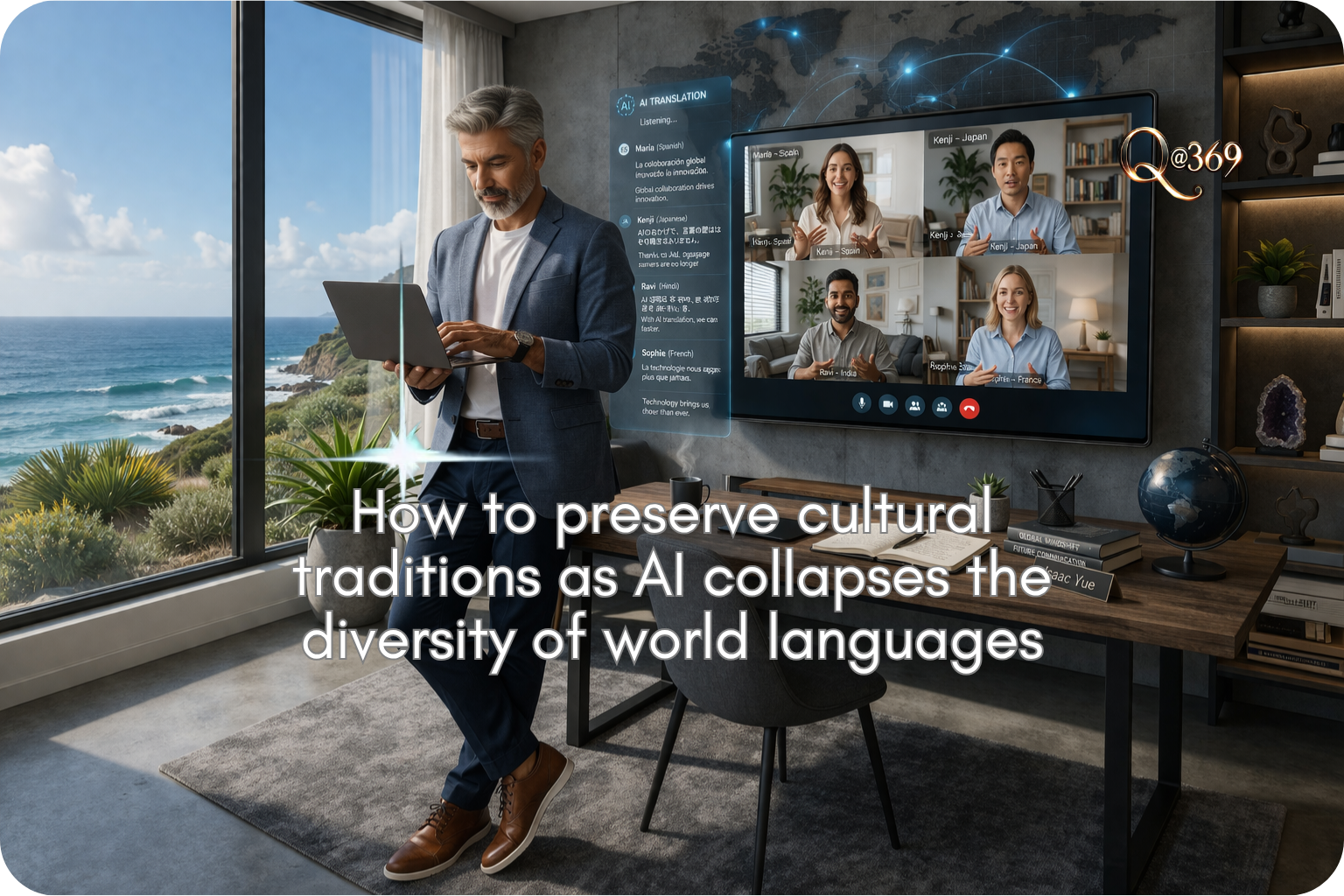
How will AI reshape the way humans understand each other across cultures?
AI translation tools are rapidly improving communication across language integration.
Understanding their impact helps you balance efficiency with cultural depth and human connection.
The Rise Of AI Translation
AI translation systems now process language in real time.
Neural networks analyze patterns across massive datasets.
Tools such as speech and text translation reduce communication barriers.
This creates faster global interaction.
Language differences become less limiting in daily exchange.
Global Language Convergence
AI translation may accelerate shared understanding.
People communicate without learning a second language.
This could lead to more unified global dialogue.
Business education and collaboration benefit immediately.
Efficiency increases across borders.
When Tone Speaks Beyond Words
Words carry meaning, but tone, inflection, and accent complete the message.
AI translation can detect basic speech patterns and emotion, yet subtle intent such as humor or irony still depends on context.
For clearer communication, use AI for speed, then confirm tone and meaning through awareness and follow up.
The Risk To Cultural Identity
Language carries culture history and meaning.
Direct translation does not always capture nuance.
Idioms humor and emotion can lose depth.
Over reliance on AI may reduce motivation to learn languages.
Cultural richness risks becoming simplified.
Neuroscience Of Language Processing
The brain processes language through complex neural networks.
Learning a language strengthens memory and cognitive flexibility.
Bilingual individuals show improved executive function.
AI translation reduces the need for deep language learning.
This may shift how the brain develops communication skills.
Efficiency Versus Understanding
AI provides speed and accessibility.
Human learning provides depth and context.
Both serve different purposes.
Relying only on efficiency may limit understanding.
Balancing both creates better communication.
The Future Of Universal Communication
AI may support a functional universal communication layer.
People may rely on tools instead of shared language systems.
Real time translation could become standard in devices.
This changes how relationships and collaboration develop.
Human connection will depend on more than words.
Isaac Yue Technology Insight Scenario

Isaac Yue tested AI translation during a global virtual meeting.
Participants spoke different languages with real time translation.
Communication flowed efficiently across regions.
Yet subtle meanings required clarification.
Isaac recognized that understanding still depended on human awareness.
“As languages grow quieter through machines, our responsibility grows louder to carry forward the stories, meanings, and traditions they once held” – Isaac Yue
Practical Application In Daily Life
Use AI translation for speed and accessibility.
Continue learning language basics to build deeper understanding.
Pay attention to tone context and cultural cues.
Ask questions when meaning feels unclear.
Combine technology with awareness.
A Surprising Historical Insight
The Rosetta Stone helped decode ancient Egyptian language.
It contained the same text in multiple scripts.
This allowed scholars to understand lost communication systems.
Human effort and comparison enabled translation.
Technology now accelerates a similar process.
Conclusion Balancing Technology And Human Connection
AI translation improves access and speed in communication.
You have learned how it supports global interaction.
You have seen the importance of preserving cultural depth.
How will you balance efficiency with meaningful understanding in your conversations.
Use technology wisely and stay engaged with the human side of communication.
A report from CSA Research found that 76 percent of consumers prefer purchasing products with information available in their native language.
References
- Vaswani, A., et al. Attention is all you need. Advances in Neural Information Processing Systems, 2017.
- Devlin, J., et al. BERT Pre training of deep bidirectional transformers. NAACL, 2019.
- CSA Research. Language preferences in global consumers, 2020.
- Harvard Business Review. The future of AI in communication, 2021.
- National Institutes of Health. Bilingualism and brain function, 2012.
See more of QuantumAlchemist369™ selected self-empowerment knowledge selections on the Book Shelf
“Quantum Alchemy: The Convergence of Science, Spirit, and Enlightenment”

Merges the precision of quantum physics with the wisdom of ancient philosophies and spirituality, offering a fresh perspective on our understanding of reality. explores the constructive collaboration between modern scientific discoveries and insights ancient from ageless philosophies and spiritual practices.
- Read Sample Pages on Amazon
- Follow the Link to Learn More
A Kind Request From the Author
Please give us your feedback.
Leave your comments below. We would love to hear your thoughts
More Language Integration
Benefits of Joining Our Community
By joining QuantumAlchemist369™, you will love to stay informed and connected with us and the Quantum Alchemist community. Join us and receive free daily email updates of blogs, events, and useful insights.
Leave a Comment
We would love to hear your thoughts. Please leave a comment and share how this content resonates with your own mindful journey.
Forum Discussion
Join the Quantumarian Forum Community discussion.
Sustain the Alchemy
If the insights here have sparked something within you…We invite you to Sustain the Alchemy
You Will Want to Explore
All the items, books and graphic designs, available in our QuantumAlchemist369 Shop
Contact Us
For more information, and to contact Isaac Yue, visit our Contact Page.


Leave a Reply