
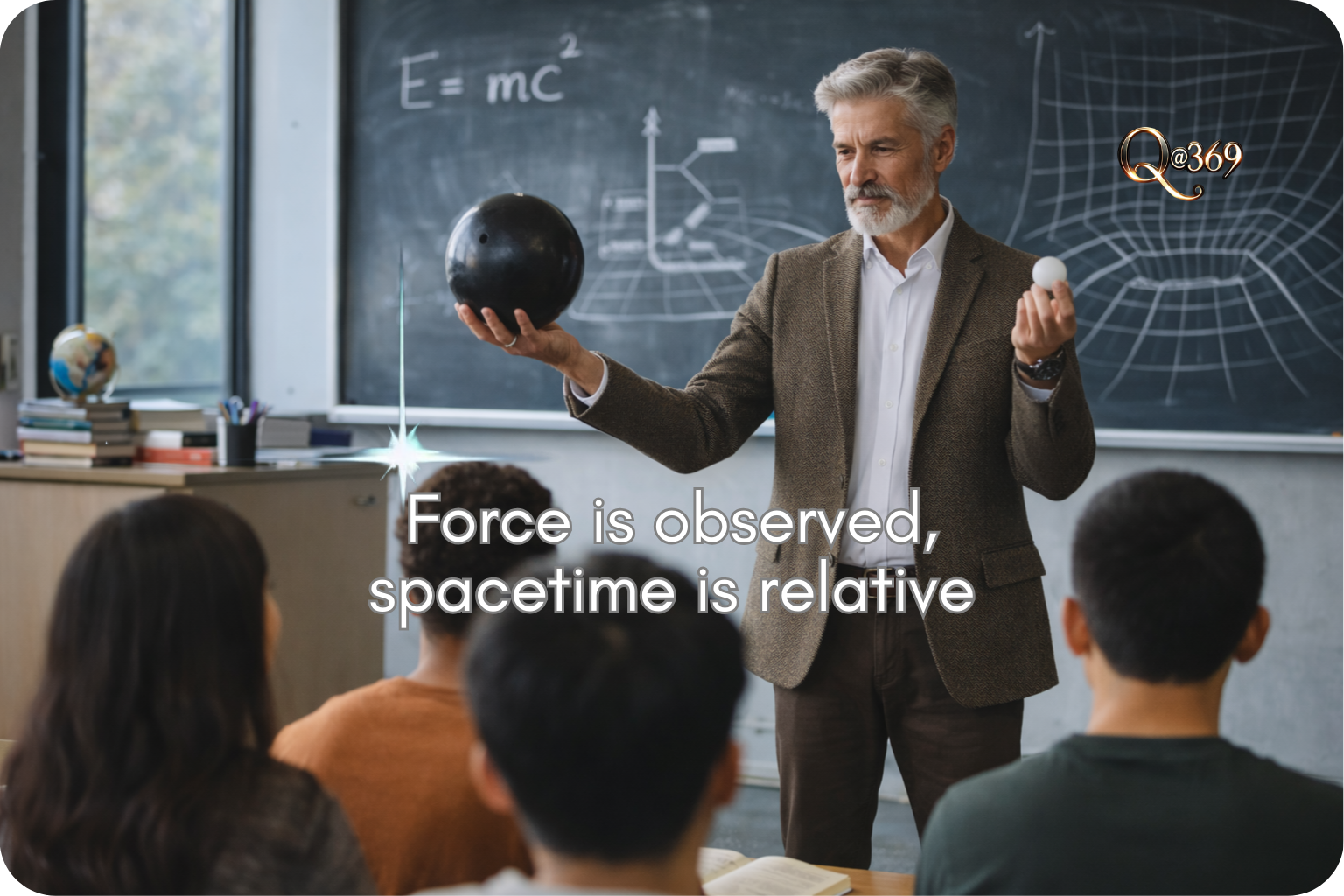
Why do modern physicists say gravity may not actually be a force?
Gravity feels familiar, yet modern physics describes it in a surprising way.
Understanding this concept reveals how spacetime, and motion shape reality itself.
Newton’s View Of Gravity As A Force
For centuries gravity was understood as a force pulling objects together.
Isaac Newton described gravity as an attraction between masses.
This model explains falling objects and planetary motion with strong accuracy.
It remains useful for engineering and everyday calculations.
Yet it does not explain how gravity actually works at a deeper level.
Practical application. Classical models are useful but not always complete.
Einstein’s Shift To Spacetime Curvature
Albert Einstein introduced a new way to understand gravity.
He proposed that mass and energy curve spacetime.
Objects move along these curves rather than being pulled by a force.
This means gravity is a geometric effect of spacetime itself.
Planets follow curved paths around stars because spacetime is distorted.
Practical application. Perspective can change how you interpret familiar experiences.
What Is Spacetime
Spacetime combines space and time into one unified structure.
Massive objects such as planets and stars create curvature in this structure.
Imagine a stretched surface that bends under weight.
Other objects follow the curved paths created by that bend.
This analogy helps visualize how gravity works without a pulling force.
Practical application. Visual models simplify complex scientific ideas.
Why Gravity Behaves Differently
Gravity is weaker than other fundamental interactions.
It also acts over vast cosmic distances without being blocked.
Unlike electromagnetic forces, gravity always attracts and never repels.
It cannot be fully explained using quantum field models yet.
This makes gravity unique among known interactions.
Practical application. Differences often point toward deeper understanding.
Energy And Gravity Are Not The Same
Energy describes the ability to do work or create change.
Gravity describes how mass and energy shape spacetime.
Energy contributes to gravitational effects through mass equivalence.
Yet gravity itself is not energy.
It is the result of how spacetime responds to mass and energy.
Practical application. Clear definitions improve clarity in complex topics.
A Surprising Scientific Insight
Experiments confirm that gravity affects time itself.
Clocks run slower in stronger gravitational fields.
This effect has been measured using precise atomic clocks.
It is essential for technologies such as GPS systems.
This shows gravity is linked to the structure of time, not just motion.
Practical application. Advanced science often impacts everyday technology.
Isaac Yue’s Reflection

I remember first encountering Einstein’s idea of curved spacetime.
It challenged my early understanding of gravity as a simple force.
I realized that objects are not pulled in the usual sense.
They are following the natural shape of spacetime.
This insight shifted how I think about structure and interaction.
It showed me that reality often behaves in ways that defy intuition.
Practical application. Curiosity opens the door to deeper understanding.
“Force is what you observe in motion, yet spacetime is the silent framework that defines what motion becomes.” – Isaac Yue
Cosmic Implications Of Curved Spacetime
Gravity shapes galaxies, stars, and the large scale structure of the universe.
Black holes represent extreme curvature where spacetime bends dramatically.
Light itself follows curved paths near massive objects.
This phenomenon is known as gravitational lensing.
It allows scientists to observe distant galaxies through cosmic distortion.
Practical application. Observing nature reveals hidden structure in the universe.
Conclusion
Gravity may not be a force in the traditional sense.
It is the result of spacetime curvature shaped by mass and energy.
Einstein’s insight expanded our understanding of motion and interaction.
What other everyday experiences might have deeper explanations beyond first impressions?
Practical use. Stay curious and question assumptions to deepen your understanding of reality.
Global positioning systems rely on relativistic corrections, improving location accuracy by several meters, demonstrating practical value of spacetime theory.
References
- Einstein A. 1915 General Theory of Relativity Annalen der Physik.
- Hawking S. 1988 A Brief History of Time Bantam Books.
- Greene B. 1999 The Elegant Universe W. W. Norton.
- Misner C Thorne K Wheeler J. 1973 Gravitation W. H. Freeman.
- NASA Gravity Overview 2022.
See more of QuantumAlchemist369™ selected self-empowerment knowledge selections on the Book Shelf
The Quantumarian Way

- Clear path to understanding coherence
- Align your daily harmonious life.
- Available in Print, Kindle and Audio
- Read Sample Pages on Amazon
- Learn More
Please give us your feedback.
Leave your comments below. We would love to hear your thoughts
More Spacetime
Benefits of Joining Our Community
By joining QuantumAlchemist369™, you will love to stay informed and connected with us and the Quantum Alchemist community. Join us and receive free daily email updates of blogs, events, and useful insights.
Leave a Comment
We would love to hear your thoughts. Please leave a comment and share how this content resonates with your own mindful journey.
Forum Discussion
Join the Quantumarian Forum Community discussion.
Sustain the Alchemy
If the insights here have sparked something within you…We invite you to Sustain the Alchemy
You Will Want to Explore
All the items, books and graphic designs, available in our QuantumAlchemist369 Shop
Contact Us
For more information, and to contact Isaac Yue, visit our Contact Page.


Leave a Reply