

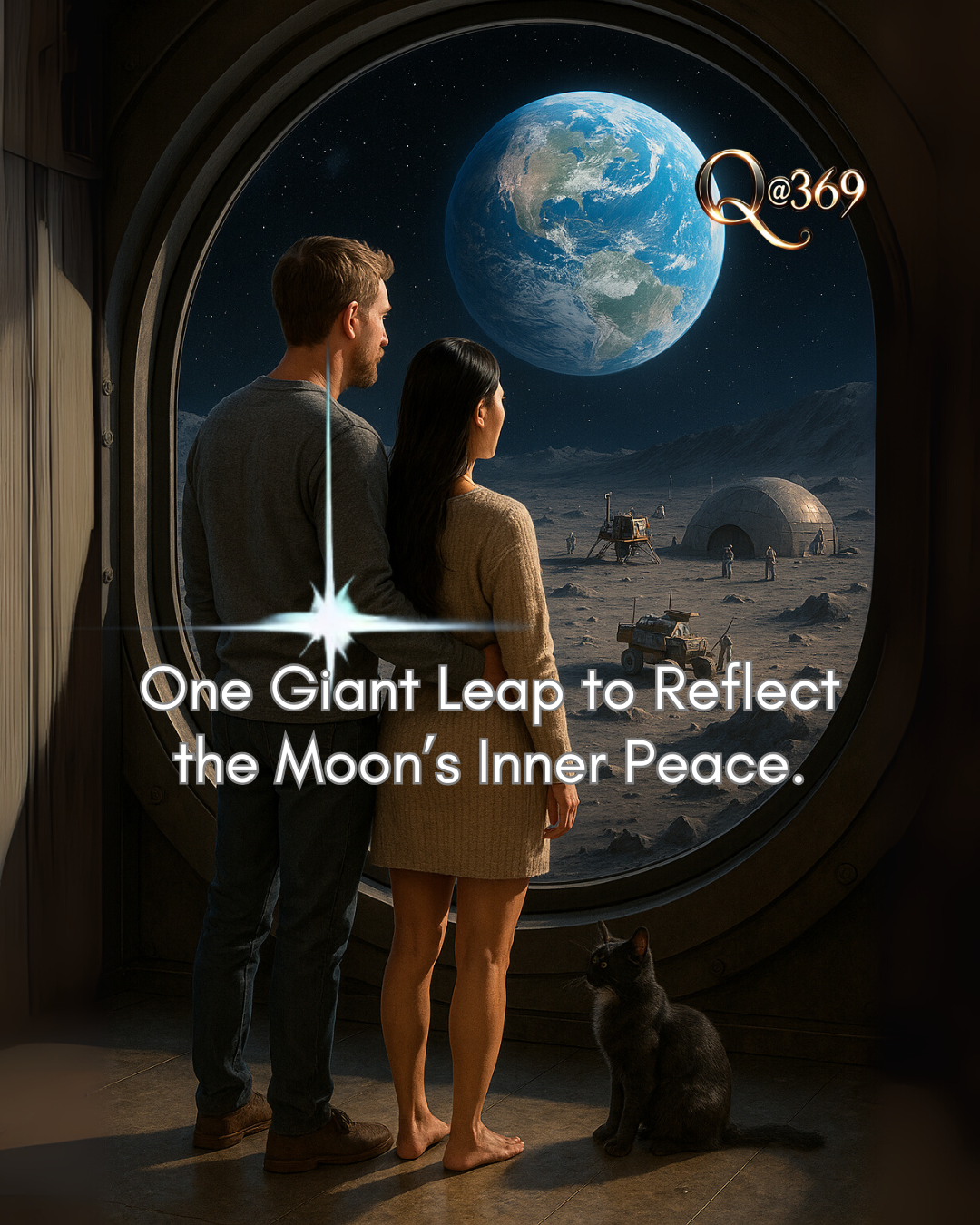
🌕 Will Humanity Ruin the Moon? A Quantumarian Call for Celestial Stewardship
The Moon won’t break, but we might break something more precious, its meaning. Modern missions reach for lunar soil with excitement, but rarely with reverence. The Quantumarian path asks: what happens when technology outpaces awareness?
☼ AUDIO: Listen to “Will Humanity Ruin the Moon? A Quantumarian Call for Celestial Stewardship” by Isaac Yue
☼ Also Available on Spotify
Estimated Growth of Human Presence on the Moon Over the Next Century

A century ago, we gazed at the Moon and dreamed. A century from now, some may call it home. This projection is not a prediction, but a question: Will we grow on the Moon with wisdom, or simply expand without awareness?
Isaac Yue’s Reflection: First Contact Was Wonder
I was in my youth when I saw that first Moon landing. My imagination filled in every grainy frame. For weeks, I drew sketches of rockets. I taped tinfoil to a toy helmet. Like millions of kids, I wanted to be an astronaut. I never made it to the launchpad. Instead, I studied space systems, spent decades designing instruments, watching orbits, coding communications.
And now? I joke I’ll only go to the Moon if there’s a Marriott and a Starbucks waiting.
But beneath the humor lives something deeper, a sense of quiet reverence. The Moon shaped our calendars, guided tides, inspired love poems, anchored rituals. Shouldn’t we pause before mining it like an empty rock?
I sometimes look at my grandkids and wonder, who among them might be the first to live on the Moon? Not just visit, but really live there. Will they rise each lunar morning beneath Earth hanging in the sky, navigating gravity-light steps to school or a research dome? I smile at the thought, but beneath it lies something deeper. If they inherit that frontier, I want them to inherit its wisdom too. Reverence must travel with ambition. Otherwise, we’ll bring the same neglect to the Moon that we once brought to forests, rivers, and skies.
No, We Can’t Crack the Moon
Let’s be clear: the Moon is not fragile.
- Its mass is approximately 7.35 × 10²² kilograms.
- Even if we removed a trillion kilograms through mining, that’s just 0.000000000014% of its total mass. It’s negligible.
- And forget knocking it out of orbit: rocket exhaust is tiny compared to its orbital energy.
You’d need 10²⁹ joules of energy to actually shatter the Moon.
For reference, the asteroid that killed the dinosaurs hit with 10²³ joules.
The Moon has survived billions of years of far greater impacts than anything humans can generate.
So no, we’re not going to break the Moon. But that doesn’t mean we won’t damage what truly matters.
The Real Risks Are Human, Not Cosmic
We bring more than technology when we land somewhere new.
We bring behavior. And often, that includes ego, rivalry, and forgetfulness.
1. Lunar Dust and Ejecta
Rocket plumes launch sharp regolith across kilometers. A single landing can damage nearby instruments, optics, or habitats with no warning. It’s invisible, but relentless. It is like sandblasting the Moon with each touchdown.
2. Cold-Trap Volatiles at the Poles
Permanently shadowed craters near the lunar south pole contain water ice. This is essential for future missions. Mining too aggressively could exhaust these rare resources or contaminate them forever.
3. Cultural and Scientific Heritage
Sites like Apollo 11’s Tranquility Base are more than history—they are spiritual landmarks. Without strict protection, tourism, branding, or careless proximity could erase humanity’s shared memory.
4. Surface Ecology of Instruments
The Moon’s albedo, its reflectivity, can be altered by dust, equipment, or solar farms. That changes the local environment and affects long-term science experiments.
5. Cislunar Congestion
The space around the Moon is filling up fast. Uncoordinated traffic could lead to collisions or a lunar version of the Kessler syndrome—a cascading debris crisis.
The Moon’s surface can be changed by boots, not just bombs.

“If your grandchild lands on the Moon, may they carry mindfulness, not just machines, into that silence.” – Isaac Yue
Humans Get Territorial—Even in Space
Let’s not pretend we’re neutral explorers. We carry Earth’s patterns with us: competition, prestige, silent conquest.
The Moon has limited real estate that everyone wants:
- Shackleton Crater (South Pole): Water-rich, ideal for bases.
- Peaks of Eternal Light: Near-constant sunlight. Only a few exist.
- Apollo 11 Site: Historic, symbolic—also tempting for tourists and brands.
- Marius Hills Lava Tubes: Rare entry points to underground habitats.
- Earth-facing Highlands: Perfect for communications. Already in planning phases.
These are the hot zones. Prized areas where landers will cluster, experiments will compete, and quiet rivalries may take root.
A Quantumarian doesn’t ignore human nature. We study it, and upgrade our behavior before damage begins.
Stewardship Must Precede Expansion
We don’t need fear. We need foresight. Here are real, science-backed solutions:
- Dust-aware landing pads and berms to protect nearby sites
- Shared maps marking heritage zones with buffer distances
- Volatile extraction quotas with monitoring and closed-loop reclamation
- Cislunar traffic protocols with transparent orbit coordination
- Environmental baselining before operations begin, objetive measurements must be made first, and monitored after.
These aren’t restrictions. They’re conscious boundaries. Mindfulness practices that are needed for moon habitation.

“The Moon reflects more than sunlight; it reflects the quality of human consciousness reaching it.” – Isaac Yue
Spiritual Reverence: The Moon Is More Than Terrain
The Moon has been witness and guide for as long as we’ve looked up.
Its phases marked planting, birth, love, loss, tides, and prayers.
Quantumarians understand that matter and meaning are not separate.
Energy awareness doesn’t stop at Earth’s edge. When we touch the Moon, we touch history. We touch potential.
The question isn’t whether we can explore. The question is whether we’ll do so consciously.
Conclusion: The Real Damage Would Be Meaning Lost
The Moon won’t crack. It won’t fall. But its silence can be polluted. Its meaning can be forgotten. The deeper risk is not technical. It is ethical disconnection.
Quantumarian exploration honors both innovation and reverence.
It’s possible to build the future without erasing the poetry of the past.
Reflection Question:
When you explore something new; whether a place, a relationship, or an idea; do you conquer it, or do you steward it?
As of 2024, over 20 countries and agencies have signed the Artemis Accords, agreeing to peaceful, cooperative lunar exploration. (Source: NASA, ESA)
A Trip to the Moon (1902) — the iconic silent black‑and‑white film where a rocket is fired to the Moon, with the Moon’s face famously struck by the capsule
References
- NASA Artemis Accords (2024)
- National Academy of Sciences: Rocket Ejecta Reports
- European Space Agency: Lunar Dust Hazards
- Planetary Society: Cislunar Traffic Coordination
- Harvard Astrophysics Journal (2023) – Regolith Displacement
- UN COPUOS Agreements (Space Heritage)
“Quantum Alchemy: The Convergence of Science, Spirit, and Enlightenment”

by Isaac Yue
Merges the precision of quantum physics with the wisdom of ancient philosophies and spirituality, offering a fresh perspective on our understanding of reality. explores the constructive collaboration between modern scientific discoveries and insights ancient from ageless philosophies and spiritual practices.
- Read Sample Pages on Amazon
- Follow the Link to Learn More
Please give us your feedback.
Leave your comments below. We would love to hear your thoughts
More
Benefits of Joining Our Community
By joining QuantumAlchemist369™, you will love to stay informed and connected with us and the Quantum Alchemist community. Join us and receive free daily email updates of blogs, events, and useful insights.
Leave a Comment
We would love to hear your thoughts. Please leave a comment and share how this content resonates with your own mindful journey.
Forum Discussion
Join the Quantumarian Forum Community discussion.
Sustain the Alchemy
If the insights here have sparked something within you…We invite you to Sustain the Alchemy
You Will Want to Explore
All the items, books and graphic designs, available in our QuantumAlchemist369 Shop
Contact Us
For more information, and to contact Isaac Yue, visit our Contact Page.


Leave a Reply