

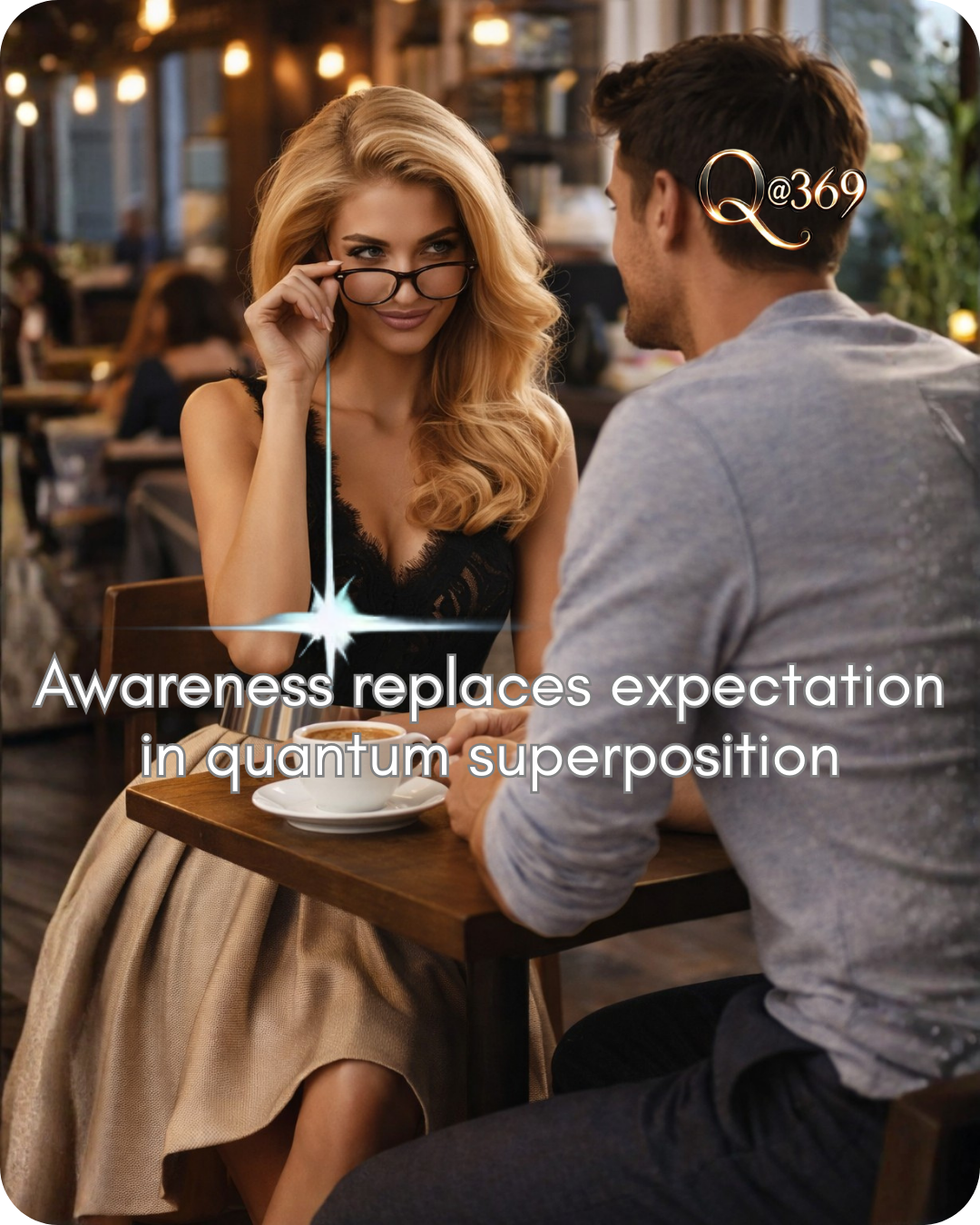
Do expectations exceed relationship stability?
Romantic connection is shaped by predictive processes in the brain that often override present reality.
Awareness restores clarity by separating perception from assumption and reconnecting you with what is actually happening.
Predictive Processing in Romantic Connection
Neuroscience describes perception as prediction corrected by input.
When expectations are strong they dominate incoming information.
Partners are seen through assumption instead of reality.
Misunderstanding increases without any change in behavior.
How Expectation Distorts Perception
Expectation narrows attention and amplifies confirmation bias.
Neutral actions become interpreted as personal signals.
Disappointment grows from imagined futures rather than present facts.
Reality feels lacking even when connection remains intact.
Awareness as a Corrective Lens
Awareness interrupts automatic prediction loops.
It reopens attention to what is actually occurring.
Perception becomes flexible rather than fixed.
Clarity replaces emotional projection.
Quantum Analogy Without Exaggeration
In physics prediction models reduce uncertainty but require measurement correction.
Human perception functions similarly through constant updating.
Awareness improves accuracy by allowing correction.
Connection stabilizes when perception updates honestly.

“Awareness quiets expectation, allowing superposition to remain open until clarity naturally emerges.” – Isaac Yue
Chloe’s Date
Chloe noticed frustration rising in a new relationship.
She realized her expectations were shaping every interaction.
When she paused and observed without assumption her perception softened.
Connection improved without either person changing behavior.
Practical Awareness Tool
Notice disappointment when it arises.
Ask whether the feeling comes from expectation or observation.
Return attention to present behavior and tone.
Update perception without judgment.
Benefits of Expectation Awareness
Relationships feel lighter and more honest.
Partners are seen more clearly.
Emotional reactivity decreases.
Connection becomes responsive rather than scripted.
Choosing Clarity Over Prediction
Expectation distorts perception when left unchecked.
You learned how predictive processing shapes romantic connection.
Where might awareness restore clarity in your relationships?
Begin by observing without assumption today.
Predictive bias awareness training improves relationship satisfaction and reduces conflict frequency in couples studies.
References
- Friston, Karl. “The Free Energy Principle.” Nature Reviews Neuroscience, 2010.
- Barrett, Lisa Feldman. How Emotions Are Made. Houghton Mifflin Harcourt, 2017.
- Clark, Andy. Surfing Uncertainty. Oxford University Press, 2016.
- Kahneman, Daniel. Thinking Fast and Slow. Farrar Straus and Giroux, 2011.
“Breaking Barriers: A Story of Love, Business and Possibilities”

By Isaac Yue
This book is a source of inspiration for anyone aspiring to live harmoniously, overcome challenges, and find purpose. Altynai’s journey showcases how to unlock life’s infinite possibilities by breaking down barriers. Through personal and professional obstacles, she illustrates that challenges are opportunities for growth
- Read Sample on Amazon
- Follow Link to Learn More
Please give us your feedback.
Leave your comments below. We would love to hear your thoughts
More Awareness
Benefits of Joining Our Community
By joining QuantumAlchemist369™, you will love to stay informed and connected with us and the Quantum Alchemist community. Join us and receive free daily email updates of blogs, events, and useful insights.
Leave a Comment
We would love to hear your thoughts. Please leave a comment and share how this content resonates with your own mindful journey.
Forum Discussion
Join the Quantumarian Forum Community discussion.
Sustain the Alchemy
If the insights here have sparked something within you…We invite you to Sustain the Alchemy
You Will Want to Explore
All the items, books and graphic designs, available in our QuantumAlchemist369 Shop
Contact Us
For more information, and to contact Isaac Yue, visit our Contact Page.


Leave a Reply