

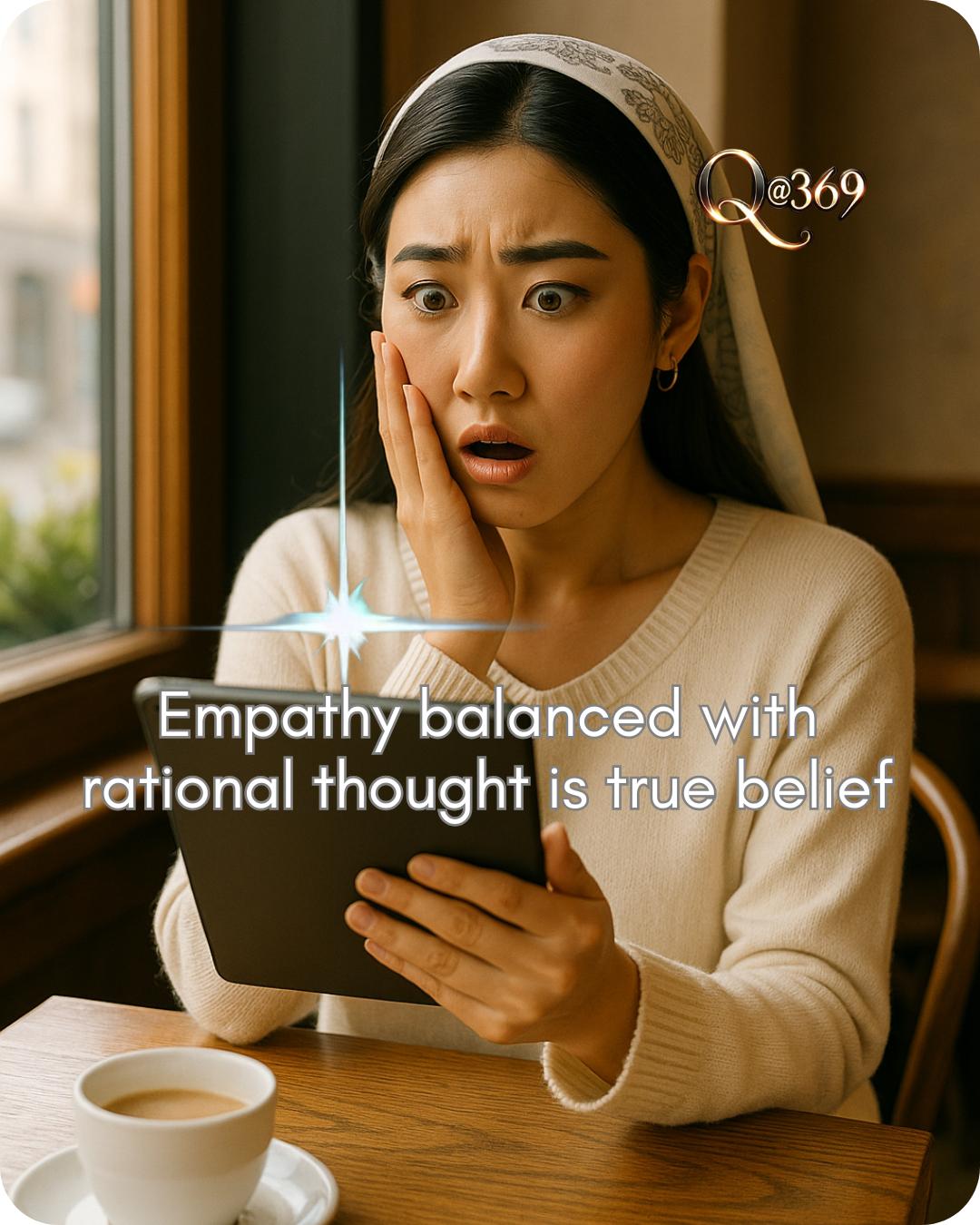
How can an observation influence our beliefs?
Why do feelings sometimes override facts?
Why can empathy shape belief even when logic says pause?
Why does coherence help us know what is true? Use the awareness of the heart mind connection as a guide.
☼ AUDIO: Listen to “How can an observation influence our beliefs?” by Isaac Yue
☼ Also Available on Spotify
Empathy Creates the First Shape of Belief
Empathy helps people understand each other.
It activates mirror circuits in the brain and the heart.
This creates emotional alignment.
You feel what the other person feels and your belief shifts accordingly.
This is a beautiful human strength.
It supports compassion and connection.
Yet empathy can also blur clarity.
Strong emotion can appear as truth even when evidence is quiet.
The heart receives signals faster than the thinking mind.
This means emotion often forms the first version of belief.
The Rational Brain Protects Clarity
The rational brain brings structure to belief.
It evaluates information and creates calm space for clear thinking.
It checks patterns and separates emotion from evidence.
Science shows that the prefrontal cortex slows emotional impulses.
This prevents fast reactions from becoming firm beliefs.
It invites reflection and supports balanced understanding.
The Quantumarian view honors both.
Emotion gives insight.
Reason gives accuracy.
Together they protect coherence.
Coherence as the Bridge Between Heart and Mind
Coherence is the state where heart, mind, and intention move with steady rhythm.
It creates emotional balance and sharp attention.
Breathing slows.
Thoughts align.
Awareness becomes calm.
In this balanced state, the heart feels with accuracy and the mind evaluates with clarity.
Truth becomes easier to sense and belief becomes easier to examine.
Coherence does not silence emotion.
It stabilizes emotion.
It does not overpower rational thought.
It strengthens it.
Three Tools to Balance Empathy With Rational Insight
One: Name the Feeling First
Emotions calm when they are acknowledged.
Naming the feeling prevents it from becoming a belief without review.
Two: Ask One Clear Question
What evidence supports this thought.
This creates rational space and lowers emotional noise.
Three: Add One Coherent Breath
Four seconds in.
Six seconds out.
This activates heart rhythm stability and aligns the brain.
These steps protect clarity without losing compassion.
How Empathy Influences Belief
Empathy shapes belief by increasing emotional resonance.
When you connect with someone, your body sends trust signals to your mind.
This can shift your evaluation of their words.
It can shift your view of events.
It can even shift your sense of truth.
This influence is not wrong.
It is part of human connection.
The goal is not to remove empathy.
The goal is to balance it with calm, rational clarity.

“The soul becomes dyed by the color of its thoughts.” Marcus Aurelius
Aylin’s Reflection
Aylin sat at a small table in her favorite corner cafe.
A friend arrived with a troubled expression and described a conflict at work.
Aylin felt her own chest tighten with empathy.
Her mirror circuits activated instantly.
Her belief began to align with her friend’s perspective.
She paused and breathed once.
Her breath softened her reaction.
Then she asked a simple question.
“What part of this is feeling and what part is fact.”
Her friend grew quiet.
After a moment, she realized the story was shaped more by fear than evidence.
Aylin felt her own clarity return.
The balance between empathy and reason revealed the truth with kindness.
Closing Reflection
Empathy is the heart’s wisdom.
Reason is the mind’s guidance.
Both matter in daily life.
When they work together, belief becomes clear and grounded.
Conclusion
Truth feels steady and grounded.
Belief feels shaped by feeling and memory.
Coherence helps you sense the difference.
Ask yourself today.
Where are my beliefs shaped by emotion.
Where are they shaped by clear observation.
Where can I bring both together to live with peace and insight.
People who engage in balanced emotional and rational reflection show thirty percent better decision accuracy.
Source: University of Michigan Emotion and Cognition Study, 2023.
References
- University of Michigan. Emotion and Cognition Study. 2023.
- Barrett, L. How Emotions Are Made. Houghton Mifflin. 2017.
- McCraty, R. Heart Brain Connection Research. HeartMath Institute. 2022.
- Damasio, A. The Feeling of What Happens. Harcourt. 1999.
“Quantum Alchemy: The Convergence of Science, Spirit, and Enlightenment”

by Isaac Yue
Merges the precision of quantum physics with the wisdom of ancient philosophies and spirituality, offering a fresh perspective on our understanding of reality. explores the constructive collaboration between modern scientific discoveries and insights ancient from ageless philosophies and spiritual practices.
- Read Sample Pages on Amazon
- Follow the Link to Learn More
Please give us your feedback.
Leave your comments below. We would love to hear your thoughts
More Truth vs Belief
Benefits of Joining Our Community
By joining QuantumAlchemist369™, you will love to stay informed and connected with us and the Quantum Alchemist community. Join us and receive free daily email updates of blogs, events, and useful insights.
Leave a Comment
We would love to hear your thoughts. Please leave a comment and share how this content resonates with your own mindful journey.
Contact Us
For more information, and to contact Isaac Yue, visit our contact page.


Leave a Reply