

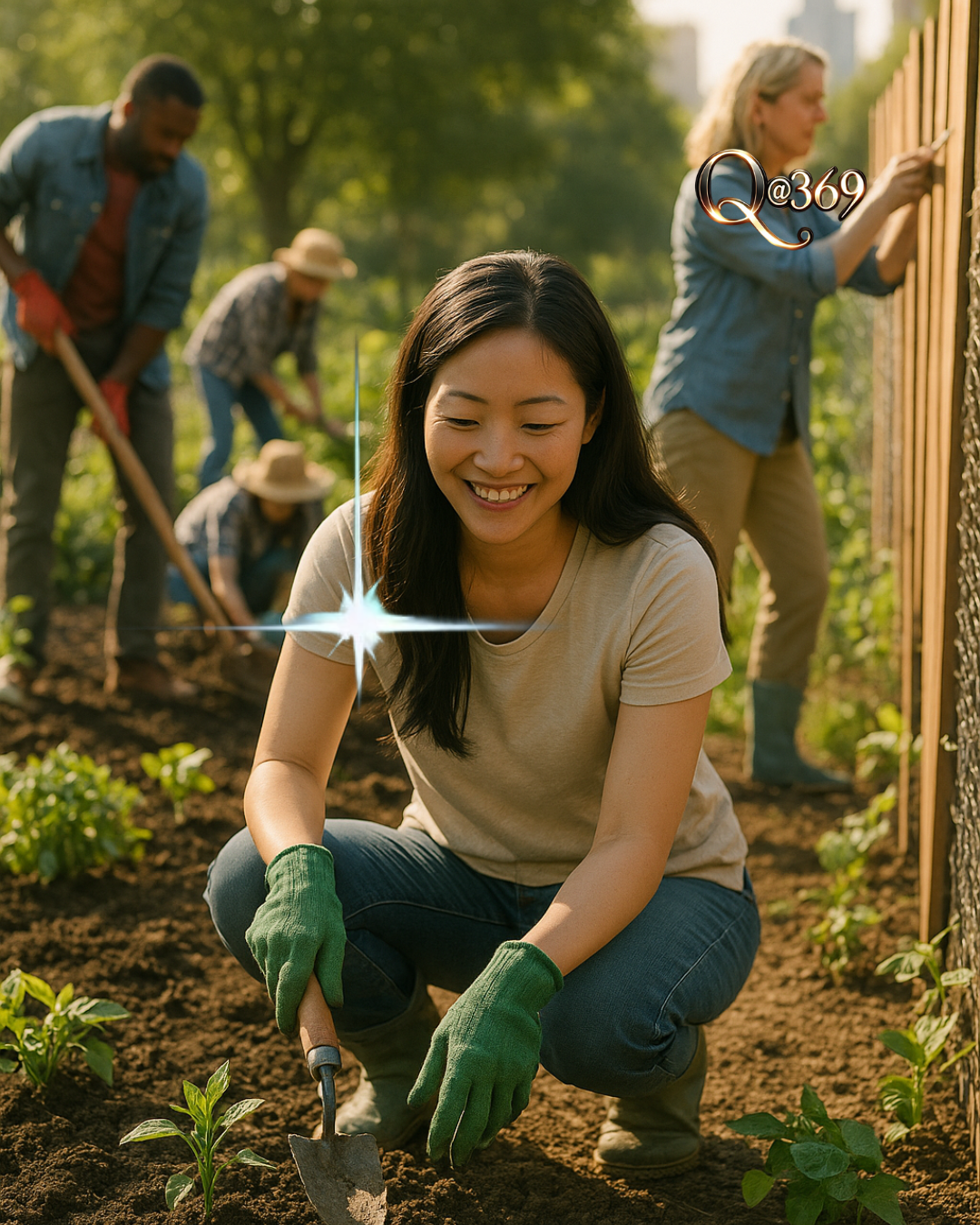
Can community gardens uplift neighborhoods?
The Garden of Life thrives when soil and spirit meet. Community gardens prove that connection grows even through obstacles. Science confirms shared gardens improve health, nutrition, and resilience, while spiritually they root us in belonging. In every seed lies a promise: what we nurture together becomes abundance.
☼ AUDIO: Listen to “Can community gardens uplift neighborhoods?” by Isaac Yue
☼ Also Available on Spotify
Isaac’s Lessons from the Farm
I grew up on a dairy farm, where work began before sunrise. My father once handed me a shovel and said, “Here’s your shovel. Wear it out, you get a raise. Break it, it comes out of your pay.”
Those words stayed with me. The shovel was more than a tool. That shovel symbolized responsibility and endurance. I quickly discovered what each end was for: one to break open the ground, the other to rest weary hands.
My first jobs included handling manure. It wasn’t glamorous. Yet I learned that manure is not waste. It was the foundation of fertility. What smelled foul to me as a child became nourishment for the land. It taught me humility, patience, and the truth that growth often begins in what we’d rather avoid. Also a lesson, look at “waste” as a transformation opportunity
That respect for soil and for farmers who work it became my foundation. Everything good requires effort, care, and resilience.
Seeds in the City
Today, cities around the world are rediscovering these truths. Community gardens rise from neglected lots and rooftops, offering food and connection. Obstacles are everywhere—space is limited, permits are tangled, and not all neighborhoods have equal access. Yet despite these challenges, gardens bloom. Soil responds to care, just as people respond to kindness.
The Human Bond in Soil
Gardens are more than food sources. They are places of belonging, where hands from many backgrounds tend the same earth. Soil erases boundaries of age and language. A seedling teaches us that growth requires patience and that harvest belongs to all. Just as my father’s shovel carried both labor and humor, community gardens carry both effort and joy.
Quantum Alchemy in the Garden
Science shows us that a handful of soil contains billions of microorganisms, each vital to fertility. Spirit reminds us that the smallest effort—a seed planted with intention—creates ripples of transformation. Quantum physics teaches us that potential collapses into reality when energy meets environment.
Community gardens embody this principle. They are entangled systems: when one seed thrives, the entire garden strengthens; when one person contributes, the community flourishes.
The Obstacle and the Gift
Every strong garden has both promise and challenge. Concrete, scarcity, and even neglect press against growth. Yet these obstacles deepen the meaning of the harvest. Just as manure enriches soil, challenges enrich communities.
My farm upbringing showed me that soil never wastes what it is given. Even what looks like failure can become food for the next season. The same is true of people—what we overcome becomes our compost for strength.

“The glory of gardening: hands in the dirt, head in the sun, heart with nature.” – Alfred Austin
PMC Warriors – Pune, India
“From a forgotten lot, ten neighbors known as the PMC Warriors grew hope into soil. Their vision turned delay into belonging, proving that even in concrete cities, gardens can bloom through care.”
Read their story here
Practical Seeds for You
- Grow herbs in a pot or windowsill—connect daily intention to growth.
- Volunteer at a community garden or food project—add your care to shared soil.
- Reflect: which “seeds” in your life need patient tending to nourish both you and others?
Shared Harvest
Community gardens are not just about vegetables. They are about human spirit—how we nurture, share, and persist together.
My father’s shovel taught me that work is steady, soil is honest, and manure is never wasted. Gardens carry the same truth: obstacles can transform into nourishment when tended with care.
Quantumarians, remember—soil returns what you invest. When you plant with intention and unity, the harvest is far greater than food. It is connection, resilience, and hope.
Reflective Questions:
- What seeds are you planting in your life right now?
- How might your obstacles become fertile ground?
- What shared harvest do you hope to create with others?
“Community gardens increase neighborhood social ties by 83% while reducing food insecurity by 35%.” – American Community Gardening Association (2023)
References
- American Community Gardening Association. (2023). Impact report on urban gardens.
- Alaimo, K. et al. (2016). Community gardening, neighborhood meetings, and social capital. Journal of Community Psychology.
- Armstrong, D. (2000). A survey of community gardens in upstate New York: Implications for health promotion and community development. Health & Place.
- Draper, C., & Freedman, D. (2010). Review of the benefits and limitations of community gardening. Journal of Community Practice.
- Wakefield, S. et al. (2007). Growing urban health: Community gardening in Toronto. Health Promotion International.
- Litt, J.S. et al. (2011). The influence of social involvement, neighborhood aesthetics, and community garden participation on fruit and vegetable consumption. American Journal of Public Health.
- Okvat, H. A., & Zautra, A. J. (2011). Community gardening: A parsimonious path to individual, community, and environmental resilience. American Journal of Community Psychology.
- Kingsley, J., & Townsend, M. (2006). ‘Dig In’ to social capital: Community gardens as mechanisms for growing urban social connectedness. Urban Policy and Research.
- National Recreation and Park Association. (2022). Community gardening and public health report.
Please give us your feedback.
Leave your comments below. We would love to hear your thoughts
More Garden of Life
Benefits of Joining Our Community
By joining QuantumAlchemist369™, you will love to stay informed and connected with us and the Quantum Alchemist community. Join us and receive free daily email updates of blogs, events, and useful insights.
Leave a Comment
We would love to hear your thoughts. Please leave a comment and share how this content resonates with your own mindful journey.
Forum Discussion
Join the Quantumarian Forum Community discussion.
Sustain the Alchemy
If the insights here have sparked something within you…We invite you to Sustain the Alchemy
You Will Want to Explore
All the items, books and graphic designs, available in our QuantumAlchemist369 Shop
Contact Us
For more information, and to contact Isaac Yue, visit our Contact Page.


Leave a Reply